Behind the Business Side of Taiji
 08Nov
08Nov
The Academy Award-winning documentary, The Cove brought widespread attention to the cruel and inhumane dolphin drive hunts in Taiji, Japan. Over the years following, images of dolphins being slaughtered for their meat and dolphins being captured for captivity, struggling as they are carried away from their pods have spread across social media. The images depict losing the most important things to them: family and freedom. Once captured, their wild spirits are broken and the dolphins become reliant on humans for their survival. The dolphins can then be sold to captive facilities to spend the rest of their lives “entertaining” humans.
Defenders of the hunts often claim that the dolphin drive hunts are an important part of Taiji culture and tradition. While it cannot be denied that whaling is an important part of this, it also cannot be denied that the dolphin drive hunts have evolved into big business, with the sales of live dolphins providing the vast majority of profits made from the hunts. Until recently, information regarding the sale of live dolphins had been unavailable to the public, including residents of Taiji. Though Ren Yabuki of Life Investigation Agency successfully obtained sales documents, all crucial data was redacted by the town of Taiji before the documents were provided.
With Dolphin Project, Mr. Yabuki filed a lawsuit against the town, claiming the redaction of information was illegal. In May of 2024, a Japanese High Court upheld this verdict, and the town of Taiji was ordered to turn over the unredacted information about the captive dolphin trade in Taiji. This included contracts which showed who was buying dolphins captured in the Taiji drive hunts, the species bought and prices paid. Unfortunately, the courts did not set a date that these documents needed to be delivered by, but information is being released – slowly. At present, information has been provided by Taiji for the years 2015-2023. More recent information will be forthcoming. It should be noted that this information contains data after WAZA (World Association of Zoos and Aquariums) suspended the membership of JAZA (Japanese Association of Zoos and Aquariums) due to pressure over the sales of dolphins from the Taiji drive hunts. After banning the sales of Taiji caught dolphins, JAZA was readmitted. Although the Taiji Whale Museum and several other Japanese aquariums gave up their membership to continue to acquire dolphins from the drive hunts, it would be interesting to see the pre-ban sales numbers.

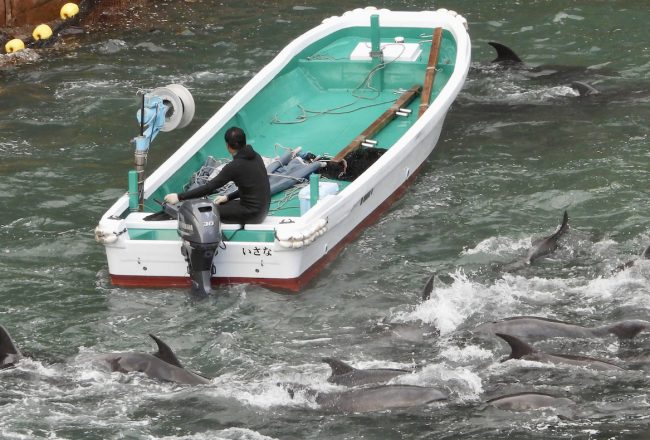
Bottlenose dolphins are driven into the Cove for captive selection and/or slaughter, Taiji, Japan. Credit: DolphinProject.com
While some information was already known, such as bottlenose being the most commonly bought dolphin species by far, and females being sold more commonly than males, there is some interesting information in the documents, including the prices of individual dolphins sold. The range of prices paid for dolphins is wide: up until 2023, bottlenose were the most expensive species due to their popularity but that changed when Pacific white-sided inched slightly higher, perhaps due to their beauty and athleticism. Another factor might be their scarcity, as they are a pelagic, deep water species not often captured. It is interesting to note that several Pacific white-sided could still be seen in the Moriura Bay sea pens as recently as 2024, even though no new captures of the species have occurred since 2020. This might suggest a lack of buyers for these expensive dolphins.
“It has been argued for many years all over the world, including within Japan, whether the dolphin drives in Taiji are tradition or business. For the first time, thanks to the Life Investigation Agency the proof is public! It is clearly a for profit business, with some benefiting more than others.” ~ Tim Burns, Dolphin Project
Unfortunately, the bottlenose, a more coastal species, continue to be driven into the Cove in large numbers, and prices paid for them varied greatly. The price of any dolphin varies with the amount of training: the more training, the more expensive the mammal. Although individual capture dates were not provided for each dolphin, those that sold for more than the most frequently listed price had been captured anywhere from a few years to 16 years prior to sale. Two bottlenose dolphins, one that had been captured in 2003 and the other in 2002, each sold for $131,200 USD in 2018, 15 and 16 years after capture. Perhaps the dolphins were already performers and the fact that they had lived that long in captivity proved that they had adapted to this life.
Not all dolphins survive so long in captivity. Since 2016, sales prices for what is assumed to be recently captured bottlenose dolphins decreased significantly. In 2017 sales contracts to China, the price for most bottlenose dolphins given was $32,810 USD (with no capture date). Dolphins that sold for more had a capture date listed. In 2023, bottlenose dolphins were captured and sold on the same day for $14,415 USD to Taiji Municipal Development.
On the opposite end of the scale were Risso’s, striped, and rough-toothed dolphins. The first contracts for striped and rough-toothed dolphins are seen in 2019 with striped dolphins sold for $10,630 USD and rough-toothed dolphins for $7,085 USD. Only one melon-headed was sold in 2018 for $32,810 USD. There were no records of sales of short-finned pilot whales within the timeframe provided thus far.
In 2016, there was one contract with China for the sale of 14 bottlenose dolphins. This sale was the beginning of what would be a long-term deal with China, including trainer exchanges.
In 2017-18 there was a sizable surge in large bulk sales of many species to facilities within China, with some of these contracts including trainer exchanges between the foreign facilities and the Taiji Whale Museum. (China was opening many aquariums during this time period and the Taiji Whale Museum provided trainer exchanges to teach dolphin health care and training methods.) One such sale in 2018 included bottlenose, Pacific white-sided, spotted, striped, Risso’s and melon-headed whales. Each dolphin was sold for $33,975 USD each, regardless of species.
In 2019, there were more frequent but smaller individual sales, many of which were handled by the Taiji Municipal Development Corporation, a corporation involved in developing tourism, selling live dolphins, and promoting whale and dolphin meat for school lunches. The corporation is run by the municipal government of Taiji, and the chairman of the board is the mayor of Taiji. During this year, the prices for all species declined. And, from 2020 onwards, the effects of the pandemic can be seen in low sales, with no sales contracts at all shown for the year 2022.
The only countries shown in the contract records are South Korea, China, and Japan. The last dolphin bought by South Korea was a single Pacific white-sided in 2015. In 2018, thanks to the hard work of groups such as Hot Pink Dolphins, Korean Animal Welfare Association, Korean Federation for Environmental Movement of Ulsan as well as public pressure, South Korea banned the import of dolphins captured in Taiji in 2018. In 2017 and 2018, the only sales were to China. In 2019, there is one more sale to China, then sales shift to the Taiji Municipal Development Corporation. Documentation shows that during 2020-2023, all but one of the sales contracts are to the Taiji Municipal Development Corporation.
The data provided raises an important question. Since the Taiji Municipal Development Corporation took over, sales have been listed as the same day or just days after the dolphins were captured. Is it possible that the corporation has become a middle man for dolphin sales? Theoretically, this would allow Taiji to hide the final destination and increase the price of the sold dolphins. The prices for individual dolphins bought by the corporation are very low compared to previous sales prices. During 2020-23, the prices for these dolphin species caught and sold on the same day were: Pacific white-sided – $21,650 USD, bottlenose – $14,435 USD, Risso’s – $14,435 USD, and striped – $10,825 USD. The lower prices could also have been caused by lower demand due to the effects of the pandemic and the growing pressure to end dolphin captivity. Much more research and investigation needs to be done to get a clearer picture of the dolphin sales in Taiji.

Taiji dolphin sales by species 2016-2023
When looking at the data that has been provided from Taiji regarding sales contracts, an important message is crystal clear: the dolphin drive hunts are a business for Taiji. Like all businesses, it is based on supply and demand. During a conversation with a Taiji resident with knowledge of the dolphin business, I was told that the hunters feel that the tireless work of activists who spread awareness is taking a toll on their dolphin sales. Demand is decreasing. This can be seen post-pandemic, where dolphinariums were closed, with little to no paying customers. When the number of sales goes down, the prices go down.
At present, many captive facilities are struggling financially. Some facilities that had captive dolphins are relocating their mammals, going bankrupt or shutting down. This includes
Marineland of Canada, Miami Seaquarium, DisneyWorld, Dolphinaris Arizona and many others around the world.
Read: List of facilities that either closed or never opened
Clearly, the tide is turning on dolphin captivity. While no one knows for sure what it will take for the dolphin drive hunts in Taiji to end, removing the profits made by the sales of captive dolphins would be a huge step towards that goal. Currently, over 165,100 people have signed the pledge to not buy a ticket to a dolphin show. While it is clear that the captive dolphin industry is on the decline in many areas, there is still so much work to be done to bring it to an end. Now more than ever, it is critical to keep the pressure on, and spread global awareness about the cruelty of the captive dolphin industry. As Dolphin Project has been saying for many years, “don’t buy a ticket.”
Efforts to bring down a multi-billion dollar industry is hard work. Please consider donating to support our work as we continue to investigate the business of captive dolphins and spread awareness about the truth behind the dolphin smile.
Featured image: Wild-caught bottlenose dolphin is transported to an unknown destination for “life” in captivity, Taiji, Japan. Credit: DolphinProject.com

Related posts
25 Dolphins Taken Captive as Taiji Hunts Begin
Beyond the Cove: How Captivity Sustains the Hunts