Concrete in a Dolphin’s Mouth After Transfer
 07Aug
07Aug
When the tourist attraction Marineland Antibes in France closed its gates in January 2025, many hoped the closure marked the beginning of a better future for the dolphins who had spent their lives there. Those hopes have quickly faded.
On July 23, 2026, eight of Marineland Antibes’ twelve bottlenose dolphins were transferred to Selwo Marina, a marine park in Benalmádena, Spain. The transfer operation was completed when the last dolphin was placed in the water during the afternoon. The move was reportedly intended as a temporary solution while a new facility is being built at ZooParc de Beauval in France.
In September 2025, all nine of Selwo Marina’s dolphins had quietly been sent to Hainan Ocean Paradise in China, leaving the tanks empty. Less than a year later, those same tanks were filled again with dolphins from France.
But what kind of facility have these dolphins been moved into?
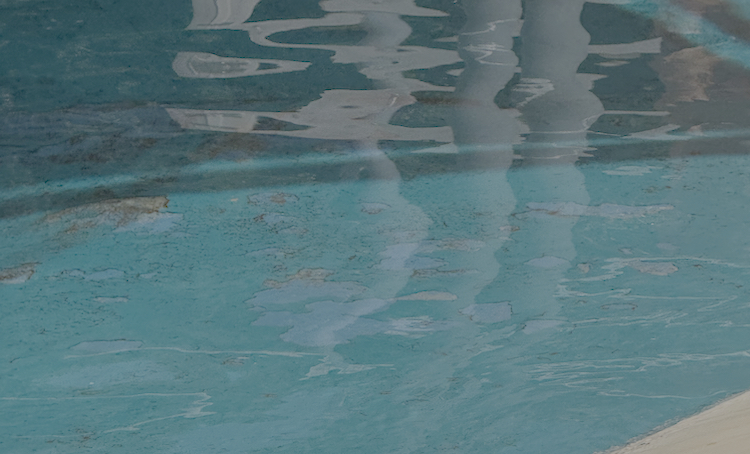
Photograph taken on July 25, showing the floor of one of Selwo Marina’s tanks. Peeling blue paint has exposed the concrete beneath, leaving both the paint and the concrete accessible to the dolphins. Credit: Alexandra Johnston
Dolphin Project team member Alexandra Johnston first visited Selwo Marina in August 2025 to assess the condition of the facility. During her visit, she documented extensive chipped paint throughout the tanks and other signs of deterioration.
Johnston returned to Selwo Marina on July 25, 2026, just two days after the Marineland dolphins arrived.
“When I returned in July 2026, many of the issues I had documented the previous year were still visible. Although some areas appeared to have received minor repairs, significant maintenance issues remain,” Johnston said.
That same day, animal advocate Georg Volk also visited Selwo Marina to document the facility. Standing near the north tank, one of the enclosures behind the show tank, he photographed the condition of the tanks. The images were shared with me by marine biologist Dr. Ingrid Visser, founder of the Orca Research Trust and a recognized expert on cetaceans.
One photograph, taken in the north tank, shows a dolphin carrying a large piece of concrete covered in blue paint in its mouth.
Not a flake, but a large piece.
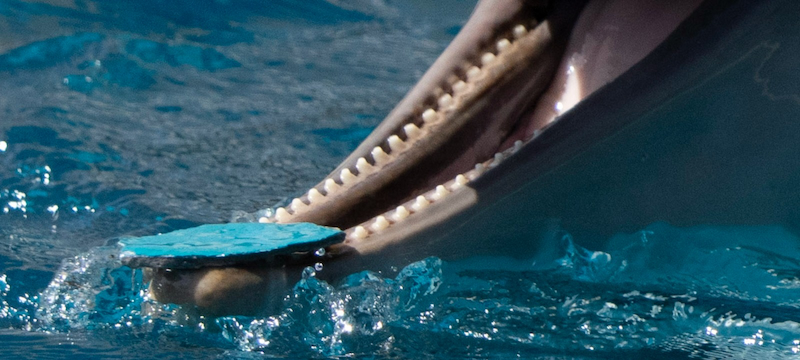
Close-up of the dolphin shown above carrying a piece of blue-painted concrete in its mouth. Dr. Ingrid Visser raised concerns about the risk that the dolphin may have ingested fragments of concrete or paint and noted that the piece came from the deteriorating surface of the tank. She added that captive dolphins may swallow foreign objects, sometimes requiring invasive procedures to remove them. Credit: Georg Volk
Another photograph shows the floor of the west tank where the damaged surface has exposed concrete and paint that the dolphins can access. At the time the photograph was taken, the west tank held five of the dolphins from Marineland Antibes.
Dr. Visser expressed serious concern about what the images reveal.
“This dolphin is ‘playing’ with, and may have ingested, concrete with blue paint,” she wrote.
She added that within 48 hours, at least one dolphin, likely more, had accessed concrete covered with blue paint below the water surface zone of the tank.
Dr. Visser explained that the piece of concrete had come from the deteriorating surface of the tanks. She noted that the damaged areas had either not been repaired or had been repaired so poorly that the dolphins were able to rip up entire pieces of concrete covered with blue paint from the tank structure.
She also warned that dolphins in captivity often swallow and ingest foreign objects, which can require invasive and stressful procedures such as endoscopy or other methods to remove them.
The conditions documented by Johnston and the photographs taken by Volk did not appear overnight.
In June 2025, Dr. Visser carried out an independent investigation of Selwo Marina specifically examining whether the facility could safely accommodate the Marineland Antibes dolphins.
Her report concluded that Selwo Marina was not an appropriate facility for the transfer. She found that the tank system was in a poor state of repair, with cracks, peeling paint, peeling sealer, and exposed concrete. She identified serious maintenance issues and apparent safety hazards at the facility.
Photographs in the report documented these issues. One image shows a dolphin with its head above the water in a tank where the surfaces are visibly damaged.
“The poor state of the dolphin tanks is evident. Rust, cracks, peeling paint, and exposed concrete are all visible in this image,” Dr. Visser wrote.
Taken together, Johnston’s inspections in 2025 and 2026, Volk’s photographs, and Dr. Visser’s assessment show that the deterioration documented more than a year earlier remained unresolved when the dolphins from Marineland were transferred to Selwo Marina.
These dolphins have already endured the stress of transport and relocation. After such a journey, the last thing they should face is a facility where maintenance issues are putting their health and welfare at risk.
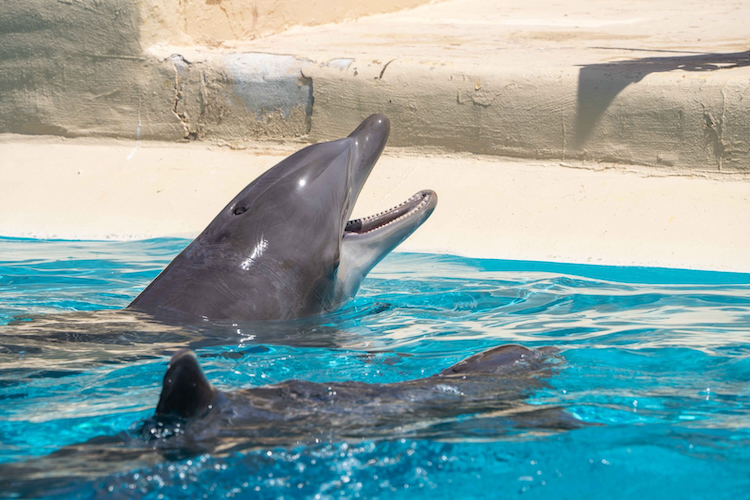
Image taken on July 25, 2026, showing two of the Marineland Antibes dolphins in one of Selwo Marina’s tanks. Extensive cracking is visible in the concrete structure of the tank. The condition of the enclosure raises serious questions about how the facility was considered suitable to receive dolphins from Marineland Antibes. Credit: Georg Volk
A dolphin carrying a piece of painted concrete from its enclosure in its mouth is not a minor maintenance issue. It is a dangerous situation that demands urgent investigation.
“How could the authorities approve the transfer of eight dolphins from Marineland Antibes to a facility where serious deficiencies had already been documented?” Dr. Visser asked.
“The concerns raised before the move still require answers,” Johnston said.
The authorities responsible for this transfer must explain how Selwo Marina was considered suitable to receive these dolphins. They must also investigate the condition of the tanks without delay and ensure that any damage posing a risk to the animals is addressed immediately.
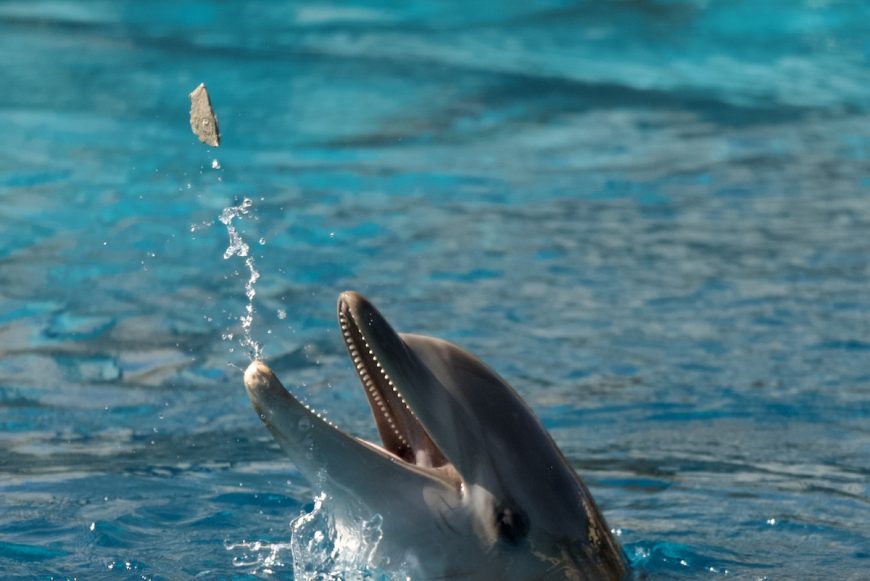
Featured image: Image taken July 25, 2026, showing one of the dolphins transferred from Marineland Antibes to Selwo Marina in Spain. Just two days after the transfer, the dolphin was seen tossing a piece of concrete into the air. If the concrete becomes lodged in the dolphin’s throat, the consequences could be life-threatening. Credit: Alexandra Johnston

Related posts
Beyond the Cove: How Captivity Sustains the Hunts
The Problem with Captive Dolphin Swim Programs