Dolphin Dies at Kolmården Zoo in Tragic Accident
 20Mar
20Mar
Nephele, the oldest dolphin at Kolmården’s Zoo in Sweden has died after suffocating on artificial seaweed which became trapped in her throat. The tragic incident took place in the middle of January of this year, according to Daniel Rolke, who is founder of the Swedish organization Animalkind.
The autopsy report has revealed that Nephele was prevented from breathing after a piece of artificial seaweed, which Kolmården staff had added to the tank as so-called “enrichment,” became lodged in her throat.
In the Swedish news publication “Aftonbladet” (which translates into Evening News) Kolmården Zoo’s chief veterinarian Bim Boijsen is quoted as saying: “What happened is very regrettable. We are deeply saddened by Nephele’s death.”

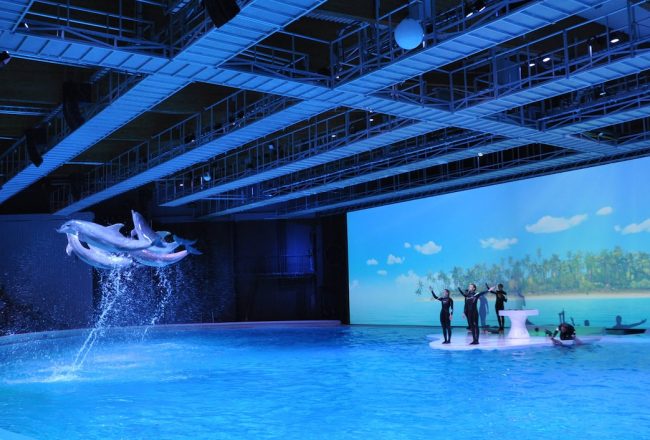
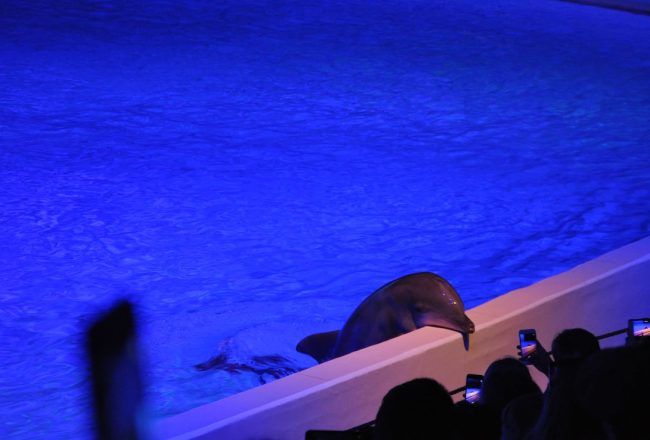
During a show at Kolmården Zoo in 2015, dolphins entertained the crowds while loud music was playing. The stadium backdrop was decorated with the appealing image of a tropical island and turquoise ocean water in order to make the dreary tank seem somewhat natural. Recently, Kolmården Zoo added artificial seaweed to the tank to give the dolphins something to look at. The decorations ended up killing 40-year-old Nephele, who was captured off the coast of Florida during the 1980s. Credit: Helene O’Barry/Dolphin Project
According to the news article, the approximately 40-year-old bottlenose dolphin Nephele was completely healthy on the morning of January 15. A moment later, she began to move in an unusual way and sank to the bottom of the pool. Bim Boijsen describes Nephele’s death this way: “It was a quick process. When the vet arrived at the scene, she had already passed away. It is very sad. Nephele was a much-loved dolphin.”
Boijsen goes on to explain that staff had added the artificial seaweed to the tank in an effort to provide “environmental enrichment” and “stimulate the animals” by making their enclosure more dynamic.
The seaweed has now been removed from the tank.
Daniel Rolke explains how Nephele ended up in Kolmården Zoo’s dreary dolphin stadium:
“In 1994 Kolmården bought two wild-caught female dolphins named Cindy and Mandy from Hagenback Zoo in Germany. The purchase was controversial, and at first, the Swedish Environmental Protection Agency refused to allow them to be imported into Sweden, as bottlenose dolphins were on the CITES Appendix II list, which meant that they could only be imported from the country where they were born or captured. Cindy and Mandy, who were nine years old at the time, had been captured in Florida, United States in 1989. Kolmården submitted a new application, in which they stated that they would conduct “research” on the dolphins in order to avoid receiving yet another rejection. So Cindy and Mandy were imported despite strong protests, and when they arrived in Sweden, Kolmården’s dolphinarium renamed them to Nephele and Delphi to make people forget the connection. Delphi died at Kolmården Zoo in 2007, in connection with a birth. And now Nephele is gone, too.”
In 2022, Kolmården Zoo announced that it would be closing its dolphin exhibit, but two years later, the dolphins are still there. Over the years, Kolmården Zoo has been heavily criticized because many of their dolphins, especially young calves, have died prematurely. After Nephele’s catastrophic death, eleven dolphins remain at the facility.

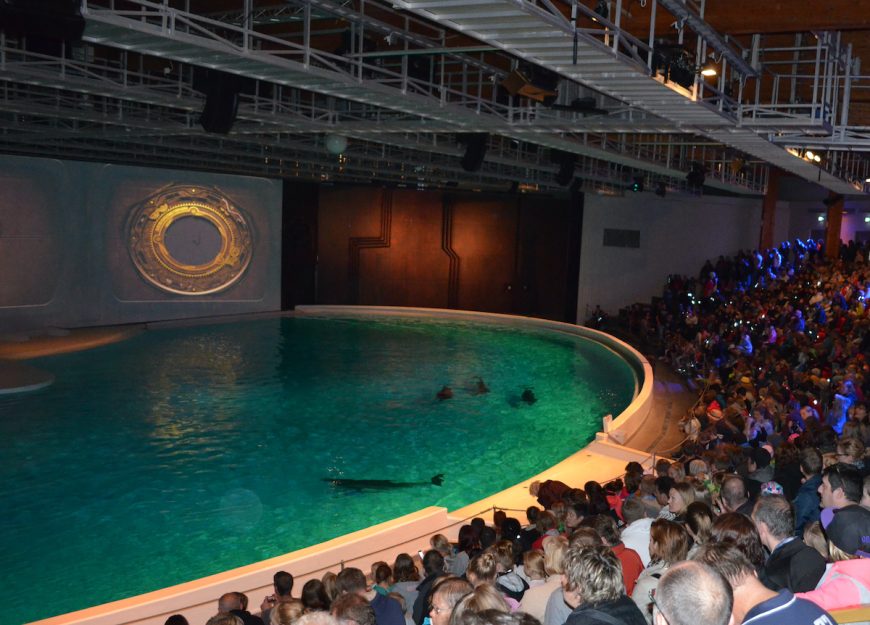
The dolphins at Kolmården Zoo in Sweden are confined in indoor chlorinated tanks all year round, and more than 60 dolphins have died there since the dolphin exhibit, named Marine World, opened in 1969. Credit: Helene O’Barry/Dolphin Project
A Dolphin Project team inspected Kolmården Zoo’s dolphin stadium in 2015. As in all other European dolphinariums, the dolphins at Kolmården Zoo are confined in a barren and completely lifeless concrete stadium with nothing to do and nowhere to swim to. The skin on some of the dolphins was covered in strange-looking white patches, which could have been caused by the heavily chlorinated water. During a meeting with park officials, the team was told that Kolmården Zoo was contemplating the possibility of adding an outdoor area to the stadium, so that the dolphins could see the sky, experience the rain, and breathe fresh air. That never happened, probably because such an expansion was considered too expensive.
Adding artificial seaweed to a dolphin tank is a cheap and very dangerous way of making the confinement appear more natural to audiences, and any dolphinarium should know that such objects present a huge danger to dolphins who are highly inquisitive by nature. Kolmården should have been aware that it would only be a matter of time before one of the dolphins ingested the artificial seaweed, especially since it’s common knowledge within the captivity industry that several dolphins and other marine mammals have died from swallowing foreign objects.
The dolphins at Kolmården Zoo in Sweden are trapped in a miniscule and artificially lit theater and never get to leave. They can’t ever go home. Nothing in this bleak confinement resembles the ocean world they naturally belong to, and there is no way for them to express their innate abilities, such as foraging, navigating, and exploring. With everything science tells us about dolphins’ astounding intelligence, highly evolved communication skills, and complex hunting techniques, it is preposterous that it is still legal in many countries to confine them under such outdated and poor conditions.
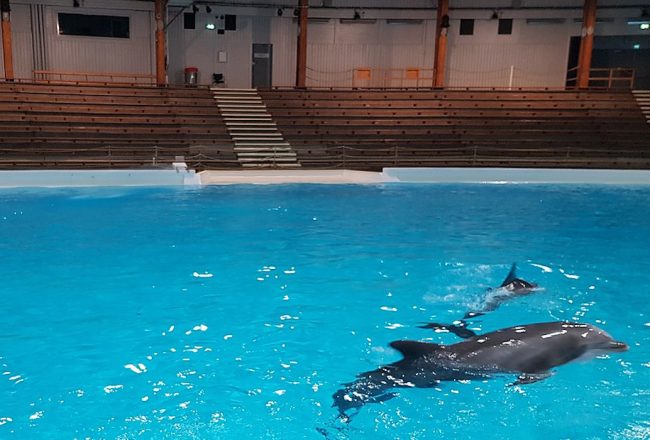
Featured image: The dolphins at Kolmården Zoo in Sweden spend 24/7 in this artificially lit theater. More than 60 dolphins have died here since the show stadium opened in 1969. Even though Kolmården Zoo announced in 2022 that it would finally close its dolphin exhibit, the zoo has yet to announce what will happen to the dolphins. With Nephele’s recent death, 11 dolphins remain trapped at the zoo. Credit: Helene O’Barry/Dolphin Project

Related posts
Luna the Dolphin is Dead
Kolmården Zoo: Another Dolphin Dies