From Freedom to Circles: Angel’s Story
 17Jun
17Jun
Part of being a Cove Monitor in Taiji, Japan, in addition to documenting the drive hunts, is to check on the numbers and health of the captive dolphins at the local captive facilities. Media from these facilities is used to educate and raise awareness. As a Cove Monitor who has traveled to Taiji yearly since 2012 with the exception of the pandemic years, I have followed and documented the life of Angel, an albino bottlenose captured in 2014.
The first time I saw Angel was during her first year in captivity, after she had been moved into the marinarium where she now resides. I was struck by her beauty but also by her curiosity. How I wished I could turn back time and wished that her family, that all dolphin families, had not tried to swim past Taiji and had not been intercepted by the dolphin hunters. However, I realized, it’s not the dolphins who need to change their behavior, it’s the humans. Dolphins have been following the Kuroshio current past Taiji for thousands of years, it’s their right, part of being free. It’s just so sad that, for Angel, it cost her freedom.
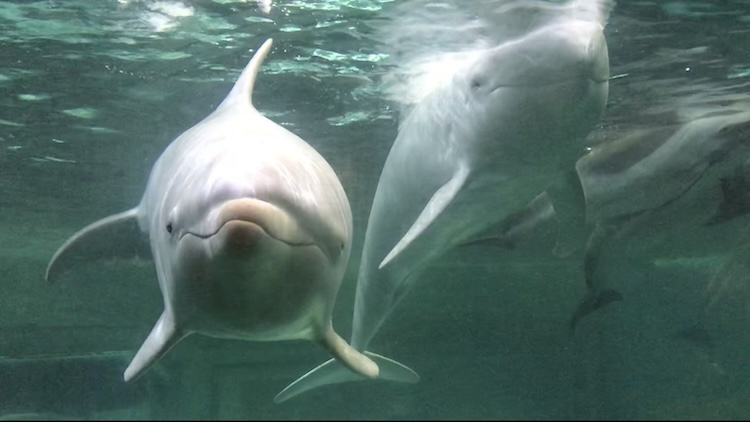
Angel and Hamata, a Risso’s dolphin, Taiji Whale Museum, Taiji, Japan. Credit: DolphinProject.org
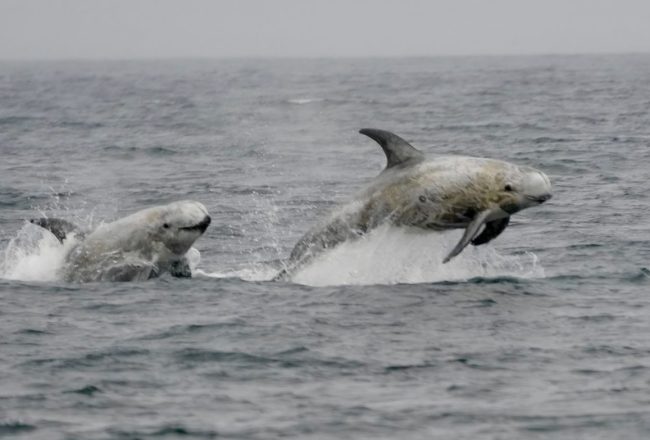
During the 2017-18 drive hunt season, I spent four months in Taiji – September through November – and then returned in February. I spent a lot of time with Angel during visits to the Taiji Whale Museum to check and document the conditions of the captive dolphins. She seemed to crave attention and interaction. Angel has had tank mates of different species come and go over the years. During this time, they had moved Hamata, the white Risso’s dolphin in with her, perhaps, in hopes of Angel and Hamata mating and producing an albino hybrid as bottlenose-Risso’s hybrids have been seen in the wild. The two did interact and both had that curiosity and desire to connect but, to my knowledge, a hybrid was never produced.
Angel and the others in the tank are “trained” to do some basic tricks but there is no room in that tank for any leaping or swimming at the surface. It’s a small tank with a tube through the middle for humans to walk through and see the dolphins above them. Her life consists mainly of swimming in never-ending circles.
When the dolphin hunting season ended, I went to see all the captive dolphins at the Taiji Whale Museum before I left for home. Something happened that day that I will never forget. When I entered the marinarium, Angel immediately swam over to me but she seemed different…agitated. In my mind, I was trying to explain to her that I had to leave, that I hated to leave her there and that I would continue to fight for her and all captive dolphins. Then, she started to forcibly ram into the glass wall. She would back up and jaw clap at me which is thought to be a sign of aggression, a message of “get away from me.” I’ll never forget the sound of her slamming against the glass wall. It was so unfair that I had the freedom to leave while she was imprisoned there, day after day, year after year. That was one of the hardest “goodbyes” I’ve ever experienced.
After not being able to travel to Japan during the pandemic for two seasons, I finally returned to Taiji. I was anxious to see how the captive dolphins were doing, especially Angel. What I saw not just on that visit but on every visit since devastated me. Angel was still there, swimming those endless circles but now, she no longer broke her circular swimming pattern. From being a curious and interactive dolphin, she now had permanent catatonic look in her eyes when they weren’t shut. Hamata had been moved. She had new tank mates, but none were her own species. The only time she broke her swimming pattern was when trainers arrived to “train” her and feed her. Just this last season, I watched her “training” in order to receive the dead fish reward. She was also being trained to accept “tubing” which is when a long tube is inserted down the dolphin’s throat to deliver hydration or medication. Once everything was done, she returned to her endless circles.
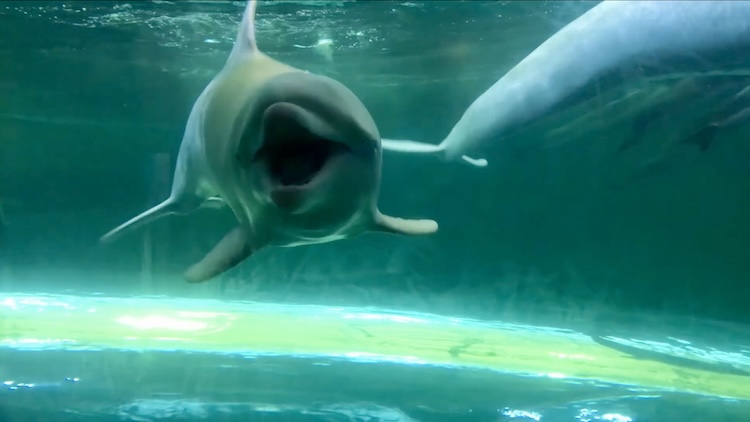
Angel jaw-clapping, thought to be a sign of aggression, Taiji Whale Museum, Taiji, Japan. Credit: DolphinProject.org
Angel went from being a young calf, swimming by her mother’s side in the ocean, to a captive at the Taiji Whale Museum where she has gone from being a curious, playful dolphin to an empty shell of a dolphin. She is empty because all that is important to dolphins was taken from her. Her family, her home, her freedom. She is not an “ambassador” for her species which is a line heard at many dolphin shows, she is a prisoner. Imprisoned by humans, for humans. She doesn’t perform in any shows. She is just there for people to stare at because of her unique coloration. Nature created a beautiful animal through genetics but that unique beauty has been a curse for Angel. Most likely, she will spend the rest of her life, swimming in circles in the marinariam in Taiji. Once, she was called the “poster child” for the anti-captivity movement. Sadly, now she is the poster child for what captivity does to the soul and spirit of a dolphin. She is broken, just existing; surviving. Angel’s story is similar to all dolphins kept in captivity.
It’s time to change the story.
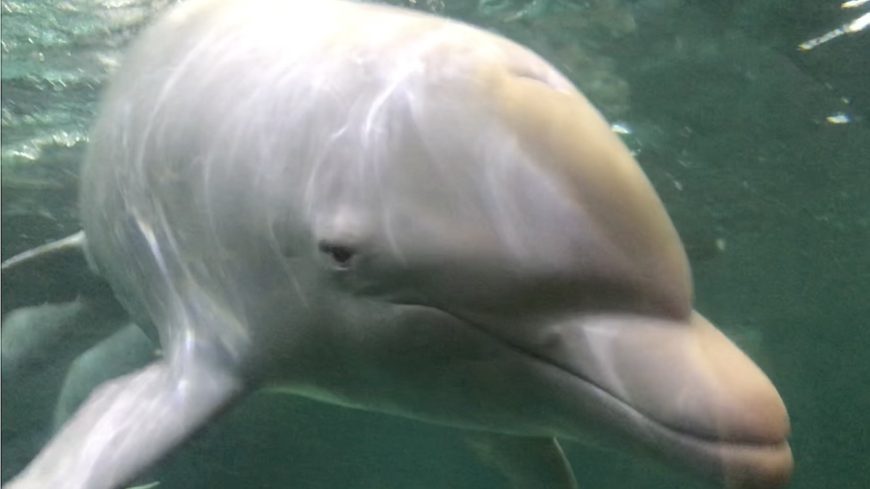
Featured image: Angel the albino bottlenose dolphin, Taiji Whale Museum, Taiji, Japan. Credit: DolphinProject.org

Related posts
25 Dolphins Taken Captive as Taiji Hunts Begin
Beyond the Cove: How Captivity Sustains the Hunts