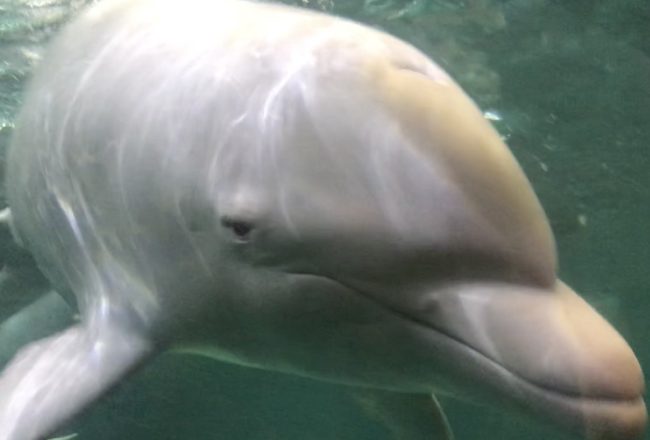
How Taiji Profits off of Dolphins’ Suffering
 02Jan
02Jan
Why do dolphin hunters in Taiji continue to capture hundreds of dolphins and force them into the town’s infamous killing cove year after year?
The answer is as simple as it is infuriating: Members of the dolphinarium industry are turning the hunt into a lucrative business by purchasing “show-quality” dolphins from dolphin dealers in Taiji. The dolphin dealers purchase some of the best-looking dolphins from the hunters and then sell them at huge profits to dolphinariums in Japan and abroad. Taiji’s trade in live dolphins, in which both the hunters and the dealers make a profit, is the reason the dolphin drive hunt, where hunters use modern motorized boats to push entire pods of dolphins ashore, continues year after year. The demand for young, unblemished dolphins that can be trained to perform in front of large, paying audiences fuels the hunt.
Not surprisingly, Taiji keeps trying to convince the world that dolphin drive hunts are an important part of its local culture and provide a vital source of food for the Japanese people. (They ignore the fact that dolphin meat is tainted with some of the world’s most dangerous toxins, and no one should eat it.) The leaders want people to believe that the highly organized drive hunt, which occurs six months out of the year, has been deeply rooted in the town’s way of life for centuries. But that isn’t true. And in 2013, Japanese conservationist Sakae Hemmi wrote a letter in which she highlighted how Taiji’s systematized dolphin drive hunt came about. She explained how recent the dolphin hunting’s history is, per the town’s own publication, The History of Taiji, edited and published in 1979. According to Sakae, “The first recorded dolphin drive was in 1933, with subsequent hunts occurring in 1936 and 1944. It was not until 1969 that dolphin drives have been conducted on a large scale.” Sakae went on to emphasize that in 1969, the main goal of the hunt was to capture pilot whales as prized showpieces for the Taiji Whale Museum. She noted, “In other words, the dolphin drive was purely for profit, having nothing to do with cultural history.”

A slaughtered pilot whale is tethered by its flukes in the Cove, Taiji, Japan. Credit: LIA/DolphinProject.com
So, based on the town’s own records, the dolphin drive hunt cannot in any shape or form be labelled as traditional.
As one of our previous blogs described, our colleagues at the Japanese animal rights organization Life Investigation Agency (LIA) have gained access to documents that detail Taiji’s lucrative business relationship with members of the dolphinarium industry. LIA’s executive director, Ren Yabuki, is in the process of scrutinizing thousands of pages that document how some of the world’s dolphinariums are turning Taiji’s dolphin drive hunts into a money-spinning enterprise.
In 2022, LIA published an article that explains how Taiji’s trade in dolphins, both dead and alive, works. In the article, LIA discussed the dolphin hunting season that began September 1, 2022, and ended February 28, 2023. During those six months, a total of 527 dolphins from five different species were killed, and dolphin trainers selected 37 to sell to dolphinariums. While at first glance these totals make the hunt look as if it is primarily about food, the money reveals otherwise. The revenue made from selling a live dolphin is far higher than the revenue made from selling a dolphin that has been killed and processed into meat. Through a public information request, LIA revealed that 80% of revenue generated by Taiji Municipal Development Corporation, which is the dolphin hunters’ top customer, was from the sale of live dolphins.

Wild-caught bottlenose dolphin being shipped to an aquarium for public display, Taiji, Japan. Credit: DolphinProject.com
We may never know how much of the dolphin meat that ends up on the shelves of supermarkets in Japan is purchased and eaten, and when I asked Ren about it, he commented: “Many Japanese people have never eaten dolphin meat, and I don’t think there are many people in Japan who want to eat dolphin meat in the future. The dolphin meat industry is very small here, and it is only carried out in a few fishing towns, including Taiji, its neighboring towns, and a few fishing towns in the northern region. Dolphin meat does sell well in supermarkets that are run by the fishing union in Taiji. However, it’s the sale of live dolphins that supports the hunt.”
Since the hunt’s primary motivator is the sale of live dolphins to members of the dolphinarium industry, why don’t the hunters release all the dolphins that dolphin trainers do not select? Why do they continue to slaughter dolphins by the hundreds every year? I think it’s in order to bring the words “tradition” and ”food culture” into the debate, thereby turning global criticism into an issue of interference with internal affairs. This strategy makes it much easier for the town of Taiji and the Fisheries Agency to rationalize the hunt when faced with criticism of the hunt’s inherent cruelty.
Ren confirmed my suspicion. He said, “The Japanese government and Wakayama Prefecture have always maintained that Taiji’s dolphin hunting is for the local traditional food. However, after LIA began its activities in Taiji, the governor of Wakayama Prefecture commented for the first time on the issue of live dolphin sales, saying, ‘If there is a demand for selling live dolphins, then dolphin hunting is not a bad thing.’”
Ren added, “This is a very important statement. Dolphin Project and LIA teamed up to get the Wakayama prefectural governor to acknowledge the sale of live animals for the first time. His statement shows that the hunt will continue as long as dolphinariums are buying dolphins from Taiji.”

Ren Yabuki of LIA watches the horizon for dolphin hunting boats, Taiji, Japan. Credit: Mimi, Life Investigation Agency (LIA)
Far from all dolphinariums around the world purchase dolphins from Taiji’s dolphin drive hunts, but the ones that do take advantage of the food argument by claiming they are not doing a bad thing at all, that they are essentially saving the dolphins from being killed. One example is Harderwijk dolphinarium in Holland. They purchased dolphins from Taiji several years ago, all of which are dead now. When confronted about the purchase, an employee at the dolphinarium responded, “At the time, we considered it as a rescue effort. The slaughter happens anyway, and if we don’t buy them, they die.” But the slaughter of dolphins in Taiji does not happen despite the alleged attempt by dolphinariums to save them. It happens because of them. Dolphinariums that purchase dolphins from Taiji’s killing cove are not saving any dolphins from slaughter. They are creating the slaughter. In the confrontation at the Harderwijk dolphinarium, which is posted on YouTube, the employee seems to realize the insincerity of his claim and finally admits: “There is no excuse for it, really.”
So, what would happen if the trade in dolphins from Taiji’s dolphin drive hunts finally stopped once and for all? Dolphin Project’s Taiji Campaign Coordinator Tim Burns commented, “I think it would cost too much to hunt dolphins with the drive hunt process if the sale of dolphins to dolphinariums stopped altogether. If the hunters still wanted dolphins for food, then the offshore harpoon industry would likely fulfill that need at a greatly reduced cost. Ten to thirteen banger boats, a number of skiffs and 25+ employees simply cannot be sustained by slaughter profits alone.”
Ren confirmed Tim’s assessment, saying, “If the dolphins become unsellable, many of the hunters in Taiji will retire. At first, about half of the hunters will retire. Then there will be no successors, and the next generation of hunters will be gone. And eventually, it will go away.”
LEARN MORE about Dolphin Project’s campaign in Taiji, Japan.
Featured image: Bottlenose dolphin secured to skiff, after being ripped away from its pod and the open ocean for “life” in captivity, Taiji, Japan. Credit: DolphinProject.com

Related posts
25 Dolphins Taken Captive as Taiji Hunts Begin
Beyond the Cove: How Captivity Sustains the Hunts