If Not Now, Then When?
 11Jul
11Jul
In March of this year, experts from the United States, Canada and Europe gathered in Vancouver, British Columbia to determine the measures necessary to help Southern Resident Orcas (killer whales). The situation is so dire, according to those that gathered, that the orcas could face extinction if the recommended measures are not implemented, and the orcas’ survival, not prioritized.
Southern Resident Orcas are comprised of three pods – “J”, “K” and “L” – and are classified as endangered both in Canada and the United States, with only an estimated 73 orcas remaining. Their habitat is located mainly in the Pacific Northwest, off the coasts of British Columbia (in Canada), and Washington and Oregon (in the United States) but the mammals have been known to forage further in search of Chinook salmon.
The Issues
➡️ Chinook salmon is the primary source of the orcas’ food, fulfilling the bulk of their daily energy requirements, yet these stocks are on the decline.
➡️ Noise pollution and boat traffic can disrupt the orcas’ natural behaviors, causing their environment to become unlivable.
➡️ Aquatic toxins can lead to a decline in the orcas’ health and a drop in full-term births.

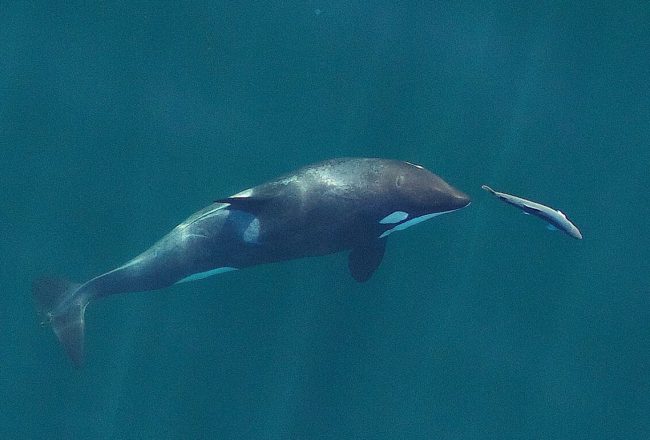
Southern Resident orca Scarlet/‘J50′ swimming with her mother Slick/‘J16′. Tragically, J50 was declared dead in September 2018. Credit: NOAA Fisheries /Public Domain
Some of the recommendations include: limiting fisheries to help the orcas access their main food source, Chinook salmon, eliminating toxic chemicals that can poison their food supplies, expanding slowdown zones for ships, and establishing and enforcing underwater noise standards. All the recommendations are based in science, and while recovery can take years, if their implementation is delayed, the mammals could be lost forever.
Despite the urgency of this situation, at the time of this writing, no emergency orders have been issued on either side of the border. The “incremental measures” announces by Canada’s Fisheries Department earlier this year sadly don’t appear to be robust enough to strengthen the orcas’ population.
We will provide updates as more information becomes available.
Learn more
Parks Canada: Protecting the Southern Resident Killer Whales
NOAA Fisheries: Saving the Southern Resident Killer Whales
Sources used in this blog
Canadian Press: Scientists map recovery for endangered orcas off British Columbia’s coast
Featured image: “J” pod Southern Resident Orcas, NOAA Fisheries via Outside Magazine, author: Katy Foster. Note: image is part of the public domain.

Related posts

Stronger Protections for Orcas in Canada
Canada Says No to Orca Protection