Is Demand for Captive Dolphins Decreasing?
 27Nov
27Nov
After a three year absence from documenting the dolphin drive hunts, I returned to Taiji recently. While I always hope that each season will be the last, there is still the need to document these hunts. Some things felt the same, some things felt very different. Familiar places, even familiar faces. The captive facilities are all still here. While I haven’t entered any facility that requires an admission fee, I’ve visited Dolphin Base frequently since arrival. Dolphin Base sea pens sit in Moriura Bay, on public land. One can visit and observe the dolphins there and “training” sessions. Not only does Dolphin Base have dolphins captured from the drive hunts but it also serves as a sort of dolphin trainer school where young people come to learn how to train dolphins. I always feel bad when I drive by the Taiji Whale Museum and see the parking lot full of cars. It seems business is going well. Business. That’s what the Taiji dolphin drive hunts are, a business. Not tradition as is often claimed. Yes, whaling is their tradition, that cannot be argued but the dolphin drive hunts started in 1969 as the town decided to build a captive facility that would display local species that pass through Taiji waters. And so it began.

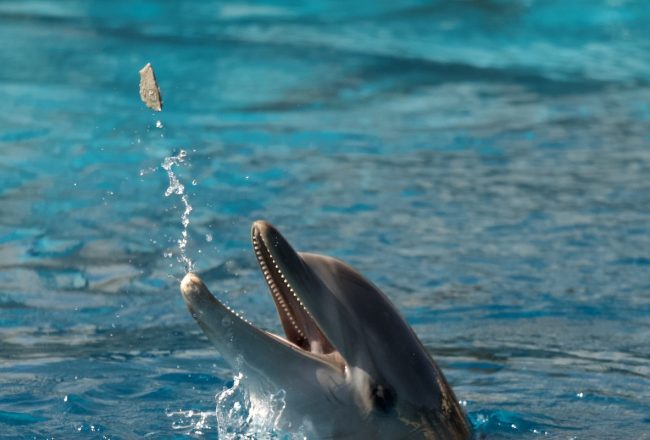
Captive bottlenose dolphin, Taiji, Whale Museum, Taiji, Japan. Credit: DolphinProject.com
The sale of captive dolphins is what keeps these hunts profitable. Yes, they make money from slaughtering and selling the meat of dolphins but the real money maker here is the captive dolphin trade. Dolphins are captured, trained to entertain humans, then sold to aquariums around the world, not just in Japan. Without the profits of the captive trade, these drive hunts may have died out. We will never know because as people became more and more enthralled with dolphins, the demand for captive dolphins grew. However, one of the things I did notice that seemed different was the number and variety of species at Dolphin Base. In the past, I observed pilots whales, Risso’s dolphins, pantropical spotted dolphins, and rough-toothed dolphins along with the always popular bottlenose and Pacific white-sided dolphins. Now, the majority of the dolphins were bottlenose with a few Risso’s dolphins. The fact that they had Risso’s was rather telling considering that no Risso’s had been captured in the previous season. That means they have been in Taiji for over a year now, unsold. Perhaps they have other reasons for keeping them, it’s impossible to know.
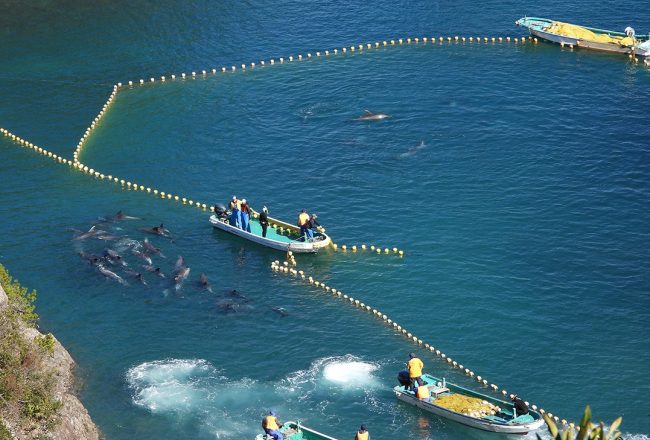
I have been fortunate to have many blue coves since returning to Taiji. However, on November 24 that changed in a heartbeat. Just like every morning, my first task was to watch the hunting boats leave the harbor to search for dolphins. From there, the next spot was Tomoyozoki, which is an old whaling lookout spot due to the panoramic view of the open ocean. Hours of waiting are spent, scanning the horizon, hoping to see the hunting boats return without dolphins. However, it doesn’t always work out that way. This day, I had just arrived at Tomoyozoki and was about to head down to the lookout point when I heard the familiar roar of the hunting boats engines. Not only were they in formation but they were very close to shore and very close to the Taiji harbor. Time to relocate — off to Takababe, a steep hill above the Cove. Upon hiking up the hill and setting up equipment, the dolphins were nearly at the mouth of the Cove. It was heartbreaking to see these animals swimming in such panic, trying to get away from the hunters and all the loud sounds coming at them. My heart dropped as I saw it was a very large pod of bottlenose dolphins. They were heading straight for the Cove. As they passed the point of no return, a net was dropped behind them. They were trapped. It looked like the Cove was churning with dolphins as they swam tightly together. Exhausted after the chase, the puffs made by their breathing filled the once silent cove.

Pod of bottlenose dolphins swim in circles after being driven into the Cove, Taiji, Japan. Credit: Dolphin Project/LIA
The hunters then left the dolphins for a few hours. Tails slapping the water, a sign of frustration and agitation could be seen and heard. These dolphins had never been confined in their lives. A net is a foreign object to them, a barrier that they cannot comprehend. Even though they could leap over the nets, it would be a leap of faith that they were not willing to take. I’ve seen panicked dolphins crash into the nets in a desperate attempt to escape but I have never seen a dolphin leap over the nets. This was a large pod, probably consisting of several subgroups traveling together. There were several mother-juvenile pairs with the smaller juveniles sticking right by their mothers’ sides. They continued to swim in tight circles as close to each other as physically possible. It’s a scene I’ve seen too many times.
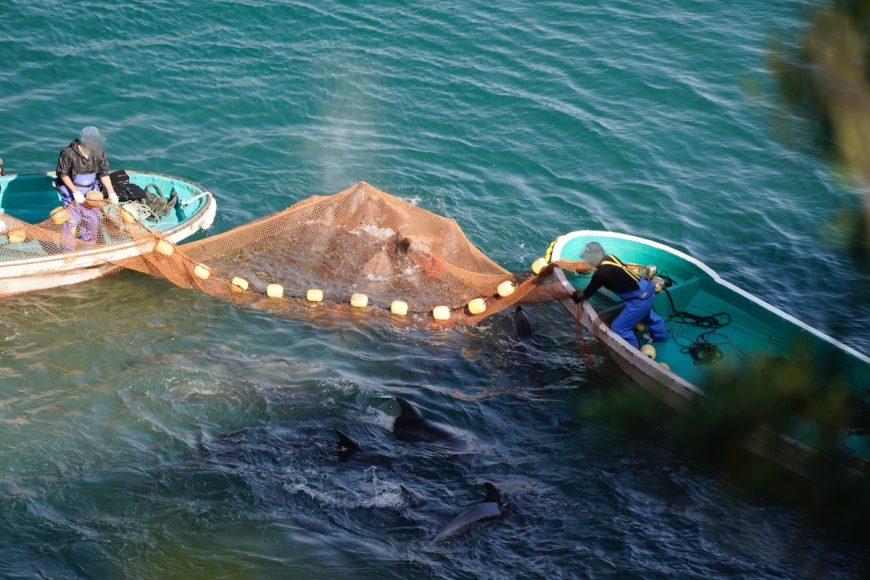
Then, the roar of the skiffs could be heard as the hunters returned to the Cove. Their first task was to net them into smaller, more manageable groups. Once that was accomplished and the trainers had been escorted under the tarps, the madness began. Like other bottlenose dolphins I had seen before, the process was the same. Divers choosing a dolphin to bring to the trainers for inspection. First a diver pounces on the dolphin, usually holding on to the dorsal fin and being dragged around as other divers join in and try to subdue the dolphin. A skiff with a black net approaches and the divers bring the dolphin over where the net is dropped and used to wrap the dolphin and pin it to the side of the boat. It takes three men to hold the dolphin as it thrashes wildly, fighting for its freedom. The skiff then carries the dolphin under the tarps where the trainers are waiting. The dolphin is sexed, measured and inspected. The ideal captive dolphin is a young female that doesn’t have too many marks or scars on her skin. If the dolphin is not suitable, it is marked with a white substance and pushed back from under the tarps. If it is unfortunate enough to be selected, the dolphin is next wrestled into a sling which is attached to another skiff and is carried through the water to be dumped into a sea pen. A sea pen is a floating cage and they can be found in the Taiji harbor and in Moriura Bay where facilities such as the Taiji Whale Museum and Dolphin Base keep the dolphins that they select and purchase from the hunters. During the process, it is chaos as the group of dolphins is restricted to a very small and shallow swimming space. Dolphins can be seen trying to push their way through the nets as they desperately try to escape, only to get tangled and caught. The hunters often ignore the struggling, trapped dolphins for what seems to be an eternity but eventually come over, untangle them and push them back into the group. By the end of this day, ten bottlenose dolphins had been carried out and dumped in sea pens in the Taiji harbor.

The dolphin captivity industry is based on supply and demand ~ Ric O’Barry, Founder/Director of Dolphin Project
After going through about half of the pod, the hunters called it a day. They left the dolphins in the Cove for the night. The next day, fearing what I assumed was going to be another selection day, I arrived at the Cove as the sun was rising. In my experience, when dolphins are held overnight, they usually start the process early in the morning. Not today. I waited and waited for a few hours, not knowing what was going on. Then, the familiar sound of a skiff coming towards the Cove was heard. I ran towards the point, expecting to see the hunters and trainers coming into the Cove but instead was very surprised to see a skiff with four slings attached to the sides. I watched in disbelief as they dropped four dolphins back into the Cove, reunited with their family. A few minutes later, another skiff arrived with three more dolphins. They too were dropped back into the Cove. What was happening? Understanding the value of bottlenose dolphins to the captive dolphin trade, I couldn’t comprehend why they were returning seven dolphins. Those viewing on our livestream and myself began to get our hopes up as the hunters began to remove the nets separating the groups of dolphins. Would this be a release? But there was a large group of dolphins that hadn’t been inspected yet and these were bottlenose…surely they would want to take more. I knew when they removed the net that separated the already inspected from the yet to be inspected dolphins that these dolphins would be released.
Watching a pod of dolphins that has been held in the Cove be released is amazing. The sheer joy you see as the dolphins swim away from the Cove is indescribable. As the last net was collected and the hunting boats were in place, the skiffs weren’t needed to push them out, they took off! Porpoising and leaping for joy, they were free again! Traveling at the same speed as when they were being driven into the Cove, they were now swimming away from the Cove, back to the open ocean, back to their freedom, back to just being dolphins. My voice cracked as I described the scene to the livestream viewers as I began to feel tears of joy. Many viewers commented that they were crying tears of joy too! After all the suffering and the anticipation of witnessing more suffering, we were just overcome with joy and relief. Although they lost three family members to captivity, none had been slaughtered and they were free again. For the three left behind, their lives are forever changed. Sadly, they will begin the process of having their spirits broken and becoming slaves for human entertainment. However, the events of the day may provide us will a glimmer of hope that things are changing.

Four dolphins were brought into the Cove, prior to the mammals being released, Taiji, Japan. Credit: Dolphin Project/LIA
Ren Yabuki, director of Life Investigation Agency believes the demand for captive dolphins has decreased. Says Ren, Due to Covid 19, many dolphins have been confined to the sea pens in Taiji as ‘stocks’. We see more dolphins being sold in this season compared to the last season but the global demand for live dolphins is obviously going down.”
The number of bottlenose dolphins taken captive in 2020-21 was 119, in 2021-22, that number dropped to 60 and in 2022-23, the number dropped further to 34. So far, this season, although they’ve had the opportunity to take many more, the approximate number taken is 14. The pandemic took a toll on the captive dolphin industry as there were no visitors for a period of time. The captive facilities in Taiji were left to feed and care for a large number of dolphins that remained unsold. This shows us what can happen if we reduce the demand for captive dolphins permanently.
Ren goes on to explain the captive dolphin trade in Taiji. “Even though dolphins were not sold due to Covid-19, the Taiji Whale Museum has continued to purchase dolphins from the hunters at taxpayer expense. In fact, Taiji Town and Taiji Municipal Development Corporation effectively control the Taiji Whale Museum. The flow of money is very opaque and Dolphin Project and LIA are bringing them into court to expose this truth to the citizens of Taiji.”
While a lawsuit was recently won over the redaction of information from public documents related to the handling of dolphins, the case is currently under appeal by the town of Taiji. Your support is needed to help this case and other cases make their way through the Japanese legal system. These lawsuits will be a big step forward towards ending the dolphin drive hunts and all the suffering associated with them.
Featured image: Bottlenose dolphins driven into the Cove, Taiji, Japan. Credit: Dolphin Project/LIA
Related:
Huge Blow to Taiji’s Dolphin Drive Fishery
Learn more about the dolphin hunts in Taiji
PLEASE SUPPORT THE LEGAL INITIATIVES IN JAPAN BY DONATING TODAY


Related posts
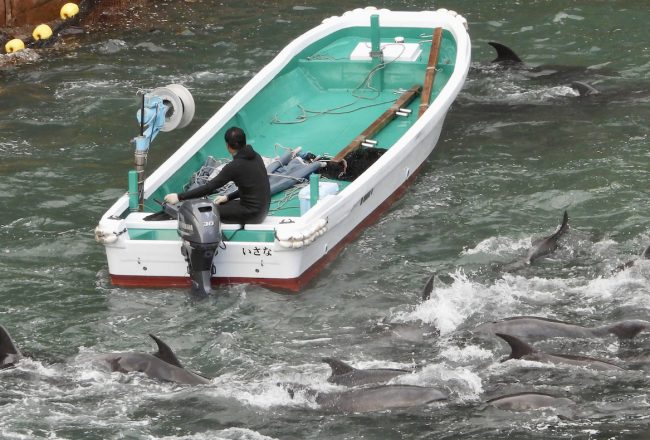
25 Dolphins Taken Captive as Taiji Hunts Begin
Beyond the Cove: How Captivity Sustains the Hunts