Let’s Never Forget Nephele
 24Apr
24Apr
Last month, we reported on the death of 40-year-old Nephele at Kolmården Zoo’s dolphin stadium in Sweden. She died by suffocation when a piece of artificial seaweed became trapped in her throat.
Nephele was captured in the Gulf of Mexico and sold to the Hagenbeck Zoo in Germany. She arrived there in April 1989 and became known as Cindy. Five years later, Hagenbeck Zoo sold her and another female dolphin, named Mandy, to Kolmården Zoo. When Cindy and Mandy arrived in Sweden in December 1994, that zoo renamed them Nephele and Delfi, [respectively]. According to online records, Delphi died in July 2007 while giving birth to a stillborn calf.
Nephele, too, was incorporated into Kolmården Zoo’s captive dolphin-breeding agenda and, according to the website Cetabase.org, gave birth to a female calf in August 2012. In August 2018, she gave birth to another calf, this time a male. Both of Nephele’s calves are reportedly still alive as of April 2024.
Two years ago, Kolmården Zoo announced it would finally close down its dolphin exhibit, which at the time held 12 dolphins. Two of them had been captured from the wild, and the others were born in captivity. It appears the zoo is having trouble finding new “homes” for its dolphins, and the zoo has yet to announce what will happen to them.
Nephele’s death is a glaring reminder why dolphins do not belong in concrete tanks in the first place. Nothing in these tanks even remotely resembles the vast ocean world they naturally belong to. The dolphins at Kolmården Zoo are trapped inside a lifeless and artificially lit amphitheater. And over the years, they have been continuously exposed to loud music and disco lights in rowdy Las Vegas-style shows that the zoo had clearly composed to provide guaranteed fun for paying spectators.
Ric and I visited the dolphinarium at Kolmården Zoo in 2015. Unlike at most other dolphinariums, the staff was willing to meet with us and discuss the animal welfare implications of incarcerating dolphins for life in chlorinated pools and using them as family entertainment. The dolphin tank was so heavily chlorinated, we could smell the chlorine as soon as we entered the stadium. Some of the dolphins had huge white patches on their skin, which was possibly the result of chlorine exposure. Kolmården’s research director insisted that the use of chlorine is not a problem for dolphins, and that dolphin shows are hugely educational. “If you want people to pay attention to a message about conservation, you need to add an element of fun to it,” he said. He also said there is no way to know if dolphins need the natural elements of nature to thrive, and he was convinced the dolphins at his zoo were thriving.
When we pointed out that the exposure to blinking disco lights is a stress factor for dolphins who cannot escape them, he said the lights were not a problem. He thought they probably even added a positive element to the dolphins’ lives, as the lights reminded them of the sun’s rays hitting the ocean’s surface. And when we reminded him that dolphins in tanks can’t even swim normally, he said most of the dolphins at Kolmården Zoo were born in captivity, and since they had no knowledge of the immensity of the ocean, how could they possibly miss it? We then pointed out dolphins are sonic creatures who constantly investigate their surroundings with sound, and they suffer when humans confine them in tanks where there is nothing to explore. His reply was that all we had to do was look at the dolphins’ high-speed enthusiasm during shows to see they were perfectly happy. There was simply no way to get through to him with the message that dolphins belong in the ocean, not inside a lifeless tank in a loud building with a cold metal roof over their heads.
But here we are, almost a decade later, and staff at Kolmården Zoo decided to add artificial seaweed to the dolphins’ tank. According to a Swedish news article, they wanted to give the dolphins some “environmental enrichment” by making their enclosure more stimulating and dynamic. So, without saying it directly, Kolmården Zoo has admitted what we tried to make them understand nine years ago: the dolphins’ living space is profoundly poor and severely lacking in anything that stimulates their natural desire to explore, and for this reason alone, confining them to tanks is wrong.
While cruising on the surface of the water, some wild dolphins use pieces of floating seaweed as a toy, carrying them around on their bodies as a way of engaging each other in play. Artificial seaweed, however, is a poor replacement for the real thing. It’s also a dangerous one since it constitutes an obvious choking hazard. Nephele’s yearning to investigate this new item in an otherwise barren concrete prison ended up causing her a painful and undoubtedly frightening death.
I encourage Kolmården Zoo to do more than simply express sadness that Nephele is now gone. That’s not enough. This is a dolphin that lost her life when she finally found something new and exciting to play with. But the new toy wasn’t even real. It was synthetic and hazardous. The zoo owes it to Nephele to openly admit it’s cruel to confine dolphins to lifeless tanks that are so far removed from the ocean world dolphins have evolved to roam. They should feel compelled to announce it publicly to make other dolphinariums hear the message.
It took Kolmården Zoo 53 long years of exploiting and breeding dolphins in tanks to realize the time has come to end this abhorrent exploitation of wildlife. Today, the European Union alone has more than 30 captive dolphin facilities. If Kolmården Zoo took responsibility for having helped make dolphin shows popular and issued a statement that it no longer supports the confinement of dolphins in tanks, it could contribute to the closure of some of them. They owe it to Nephele and the others to do everything in their power to try.
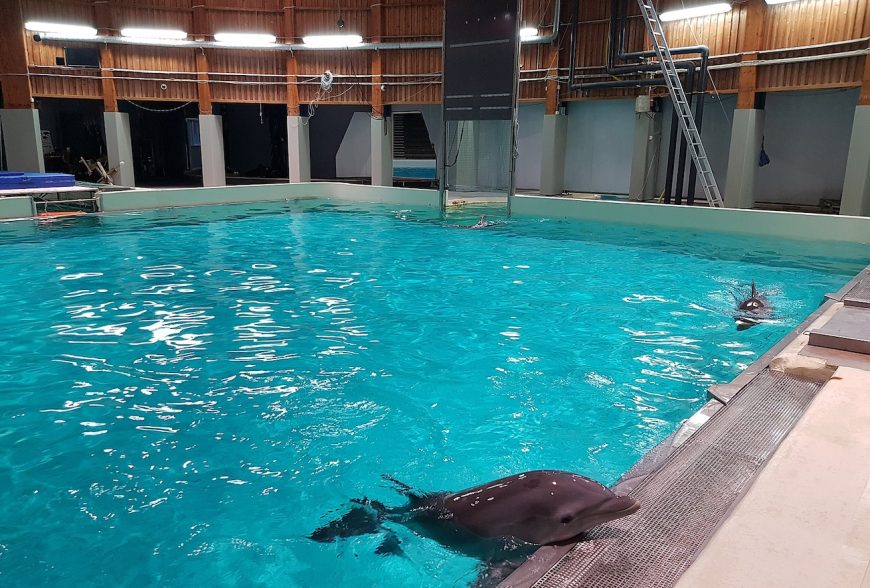
Featured image: Hundreds of dolphins around the world are trapped within the barren walls of concrete tanks. By human design and intervention, they will spend the remainder of their lives far away from their natural homes, with little to do and nowhere to swim to. Nothing in these lifeless confinements resembles the diverse ocean world they naturally belong to, and there is no way for them to express their innate abilities, such as foraging, navigating, and exploring. Kolmården Zoo, Sweden, Author: Kigsz, Licence: Creative Commons Attribution-Share Alike 4.0 International
Related

Related posts
Beyond the Cove: How Captivity Sustains the Hunts
Concrete in a Dolphin’s Mouth After Transfer