Marineland d’Antibes’ Cetaceans Deserve Better
 24Mar
24Mar
We are still trying to convince French authorities not to allow Marineland d’Antibes to sell its 12 bottlenose dolphins and two orcas, a female named Wikie and her son, Keijo, to captive dolphin facilities abroad. Marineland, located on the French Riviera, closed its doors in January this year after authorities declared they would no longer allow the captive breeding and commercial exploitation of orcas and other dolphins.
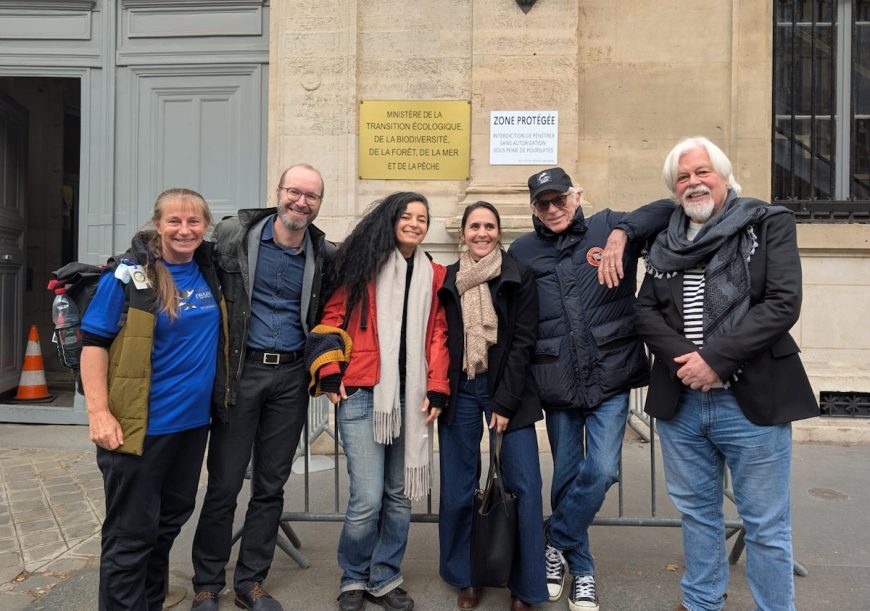
Dolphin Project Founder/Director Ric O’Barry has recently participated in meetings with French Minister for Ecological Transition Agnès Pannier-Runacher, Lamya Essemiali of Sea Shepherd France, Captain Paul Watson, marine biologist and orca expert Ingrid Visser from New Zealand, French wildlife sanctuary expert Delphine Ronfot, and German veterinarian Dr. Jan Schmidt Burbach of World Animal Protection Denmark. The purpose of the meetings was to discuss the future of the orcas and bottlenose dolphins currently held at Marineland.
Our aim is to convince authorities to allow them to retire in sea sanctuaries where non-releasable dolphins can live out their lives with some much-deserved quality, without ever again having to entertain spectators for food rewards of dead fish. Predictably, Marineland is seeking for them to remain within the archaic structure of its own industry.
This is the same problem that arises every time a dolphinarium finally closes. The closure is a victory, because it means one less facility where dolphins are exploited for tourists, but it doesn’t change anything for the dolphins that are sold to another bleak concrete theater abroad, where the exploitation continues.

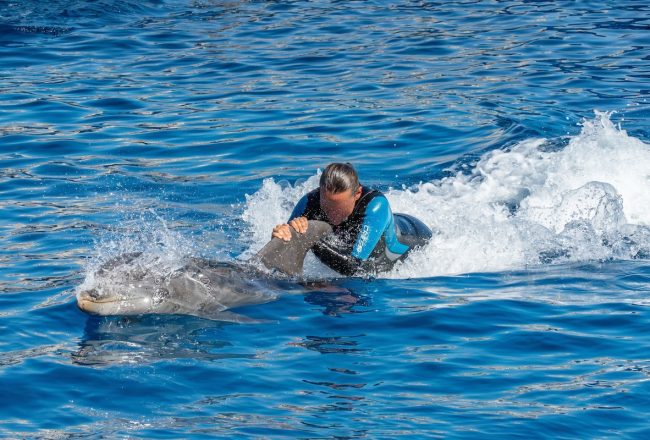
Marineland in Antibes, France no longer has any use for its bottlenose dolphins and reportedly wants to sell them to the dolphinarium industry abroad, possibly China. They seem determined to make sure the dolphins remain within the same archaic structure of their own industry. even though retirement in ocean sea pens is a much more humane option. Credit: Author-DimiTalen, License-Creative Commons CC0 1.0 Universal Public Domain Dedication
That is precisely what happened to the dolphins Spain’s Madrid Zoo recently sold to a dolphinarium in Hainan, China, where there are no animal welfare laws to protect them. At some point, Marineland sought to send Wikie and Keijo to the Kobe Suma Aquarium in Japan, but authorities fortunately would not issue the permit needed to complete the transfer.
There are reports that Marineland now wants to send the orcas to the notorious orca exhibit at Loro Parque in Tenerife, Spain, where orcas are heavily promoted as “must-see” tourist attractions. Four orcas have died at Loro Parque’s orca stadium in the last four years. Today, just three remain: Tekoa, a male orca sent there from SeaWorld, USA in 2006 together with three other young orcas who have since passed away; Adán, a male orca born at Loro Parque as a third-generation orca; and Morgan, a once-wild female orca found alone and malnourished off the coast of Holland in 2010 who is believed to belong to a community of orcas in Norway.
Loro Parque recently announced that Morgan is pregnant with her second calf. Her first calf, a female named Ula, died in August 2021, about a month before her third birthday.
If Wikie and Keijo, who are second- and third-generation orcas of Icelandic descent, end up at Loro Parque, they will no doubt be incorporated into the zoo’s highly controversial breeding program and made to perform for crowds of tourists, just like the others. These are the exact two consequences the French government no longer wants to see happen to orcas.
Marineland in France has exploited orcas and bottlenose dolphins for decades. Of the 12 bottlenose dolphins currently held there, two were captured from the wild (Cuba and the USA) during the 1980s. The remaining 10 were born in captivity, either at Marineland or at a captive dolphin breeding facility in Spain.
According to the Cetabase website, 34 bottlenose dolphins have died at Marineland. (This number includes one stillborn calf.) Of these, 23 had been captured from the wild, in either the USA or Guatemala.
Marineland’s history with orcas is equally sinister. From 1970 to 1990, Marineland purchased eight wild-caught orcas: one from Canada, one from the USA, and six from Iceland. From 1993 to 2013, six live orcas, all Icelandic, were born at Marineland. Marineland kept five of them and in 2002 sent a female named Shouka to the USA to perform there.
This was the second time that Marineland would send one of its orcas abroad. In November 1995, Marineland sold wild-caught Tanouk (captured in Iceland in 1989) to an amusement park in Japan, where he died five years later.
Since Marineland’s orca exhibit opened in 1970, 10 orcas have perished there. The last surviving orcas at Marineland were born at the stadium. Wikie, born in June 2001, is the daughter of two wild-caught Icelandic orcas, and Keijo is her son, born in November 2013.

Morgan, who is pregnant for the second time, entertains the cheering crowds during a performance at Loro Parque in Tenerife, Spain. She is frequently ordered by trainers to exit the water and expose her entire body on the concrete floor, much to the delight of spectators who use her as an entertaining photo opportunity. If Marineland’s Wikie and Keijo end up here, they, too, will no doubt be used as breeders and entertainers. Credit: Helene O’Barry
It is not surprising that Loro Parque wants to get a hold of Wikie and Keijo, considering the facility has lost four orcas in just four years. Securing more trainable orcas through captive breeding is essential to keeping the popular shows going far into the future. Just one female (Morgan) is probably not enough to achieve that goal, especially if her offspring dies young, as Morgan’s daughter, Ula, did.
But breeding orcas and bottlenose dolphins in tanks is cruel, and we urge the French authorities to prohibit it. If Marineland, the French authorities, and the international animal welfare community work together, we can create ocean sanctuaries for them, right here in Europe.
We hereby urge the French authorities to help stop the cycle of cruelty by ensuring the orcas and bottlenose dolphins Marineland is now seeking to get rid of can live out their lives close to nature rather than continue to be enslaved as performers in concrete stadiums abroad.
Featured image from left to right: Ingrid Visser, Jan Schmidt Burbach, Lamya Essemiali, Delphine Ronfot, Ric O’Barry, and Paul Watson. Credit: Sea Shepherd France

Related posts
Beyond the Cove: How Captivity Sustains the Hunts
Concrete in a Dolphin’s Mouth After Transfer