Morgan Gives Birth for a Second Time
 31Mar
31Mar
Loro Parque in Tenerife, Spain announced on its website on March 31st that Morgan has given birth. They believe the calf is a male but are not 100 percent certain yet. On its website, Loro Parque says: “We’re happy to inform that Morgan’s baby has been born, and to ensure the well-being of mother and calf, the presentation is temporarily suspended.”
This is Morgan’s second calf since the Harderwijk dolphinarium in Holland sent Morgan, who once belonged to a community of orcas in Norway, to Tenerife, Spain in 2011. She has entertained crowds of fun-seeking holiday makers at Loro Parque’s small show stadium ever since. Her first calf, a daughter named Ula, died in August 2021, about a month before her third birthday. So far, all three calves that came into this world at Loro Parque’s dreary orca stadium were separated from their mothers shortly after birth to be raised by trainers. Back in 2018, when Ula was born, Loro Parque said Morgan did not produce enough milk for her daughter and therefore had to be separated from her, so that humans could feed her instead. An eye witness told me at the time that Ula spent a large portion of her early life confined in the stadium’s medical tank, bonding with her trainers instead of with Morgan. It remains to be seen if the same will happen to Morgan’s new calf. Hopefully, the two will be allowed to remain together.

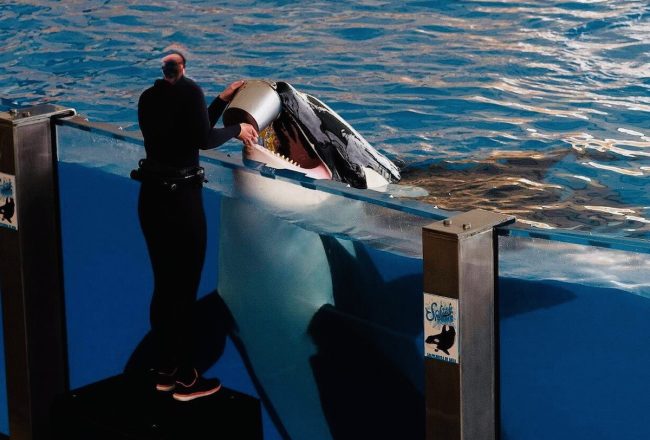
With the passing of Skyla, Ula, and Kohana during 2021 and 2022, Morgan has become the sole female orca left at Loro Parque in Tenerife, Spain. To Loro Parque, she no doubt has tremendous value as a breeder, and with the birth of a (presumed) male calf on March 31st, it will be the second time Morgan has faced the problematic task of raising a calf inside a miniscule show stadium. Her first calf died in 2021 just short of her third birthday. Credit: Helene O’Barry
As a result of Loro Parque’s controversial and highly unethical breeding program, yet another orca has been sentenced to life-long confinement in a minuscule show stadium where he will never be able to swim normally or put any of his natural abilities to any real use. When he is old enough to undergo training, he will no doubt be programmed to respond to his trainers’s commands and fulfill his role as a compliant performer, just like Morgan, Adán, and Tekoa. I predict that Loro Parque will never stop breeding its orcas, as long as tourists continue to buy tickets to watch them perform. Having a small orca calf on display at the stadium will attract even more visitors, and Morgan’s son, too, will be heavily promoted as a “must-see” tourist attraction for as long as he is alive.
The exploitation and captive breeding of orcas must stop once and for all.
TAKE ACTION NOW ➡️ Please SIGN THIS PETITION to ask TUI to stop promoting and selling tickets to Loro Parque.
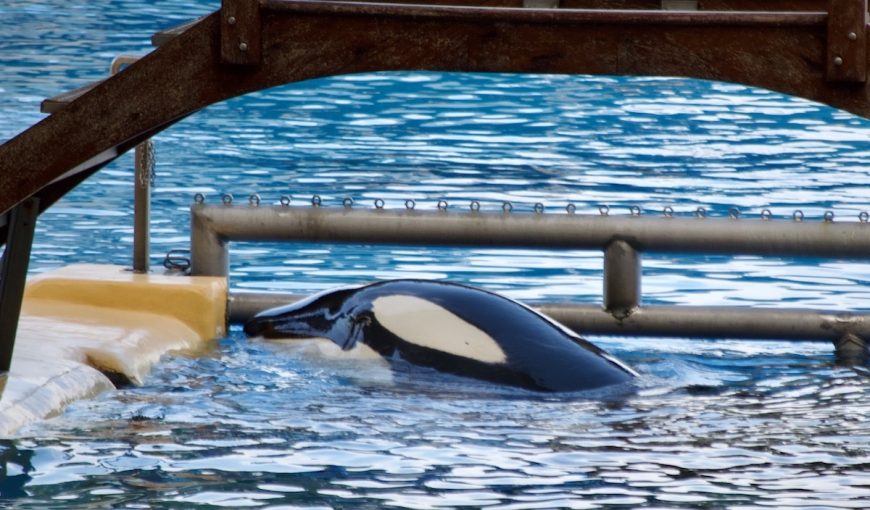
Featured image: Morgan is believed to belong to a community of orcas in Norway. When, on June 24, 2010, she was found dehydrated and malnourished off the coast of Holland, staff from Harderwijk dolphinarium brought her ashore and placed her in one of their tanks. In 2011, a judge ruled that she should be sent to Loro Parque, and she arrived there on November 29th that year. She has lived there since, and a team of trainers has successfully shaped her into a performer, just like the others. Her new calf, too, will no doubt be incorporated into shows as soon as he can be trained to follow his trainers’ commands. Credit: Helene O’Barry

Related posts

Wikie and Keijo: From One Tank to Another?

Wikie and Keijo May be Sent to Loro Parque