
Morgan’s Monotonous Existence at Loro Parque
 18Dec
18Dec
With the passing of Skyla, Ula, and Kohana during 2021 and 2022, Morgan has become the sole female orca left at Loro Parque in Tenerife, Spain. She performs in daily shows alongside Keto, Tekoa, and Adán, and hardly a day goes by that I don’t worry about an announcement from Loro Parque that she is pregnant. If that happens, it will be the second time Morgan has faced the problematic task of raising a calf inside a miniscule show stadium.
Morgan is believed to belong to a community of orcas in Norway. When, on June 24, 2010, she was found dehydrated and malnourished off the coast of Holland, staff from Harderwijk dolphinarium brought her ashore and placed her in one of their tanks. In 2011, a judge ruled that she should be sent to Loro Parque, and she arrived there on November 29th that year. She has lived there since, and a team of trainers has successfully shaped her into a performer, just like the others.

Morgan performs alongside now deceased Kohana during a show in 2021. The Blackfish-effect unfortunately doesn’t seem to have reached Tenerife, and bleachers were packed during all three shows that day. Crowds of tourists buy tickets to orca shows with one goal: to have fun and be entertained. Watching orcas jump and dance on command fits the bill perfectly. And when the music stops and the show is over, spectators leave the theater and move on to their next holiday adventure, oblivious to the display of human supremacy they have just witnessed and applauded.The orcas, of course, are stuck in these tanks and never get to leave. They can’t ever go home. Their journey stagnates right here, within the barren walls of lifeless, barren concrete tanks. Credit: Helene O’Barry/Dolphin Project
On September 22, 2018, Morgan gave birth to a daughter, and Loro Parque named her Ula. According to a blog that Loro Parque posted on its website on July 15, 2020, DNA tests confirmed that Ula’s father is Keto. He is reportedly also the father of Adán, who was born on October 13, 2010, and Vicky, who was born August 3, 2012, and died ten months later, on June 16, 2013. Adan and Vicky’s mother is Kohana, who is now deceased. Kohana was Keto’s niece, which makes Adán and Vicky inbred. Keto, who was born at SeaWorld Orlando June 17, 1995, is 75 percent Icelandic and 25 percent Southern Resident. So Ula was 50 percent Norwegian, 37.5 percent Icelandic, and 12.5 percent Southern Resident. The enormous ethical implications of producing hybrid orcas that never would exist if nature had its way does not seem to bother Loro Parque, just like it never bothered SeaWorld.
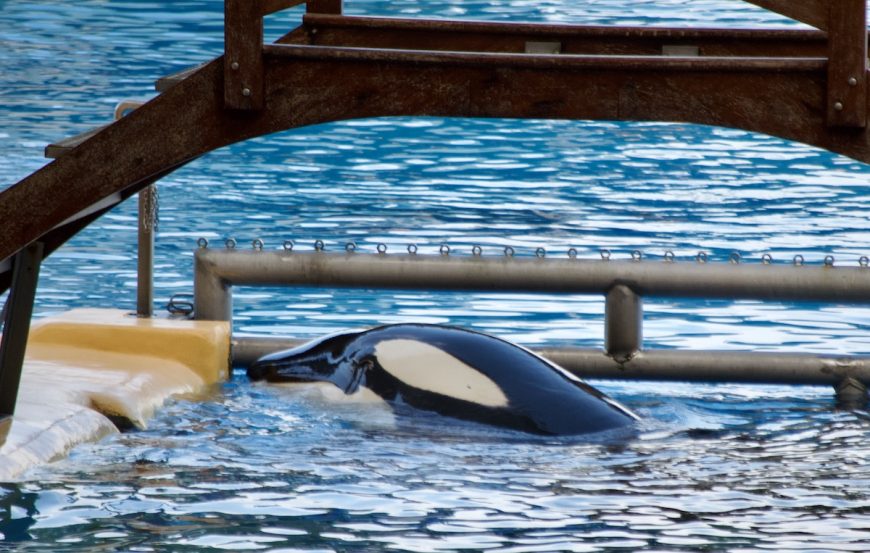
Morgan has been through a lot, and when I saw her during the summer of 2023, I got the impression she was tired. (Whether it was just on that particular day, I can’t say.) She was logging at the show pool’s glass wall prior to the show while tourists lined up to take selfies with her. During the performance, she compliantly followed her trainers’ commands and beached herself on the concrete slide-out for photo ops. Her trainer rewarded her with some fish and gelatin. I got the feeling the monotony of life in such a barren living space, where she can’t even swim normally, is wearing Morgan out. If that’s the case, it’s no wonder. She has been trapped there for more than a decade, and the boredom must have become excruciating as time has gone by.

During shows, trainers instruct Morgan and Keto to beach themselves onto the concrete platform. While the loud music is playing, they shake their heads vigorously with their mouths wide open. This makes their tongues shake from side to side, giving them a rather silly look. Spectators, of course, find the “dance” comical, and the entire stadium erupts into laughter and applause. Training captive orcas to act like this teaches the audience respect for nature, according to the dolphinarium industry. Credit: Helene O’Barry/Dolphin Project
Loro Parque still promotes Morgan as the star of the show and gives audiences a rather rosy account of how she became theirs, as if Morgan’s life story turned into some kind of fairytale with a happy ending. (They call it “the great rescue story that brought her here.”) From Morgan’s perspective, however, the story of how she got lost is not great at all, and the happy ending has never come. After all these years, she remains trapped in a theatrical show stadium hundreds of miles away from home. Because she is confined in such a small space with three males, the likelihood of her becoming pregnant again is high, but I’m still hoping it won’t happen. Morgan never should have been transformed into an entertainer, nor should her role in life be that of providing Loro Parque with offspring that are destined to spend their entire lives performing for crowds of tourists.
How you can help – TUI – Petition: Ask TUI to Stop Selling Tickets to Dolphin Shows
Featured image: The stadium presents Morgan’s rescue story to spectators by displaying various drawings and text on the stage backdrop: “We want to share with you all the great story that brought her here,” the text reads. Loro Parque goes on to say that Morgan’s family, unfortunately, was never found, and she cannot be returned to the sea. Credit: Helene O’Barry/Dolphin Project

Related posts

Wikie and Keijo: From One Tank to Another?

Wikie and Keijo May be Sent to Loro Parque
