Morgan’s New Calf Faces Life of Restraint
 10Apr
10Apr
Loro Parque in Tenerife, Spain, has confirmed that Morgan’s new calf, born on March 31, is a male. In a pinned Instagram post, the Spanish Zoo, where orcas, bottlenose dolphins, and sea lions are used in daily shows, describes the calf’s arrival: ”Big news from Loro Parque! At 5:00 a.m. this morning, Morgan gave us an incredible gift: her baby was born!” I think there is something incongruous about the wording. To claim the new calf is Morgan’s “gift” to Loro Parque implies ownership. I suspect this is how Loro Parque feels about all four orcas at their exhibit: They are their property, and they can govern their lives in ways that suit them, even if that means producing orcas that will never experience nature for as long as they live.
Unlike the other three calves that were born at Loro Parque since the orca exhibit opened in 2006, Morgan’s son has not been separated from his mother. When Morgan gave birth to a daughter in 2018, Loro Parque separated them so that trainers could start feeding the calf. They did this because Morgan was not producing enough milk. Thankfully, this time appears to be different, and Loro Parque has released a video that shows Morgan and her beautiful newborn calf in one of the pools at the stadium.
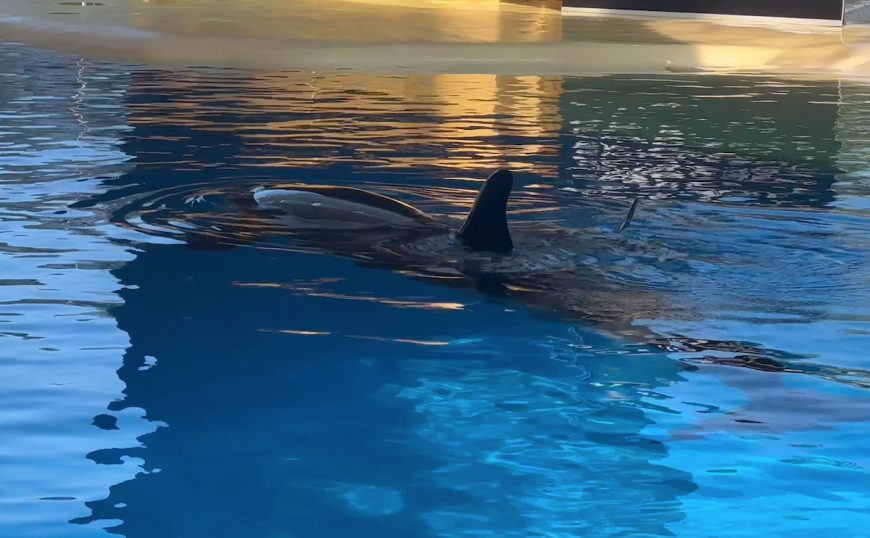
In the video, Morgan and her son are swimming together. The calf knows to position himself right next to Morgan and moves his small tail flukes up and down with such enthusiasm, as if he thinks that he and his mother are going to swim in a straight, uninterrupted line, side by side. For a moment, while the walls of the tank are out of the frame, it looks like they are traveling out in the open sea.
They aren’t, of course. They are walled in on all sides. Their habitat—if one can even call it that—is grotesquely small. Despite his boisterous energy and zest for life, Morgan’s calf is destined to swim in closed circles forever, going nowhere, just like his mother and the others.

According to an eyewitness, Morgan and her new calf spend a lot of their time swimming in circles in the show pool at Loro Parque’s orca stadium. Credit: Susan Stevens
I imagine it might take a while before he realizes that this small, dreary space is not the beginning of something bigger. He will never know what a real wave feels like, nor will he experience the thrill of using his speed, intelligence, and ability to cooperate and plan ahead to catch live prey. Morgan’s calf will never use his sonar to explore a vast ocean world filled with diversity, challenges, boundless activities, and a real purpose. This little orca is built to travel, and he is built to one day become the ocean’s most dominant hunter, but by human design, he will never experience either one of those.
When he is old enough, trainers will begin shaping his behaviors and molding him into a compliant performer, just like they did with Morgan and her first calf, a female named Ula, who was born in 2018 and died in 2021, just four weeks before her third birthday.
As time goes by, Morgan’s son will realize how the system works, with his days filled with repetitive performances, training sessions, cheering audiences, and not enough space to swim. As he grows larger, the show stadium will seem smaller and smaller. He might experience the strong urge to break free and keep on swimming far past the iron gates and concrete walls, but that urge will never be fulfilled. Not once in his life will his sleek and torpedo-shaped body travel fast and unhindered through the ocean’s ever-moving currents, and I wonder how many hours of his life will be spent staring at a concrete wall or logging lethargically by one of the gates, waiting for something out of the ordinary to finally happen, waiting for a change.
But that change will never come. This ugly concrete theater is the only world this beautiful being will ever experience. It’s nothing but a lifeless concrete box where he has no choices over his life, and crowds of tourists line up to gawk at him through the glass.
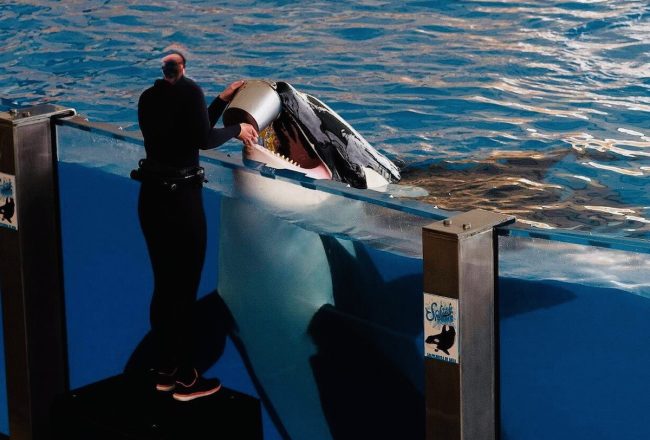
Morgan’s son will most likely be trained to beach himself onto the hard concrete slide-out and maybe, when he is bigger, trainers will make him use his tail-flukes to splash cascades of water onto rows of tourists seated in the splash-zone, just like they did with now deceased Keto who sired Morgan’s daughter, Ula.
Morgan’s son was born into a world where wildlife is paraded on a stage, much to the delight of the island’s many holiday makers, and his primary role in life will be that of pleasing crowds of spectators under the hot sun, surrounded by souvenir shops and food stands.
Even though he was born an apex predator, he will never learn how to hunt, but he will learn to spin around on command, and trainers will feed him dead fish as rewards when he does it correctly. He will be programmed to move his flippers up and down while swimming on his side along the perimeter of the show tank, and spectators will assume he is waving at them, and they will think it’s endearing and feel some kind of sentimental connection that isn’t there.
He might be trained to shake his head quickly from side to side while lying stranded on the platform, completely exposed and available for photo-ops. I have seen Morgan and the others perform that demeaning head-shaking trick, and spectators immediately erupt into hysterical laughter at the sight of orcas whose tongues are dangling quickly from side to side, in a silly sort of way, while the happy holiday music is playing. This is what awaits Morgan’s new calf. This will be his life.

Morgan is believed to belong to a community of orcas in Norway. She somehow became separated from her pod and was found alone and malnourished off the coast of the Netherlands in June 2010. She was taken to Harderwijk dolphinarium and held there for over a year. In November 2011, after a Dutch court decided that returning Morgan to her family was not possible, Morgan was sent to Loro Parque’s orca stadium on the Spanish island of Tenerife. She has lived there since then and performs daily in front of mainly European holiday makers. In September 2018, Morgan gave birth to a daughter, named Ula, but the calf died just short of her third birthday in August 2021. On March 31, 2025, Morgan gave birth to a son, and it is only a matter of time before he, too, will be used in performances. Credit: Helene O’Barry
As a result of Loro Parque’s conviction that breeding hybrid orcas in tanks can be labeled as “conservation,” Morgan has given birth twice since she arrived at the stadium in 2011, first to a daughter, who is now dead, and recently to a son. But breeding one of the ocean’s most powerful top predators in small concrete theaters and advertising them as “must-see” attractions is both self-serving and unethical. Morgan never should have been transformed into a tourist magnet, nor should her role in life be that of providing Loro Parque with offspring destined to spend their entire lives performing on a stage. I can’t help but wonder: How many more calves will Morgan’s body have to produce and present as “gifts” to her human keepers before Loro Parque is finally satisfied? When will enough be enough?
Featured image: Morgan has given birth twice since she arrived at Loro Parque in 2011, first to a daughter, who is now dead, and recently to a son. How long will it be before trainers start the process of shaping Morgan’s second offspring into a performer, just like they did with her daughter Ula? Credit: Susan Stevens

Related posts

Wikie and Keijo: From One Tank to Another?

Wikie and Keijo May be Sent to Loro Parque