Ocean Just Out of Reach for Stella and Ran
 12May
12May
The show stadium at Kobe Suma SeaWorld in western Japan has been built right next to the Pacific Ocean, within the orcas’ view when they jump on command. They can undoubtedly hear it, too, when there is no music playing, and the sound of applauding audiences has died down. The orcas are named Stella and Ran. Stella was wrestled from her mother off the coast of Iceland when she was about a year old. Ran is her 19-year-old daughter who was born in captivity.
Stella’s days of freedom came to a halt in October 1987 when a capture crew encircled her and her pod with a purse seine net and hauled her and three other young calves onto the deck of the boat. The capture team transported them to the Hafnarfjörður Aquarium in southern Iceland. This is where orca traders warehoused newly caught Icelandic orcas until buyers were found. Stella and the other calves, who became known as Bubba, Maggie, and Oscar, were locked up at Hafnarfjörður Aquarium for five months until, on March 29, 1988, they were loaded into transport boxes and flown to Japan. Their destination was Kamogawa SeaWorld in Chiba Prefecture.
Bubba, Maggie, and Oscar died in 1991, 1997, and 2012, respectively. During her 38 years of confinement, Stella, who is the oldest captive orca in Japan, has performed at three different amusement parks and, from 1998 to 2012, provided the country’s aquarium industry with five offspring, all sired by an Icelandic orca named Bingo who was captured in November 1984.

Stella and her 19-year-old daughter Ran perform at Kobe Suma SeaWorld in Japan five times per day. Stella, who was captured off the coast of Iceland in 1984, has provided the Japanese amusement park industry with five female offspring. Four of her daughters are still alive, but she only lives with one of them. Credit: Life Investigation Agency (LIA)
Stella’s life has been marked by forced separations from family members and numerous transports among Japan’s aquariums. She spent the first 23 years after her capture at Kamogawa SeaWorld, which is the first facility in Japan to breed captive orcas. She gave birth to a daughter in January 1998. The calf, named Lovey, was the first successful orca birth at a Japanese aquarium. Stella’s second daughter, Lara, was born in February 2001. Her third offspring, a female named Sarah, was born in May 2003 and died in April 2006. In February 2006, Stella gave birth to her fourth calf, a daughter named Ran.
In October 2008, Stella became a grandmother when Lovey gave birth to a son named Earth. Earth’s father is now-deceased Oscar, who was captured in Iceland at the same time as Stella was.
In December 2011, Stella, Bingo, and Ran were uprooted and sent from Kamogawa SeaWorld to Port of Nagoya Public Aquarium in Aichi Prefecture. The transfer separated Stella from her daughters, Lovey and Lara, and from her grandson, Earth, and Ran from her two sisters and nephew. The following year, in July 2012, Stella became a grandmother for a second time, when Lovey gave birth to a daughter named Luna. Luna, too, was sired by Oscar. Stella has never seen her.
In November 2012, Stella gave birth to her fifth calf, a daughter named Rin, who was sired by Bingo. Bingo died at the Nagoya Aquarium in August 2014 after spending 30 years in captivity.
In December 2015, the Nagoya Aquarium sent Ran back to Kamogawa SeaWorld, leaving Stella and Rin behind. On that same day, Kamogawa SeaWorld separated Earth from his mother, Lovey, and sent him from Kamogawa SeaWorld to Nagoya Aquarium, permitting Stella to see her grandson, Earth, for the first time.
In March 2024, Stella was separated from Rin and Earth and sent to Kobe Suma SeaWorld. Her daughter, Ran, arrived at Kobe Suma SeaWorld from Kamogawa SeaWorld the following month, and they saw each other for the first time since they had been separated eight years earlier. Today, Stella lives without three of her daughters, and she lives without her two grandchildren. The only family member she has left for company is Ran.

Today, Japan has three display facilities that exploit orcas in commercial shows: Kamogawa SeaWorld in Chiba Prefecture, Port of Nagoya Public Aquarium in Aichi Prefecture, and Kobe Suma SeaWorld in Hyōgo Prefecture. Combined, they keep seven orcas captive. Wild-caught Stella and her daughter Ran perform at Kobe Suma SeaWorld. Stella’s daughters Lara and Lovey (who is mother to Stella’s grandchildren Earth and Luna) perform at Kamogawa SeaWorld together with Luna. Stella’s daughter Rin (also known as Lynn) and her grandson Earth perform at Port of Nagoya Public Aquarium. Credit: Life Investigation Agency (LIA)
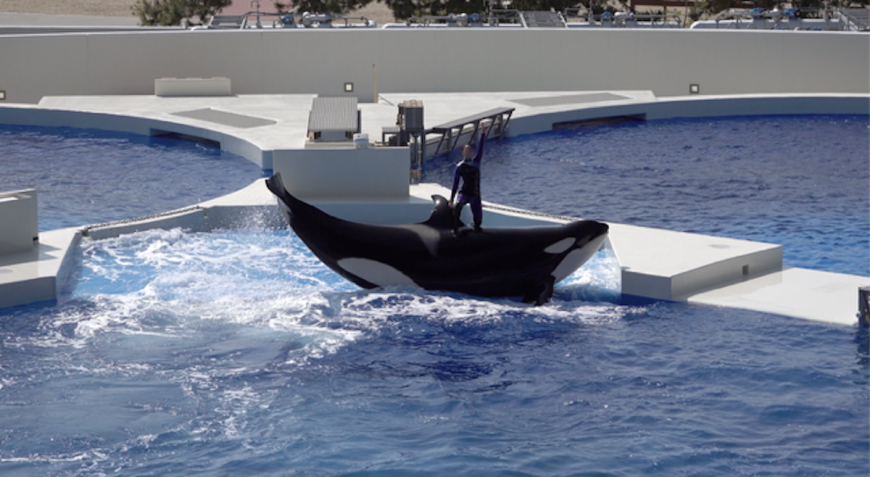
Ren Yabuki, who works with the Japanese animal rights organization Life Investigation Agency (LIA), recently visited Stella and Ran at Kobe Suma SeaWorld to document their poor living conditions. (He received an invitation from Kobe Suma SeaWorld and went in without having to buy a ticket.) The orca stadium at Kobe Suma SeaWorld, which seats 2,500 spectators, opened to the public on June 1, 2024. Ren was disheartened when he saw how many people had purchased tickets. The stadium was full. He sent me a video of the show, and it’s the usual sad scene with trainers ordering orcas around on a stage while happy music is playing. Stella and Ran swim along the perimeter of the tank while waving at spectators with their pectoral fins. Two female trainers, dressed in black-and-purple dry suits, dance on the stage, wearing plastered-on smiles and throwing dead fish to the orcas each time they perform a trick correctly. Spectators laugh as the orcas obediently splash water on the front rows with their tail flukes, while the sound of Taylor Swift’s hit song, “You Belong With Me,” plays through the sound system. At some point, one of the trainers jumps into the tanks and climbs onto Stella’s back and rides her around the tank. Then the other trainer crawls onto Ran’s back and starts riding her, too. The spectacle, which is repeated five times a day, ends with Stella beaching herself onto the concrete platform with her trainer balancing on her back. This is Stella and her daughter’s life—being used as ride-on toys in a Japanese amusement park, thousands of kilometers away from their natural home range in Iceland.
I asked Ren what it was like to see Stella and Ran perform. He answered: “Seeing them in person evoked many emotions. It would in any activist who wants to see orcas live in the ocean, wild and free. During the show, I thought about how frustrating it must be for them to be locked up in a small and lifeless tank and have to jump and spin around on command over and over. I think they experience a lot of boredom and mental pain as a result of how humans treat them.”
I also asked Ren what can be done to educate consumers in Japan about the suffering of captive orcas. He responded: “Kobe Suma Sea World is not an educational facility at all. It’s an amusement facility, just like Disneyworld, where orcas, bottlenose dolphins, and other animals are exploited as family fun. Humans crave entertainment, which makes this kind of animal exploitation difficult to end. But we can never give up. We need to make people understand that orcas do not thrive in tanks, and that their role in life should not be to amuse us.”
Ren described to me that Stella and Ran can sometimes be heard vocalizing during the night after their trainers and audiences have left the stadium. It makes me wonder if they are trying to connect with some other lifeforms out there. Perhaps Stella still remembers aspects of the freedom she enjoyed before humans dragged her into show business. And perhaps Ran intuitively knows that she was meant to live a very different kind of life. The vast expanse of the ocean is right there in front of them, but they can never reach it, and no matter how far their cries and whistles carry through the depths of the water, they will never receive a response.
References:
Killer Whale Wiki
Ceta-Base
Featured image: Stella, who is pictured here with a dominant trainer standing on her back, is one of the last three survivors of the more than 50 wild-caught orcas that were flown out of Iceland during the ’70s and ’80s. The other two are female orca Katina who was captured in 1978 and performs at SeaWorld in Orlando, and a male called Ulises, who was captured in 1980 and performs at SeaWorld in San Diego. Credit: Life Investigation Agency (LIA)

Related posts

Wikie and Keijo: From One Tank to Another?

Wikie and Keijo May be Sent to Loro Parque
