One Dolphin’s Story: Adán
 11Nov
11Nov
Adán was born at Loro Parque, Tenerife, on October 13th, 2010.
His mother, Kohana, was only eight years old when she gave birth to him, making her one of the youngest captive orcas ever bred—at an age when wild orcas are still learning from their families, not raising calves of their own. His father, Keto, was Kohana’s half-uncle, meaning Adán was inbred by design, a genetic compromise driven by the demands of the captive orca entertainment industry.
From the very beginning, Adán faced what no orca calf should: abandonment. Kohana showed no maternal interest in him, perhaps because she herself had been separated from her mother as a young calf, when she was sent from SeaWorld in the United States to Tenerife. Instead of learning from his mother in the comfort of a bonded pod, Adán was bottle-fed and hand-raised by humans, adapting the best he could to an artificial world of shows and applause, completely detached from the ocean, its rhythms, and its culture.
As he grew, Adán became part of a man-made collection of orcas, all but one born in tanks, cobbled together not by nature, but by corporate decisions. Among them was Morgan, rescued from the Wadden Sea in Holland and never returned to the wild, and older orcas like Keto, Kohana, Skyla, and Tekoa, who had all been shipped to Loro Parque’s newly built concrete amphitheater from SeaWorld in 2006.

In 2006, SeaWorld sent four orcas to Loro Parque on a so-called breeding loan, including relatives who would never breed in the wild. Skyla, Kohana, and Keto have since died. As part of Loro Parque’s controversial breeding program, Kohana mated with her half-uncle Keto; both calves were rejected and hand-raised by humans. Adán, pictured here with his trainer, has spent his entire life performing as a “must-see” tourist attraction in Tenerife, Spain. Credit: Helene O’Barry
Adán has seen death up close many times. His only full sibling Victoria—nicknamed Vicky—who was reportedly also inbred, died before reaching her first birthday. Like Adán, she was rejected by their mother Kohana, who seemed unable to cope with the role of motherhood. Others in his enclosure—Skyla, Kohana, and Morgan’s young calf Ula—are also gone now. In November 2024, Keto died as well. One by one, several of his tankmates have disappeared.
These losses are not mere statistics. For orcas, who are highly social beings with strong emotional bonds and long-term memory, this is trauma. It is grief without end, compounded by the stress and monotony of captivity.
Adán is still alive today. He lives with three other orcas: Tekoa, Morgan, and Morgan’s eight-month-old son, Teno. He continues to perform for crowds, day after day, as music blares and trainers signal commands from the poolside. I get the impression he has a close bond with certain tankmates—Morgan for instance—and while these connections no doubt mean a great deal to him, they are also likely his only comfort within the bleak confines of captivity.
In nature, orcas travel vast distances, dive deep, hunt cooperatively, and pass knowledge across generations. They are cultural beings. But Adán was born into an unnatural world of show business, trained to perform for tourists, and raised by humans amid concrete, glass, and repetitive routines. These abnormal conditions have molded his behaviors, and his entire experience of life.

Adán looks through the glass, waiting for a handful of fish to be handed to him by a human trainer – a surreal scene for a creature built to roam the oceans, hunt live prey, and live freely. Credit: Helene O’Barry
I share Adán’s story to raise a deeper question: What have we done to beings like him? Adán is not “just an orca at Loro Parque.” He is a sentient being whose entire life has been shaped by our choices to confine, to breed, to display, and to use as entertainment. If we understand his history, his losses, and his restraints, perhaps we can begin to see why the time has come to challenge the very practice of orca captivity. Because when an orca like Adán spends his entire life cut off from the sea and surrounded by barriers, what is taken from him is not just his freedom but also the chance to live a life of purpose, as nature intended.
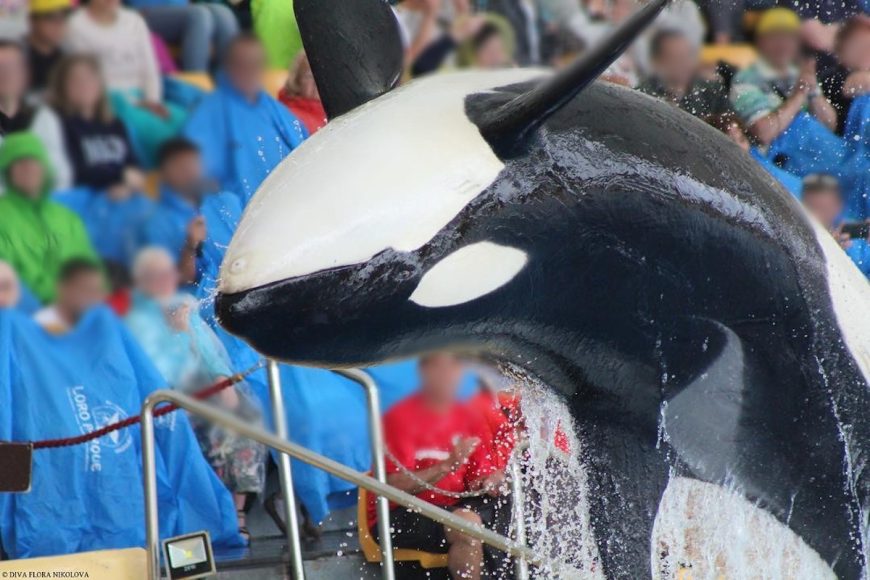
Featured image: Born in a tank and raised by humans, Adán has never chased a live fish or felt the pull of the ocean. His entire life will be spent performing in a concrete amphitheater built to entertain tourists. This small, artificial world of music, commands, and applause is all he will ever know. Credit: DIVA FLORA NIKOLOVA, www.inherentlywild.co.uk

Related posts
Beyond the Cove: How Captivity Sustains the Hunts
Concrete in a Dolphin’s Mouth After Transfer