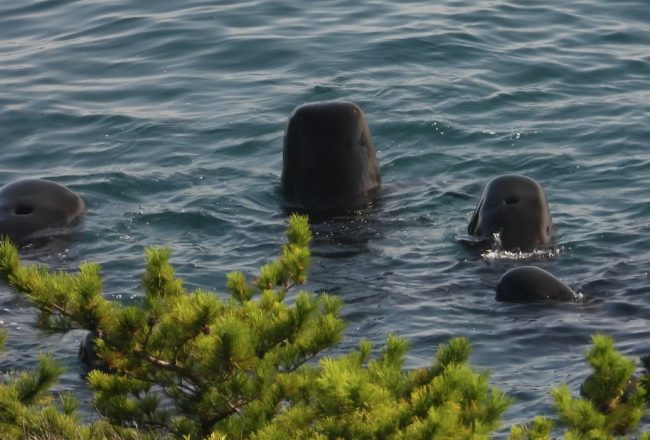
One Dolphin’s Story: Bimbo
 07Jun
07Jun
Quick Facts
Caught: January 21, 1959, near Catalina Channel, California
Released: Late July/early August 1967
In a time when SeaWorld was still years away from being developed, Marineland of the Pacific was the golden star of the marine park world. Situated in Palos Verdes, an hour’s drive away from downtown Los Angeles, it opened August 28th, 1954 and would operate for the next three decades as the West coast’s most popular marine park.

Aerial view of Marineland of the Pacific, 1963. From Los Angeles Public Library’s Security Pacific National Bank Photo Collection.
At this point, the biggest marine mammals ever kept in captivity were the gregarious short-finned pilot whales. On February 27, 1957, Marineland of the Pacific made history when the forefathers and crew captured a female pilot whale alive, and brought her back to the park. Sharing her new tank with several Pacific white-sided dolphins, she proved to be a huge box office draw, and was named Bubbles in a children’s contest.
After surviving her first year in captivity, Bubbles would go on to swallow one of her toys, a rubber inner tube. Refusing to perform and ‘off her feed,’ caretakers gave her large quantities of mineral oil-injected fish squid and anchovies as an experimental treatment. Fearing her impending death, the Marineland team headed out to sea once more to find a replacement. On June 26, a young female pilot, dubbed ‘Squirt,’ was lowered into the newly constructed Sea Arena. The worst never came to pass, as Bubbles regurgitated the inner tube twelve days later (still inflated). She was then moved to the Arena, along with newcomer Squirt.
[/vc_column_text][/vc_column][/vc_row]While a song and dance of lightning-fast Pacific white-sided dolphins and hat-toting, twirling pilot whales kept the crowds coming, Marineland itched to catch a mate for Bubbles. Not only would a birth of a whale in captivity bring more recognition to the park, having a bull pilot would provide an outlet for Bubbles as she began to sexually mature.
She would reveal her domineering side in her habit of playfully battering the divers, and others in the tank. The park’s largest turtle, Mas Grande, got the worst of it, having been slammed against the tank side with such a force his carapace was cracked. Chief Marineland diver, Jake Jacobs, experienced this first hand while doing a dive:
I had been making a feed… when Bubbles sneaked up behind me and butted me in the small of my back with her blunt nose. I saw colored lights that weren’t there, and then the sound of the air seemed to stop for an instant. Now I knew how the turtles felt when she butted them. The next day when Ray Cribs was down, she knocked him out for a moment, but fortunately he came to before he lost his helmet. This is serious because the man tending the lines on the top deck couldn’t see what was going on below. A man could drown before the tender found out what happened.”

Squirt I, left, with Bubbles I, right. © Peter Stackpole, Life Magazine (February 1959) via Google Books.
The Marineland capture crew, aboard the Geronimo, intensified their search for a bull pilot. Encountering one proved to be a challenge, since, according to Jacobs, “adult males guard the [pod] and are less likely to stray from formation than females and half-grown calves.”
A lone adult male stranded ashore in June 1958 at an unknown location, but died while being transported to the marine park, having suffered from an intestinal ailment. It wouldn’t be until the beginning of the new year when veteran animal collector Frank Brocato phoned in the news Marineland’s staff had been waiting for: a 17 foot male had been caught on January 21, 1959, near Catalina Channel, California.
The prized pilot whale was far too large to stay in the smaller acclimation pools, so he was hoisted and deposited right into the Sea Arena. Confused by his new surroundings, he promptly sank to the bottom of the tank, returning to the surface a short while later. For the first nine days, he turned away from food, but eventually gave in to eating dead fish.

Bimbo looks on as Marineland staff members prepare to hoist him and his ‘stretcher’ into the Sea Arena tank by crane. © Peter Stackpole, Life Magazine (February 1959) via Google Images Life Archive

Bimbo being rolled out of the “stretcher” and into the tank. © Peter Stackpole, Life Magazine (February 1959) via Google Images Life Archive
Park employees suggested he should be named Ferdinand, but it was decided to let the visiting children hold another contest. From an estimated five thousand entries, three names were chosen and placed into small barrels, which were tossed into the Sea Arena. Bubbles chose the barrel at random, selecting the one containing the name “Bimbo.” He was a quick learner; four weeks after his capture, he “learned to lunge half his body clear out of the water to accept food out of his trainer’s hand.”
For the first three years, he performed like clockwork. During his stay, he would grow to a length of 20 feet 9 inches, and weigh approximately 6,000 lbs. Courtship was observed between Bubbles and Bimbo, consisting of playful head-butting, which were powerful enough to “shake a whale’s whole massive body.” In Jake Jacobs’ opinion, Bimbo was surprisingly “more placid and tractable than Bubbles,” and although he was twice the size of her, he would “flee like any henpecked husband when she became impatient with him, biting his flukes.”

Bimbo during a show, 1960. Courtesy of Marineland of the Pacific Historical Society,
His time at Marineland, however, was not without tragedy.
On March 8, 1960, marine park staff arriving for the day would find Bimbo and Squirt propping up Bubbles’s lifeless body on the surface for almost four hours. Bimbo refused to surrender her body, carrying her by her pectoral fin away from staff, occasionally displacing hundred-pound rocks in the tank as he tried to evade divers. Eventually, her body was speared and reeled in.
Scenes of mother dolphins carrying the bodies of their deceased calves have been reported in the wild – from mother pilot whales, to bottlenose, to orca. Marine biologists and cetacean researchers have interpreted this as a sign of grieving, pointing to a higher intelligence and emotional capabilities. This behavior among males, however, has been rarely seen – with the exception of pilot whales. In June 2010, filmmaker Rafa Herrero Massieu documented such an event off the Canary Islands, where a full grown bull carried the carcass of a newborn for several days, in the same manner Bimbo had done. Whether this was the calf’s father or relative was uncertain.

Bimbo carrying Bubbles’ lifeless body. Photograph by Peter Vanderhoof, from the scientific report, “Further Observations on the Pilot Whale in Captivity” by David H. Brown.
Bubbles’ death was not publicly announced. Instead, another female that had been at the facility (or may have been captured shortly after) inherited the name – thus starting a trend. Former SeaLife Park dolphin trainer, animal behaviorist and writer Karen Pryor mentioned there was a joke amongst trainers how “one famous pilot whale on the mainland,” most likely alluding to Bubbles, “actually consisted of a series of thirteen animals bearing the same name.” Her necropsy revealed she had swallowed a rock, and died from choking as she tried to expel it. (Curator David H. Brown later admitted that up until 1966, seven more dolphins and whales would die from ingesting foreign objects.)
The casualties continued: Squirt would die from an intestinal infection later that year. A five-year-old pilot named Buttons, captured two months after Bubbles’ death as a replacement, died on July 28, 1961 possibly from gastritis.
On March 28, 1962, one of the three Pacific white-sided dolphins, Debbie, that had shared the tank with the pilots for over three years, was found dead. For the duration of the morning, Bimbo gingerly carried her body with him, grasping her by the pectoral fin, dorsal and flukes. His eyes, normally relaxed in usual circumstances, were opened wide, displaying his emotional distress.

Bimbo carrying Debbie’s body. Note Bimbo’s wide eyes and the nylon line. © Cliff Brown
Divers tried, twice, to take the dolphin’s body, yet Bimbo dove to avoid them. At one point, he accidentally self-inflicted a two-foot long abrasion on his side while trying to dodge them. A harpoon gun was used to reel the corpse in but Bimbo would grab it and tear off, easily snapping the 1/4-inch and 3/8-inch nylon lines. The staff eventually recovered the body using modified swordfish harpoon. Needless to say, Bimbo was upset: Brown, who had been watching the ordeal closely, described how he “made a great flurry” to recapture it, emitting “several shrill cries.”

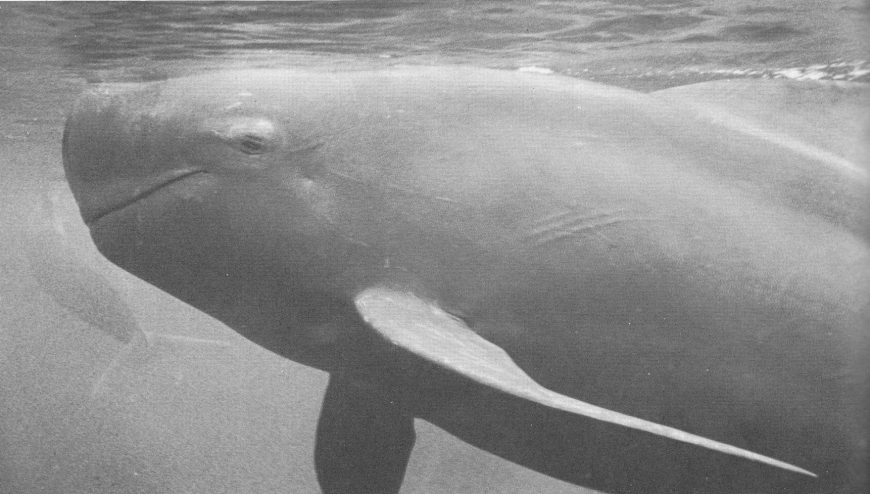
Bimbo watching. © Lou Jacobs; from Duncan the Dolphin. Scanned by the author.
Starting July in the same year (1962), Bimbo’s behavior became increasingly bizarre. He was depressed and anorexic, and had bouts of aggression. His companions becoming targets for his unprovoked attacks. In some stretches, he refused to perform at all. In early August, he was given a dose of Sparine, an older medication used to treat schizophrenia but is now no longer approved for human use. For seven days, his behavior improved, until the evening of August 16, when he turned and savagely attacked the youngest whale in the tank, throwing her 780-pound body clear out of the water. She died from blunt force trauma: her jaw was fractured, her chest cavity was filled with blood, and an inch-long tear was found in her heart’s right ventricle.
Staffers drained the tank to strand the animals, in hopes a “common stress conjointly shared” would “reset” the animals and prevent further incidents. The stunt worked for a year, before his behavior changed once again in late summer of 1963. For a month, Bimbo only ate intermittently. Appetite stimulants were administered to no effect, yet he showed no signs of disease or infection. From August to end of September, he had lost approximately 500 pounds in body weight. Not only was he starving, but severely dehydrated, since cetaceans stay hydrated from the fish they consume.
Dr. M. E. Webber, a physicist with an interest in cetaceans, was called in to figure out what was causing his hunger strike. Webber diagnosed Bimbo with manic depressive psychosis, based on the staff’s observations of Bimbo’s fluctuating apathy and sudden bouts of aggression. After being force-fed 6,000 milligrams of Niamid, a psychotherapeutic drug (which is also no longer on the market), a switch was flipped and he began to eat once more, with an additional three more months of antidepressant therapy.
From there on out, Bimbo was “retired to stud.” As there was still hope he would sire calves, Marineland staff was adamant against releasing him back into the wild. Relieved the dilemma was over, David Brown would tell the Associate Press almost a year and a half later he believed it was the training – not the slew of cetacean deaths – that negatively effected Bimbo.
He was middle aged when we got him – about 20 years old, and whales usually live 30 t0 40 years. He’s not as flexible mentally as our younger whales.” ~ David Brown, then curator, Marineland of the Pacific

Bimbo carrying the stillborn common dolphin corpse prior to eating it. © Cliff Brown, taken from the scientific report, “Observations on the Behavior of Wild and Captive False Killer Whales in Captivity, with Notes on Associated Behavior of Other Genera of Captive Delphinids (1966).”
While out of the woods, Bimbo’s strange behavior continued. In February 1964, a short-beaked common dolphin that had been captured just two months earlier gave birth to a stillborn after a difficult labor. During the ordeal, her “attendants” – a false killer whale and two Pacific white-sided dolphins – hovered close by. After the common dolphin tried to bring her dead calf to the surface, Bimbo snatched the little corpse from her, holding it in his mouth for 30 minutes before swallowing it whole.
For another three years, Bimbo would occasionally “sulk,” but his outbursts were limited. Although he was observed mating with his female cohorts and the false killer whale, Swifty, whom he shared the pool with, he never sired offspring. He returned to performing in 1966, and on one occasion, was deemed safe enough for then-California Governor Edmund G. Brown to allow his grandchildren to pet and feed the giant.
During a late afternoon performance on June 3, 1967, trainer Larry Clark was preparing for Bimbo’s finishing leap when the pilot whale had other plans, and charged the 2 ft x 4 ft observation porthole, shattering the 1.5-inch, double-pane glass. At least 350,000 gallons of water gushed into the viewing gallery. Visitors were evacuated from the park, and four were sent to the hospital for cuts. Bimbo’s tank mates, the other pilot whales, false killer whale, and four dolphins were moved to other pools in the park, and he was left behind on his own in the Sea Arena, sporting a gash on his rostrum. A few days later, he would try to break another set of windows.

From The News-Herald, dated June 8, 1967. Bimbo’s dorsal can be seen in the background.
Now posing a real danger to patrons and a public relations nightmare, Marineland was at a crossroads on what to do with Bimbo: euthanize him, or release him. Bimbo would be left in the tank for a few weeks while staff determined whether he was fit to fend for himself. Mercifully, they chose the latter option.
Prepping the nearly two-ton, oversized dolphin for transport was a massive undertaking: even with an injection of tranquilizers and ten men, Bimbo thrashed and refused to move into the stretcher, nearly drowning a few of the handlers. After two tries, he was finally hoisted up from the tank with a 50-foot crane, and spirited out of the park. He was taken out to sea on the same boat, the Geronimo, that had caught him eight years earlier.
Marineland staff were very careful about his release location: they headed 22 miles out at sea, near Catalina Channel where we was originally caught. The team event went the extra step in locating a pod of pilot whales to give Bimbo an extra chance in integrating into a pod. Recalling the moment he hit the water, a Marineland spokesperson said, “When they put him in the water, he hung around the boat for a while, wondering what to do.” Chief Curator John Prescott went on to elaborate further:
We turned him loose in a school of pilot whales and he couldn’t believe he was free. He took off in a straight line for 500 yards – like he was looking for a wall – and then he’d jump like a big dolphin, come back and do it all over again.”
Bimbo was reportedly re-sighted in 1969 in Santa Barbara, California by a U.S Navy marine mammal collector, and again by San Clemente in 1974, identified in photographs taken by Prescott and SeaWorld veterinarian Lanny Cornell.
To read more in depth about the birth of Marineland of the Pacific, and American society’s views of cetaceans at time, please read Isobel Griffin’s 2018 Master’s Thesis, “Caging the Seas: Cetacean Capture and Display at Marineland of the Pacific, 1954-1967”
The following resources were used in this article:
- The Porpoise Watcher by Kenneth S. Norris (1974)
- Marineland Diver by Jake Jacobs (1960)
- Wonders of an Oceanarium: The Story of Marine Life in Captivity by Lou Jacobs Jr. (1965)
- Lads Before the Wind: Adventures in Porpoise Training by Karen Pryor, 1975.
- Big Star All at Sea, Duane Valentry, Sea Frontiers, Vol. 15: 219-223.
- “List of Cetacean Releases and Reintroductions” by Ken Balcomb III, 1995.
- “Behavior of a Captive Pilot Whale” by David H. Brown, Journal of Mammalogy, Vol. 41, No. 3 (Aug., 1960), pp. 342-349
- “Intergeneric Behavior by a Captive Pilot Whale” by Melba C. Caldwell, David H. Brown and David K. Caldwell, Los Angeles County Museum Contributions in Science, Vol. 70, October 4, 1963
- “Observations on the Behavior of Wild and Captive False Killer Whales in Captivity, with Notes on Associated Behavior of Other Genera of Captive Delphinids” by Melba C. Caldwell, David H. Brown and David K. Caldwell, Los Angeles County Museum Contributions in Science, Vol. 95, April 4, 1966
- “Further Observations on the Pilot Whale in Captivity” by David H. Brown, Zoologica, 1962
- “Squirt of Marineland’s Whale Circus, Dead,” Los Angeles Times, March 16, 1960
- “Giant Whale Gets Release,” Playground Daily News, November 24, 1967,
- “Clever Comics of the Sea,” Life Magazine, February 16, 1959
- “The Pilot Whale at Marineland” by Henry Kritzler, Natural History Magazine, September 1949
The author would like to give her sincere thanks to The Marineland of the Pacific Historical Society for their time and effort in providing additional information and photographs; to CetaBase for fact-checking and providing scans of “Sea Frontiers”; and to Jennifer Bennet for scanning “Wonders of an Oceanarium.”
(Originally published June 7, 2016)
Featured Image: Bimbo/Lou Jacobs Jr/”Wonders of an Oceanarium,” 1965

Related posts
2022: A Year to Remember
2021: A Year in Review