One Dolphin’s Story – Ramu/Winston
 10Mar
10Mar
On October 4, 2010, SeaWorld’s first captive-born orca, Kalina, passed away shortly before midnight, stricken with bacterial septicemia. Dubbed as the original Baby Shamu, she was a unique individual, described as having a high energy, a “motivated attitude” and “regularly solicited attention from trainers.” She was a mother, having four calves, and a grandmother to three.

Kalina, March 11, 2010. © Kenny Alexander/flickr/CC BY-NC 2.0
She was also a hybrid of two very different orca populations — born of an Icelandic mother and a Southern Resident father. And while she has her place in the annals of marine mammalogy, her father Winston has an equally compelling story.
It is August 8, 1970, in Haro Strait, Washington. Some 50 whales are corralled by speed boats and seal bombs from the Strait into Penn Cove. What should have been superpod — an annual event where the three Southern Resident orca pods merge and socialize during the plentiful chinook salmon runs — has been anything but.
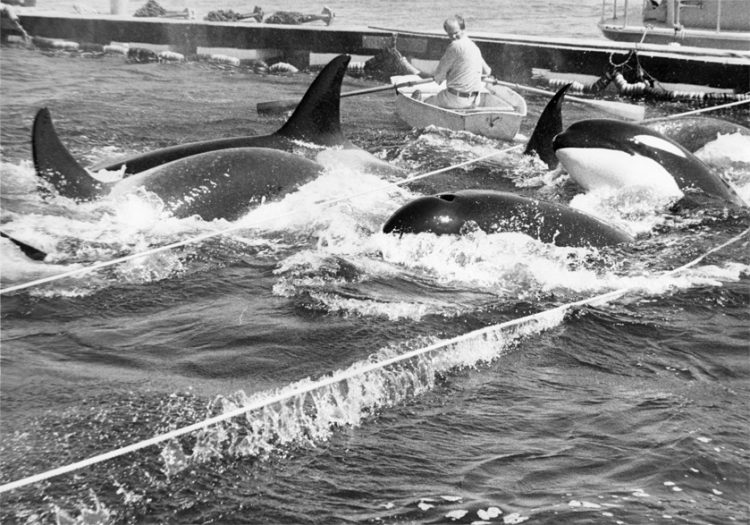
Scene of the Penn Cove orca roundup, August 8, 1970. Photo by Wallie V. Funk. From the Wallie V. Funk Papers and Photographs, Center for Pacific Northwest Studies, Western Washington University.
A dozen calves have been isolated and squared away in a makeshift pen with nets, floating docks and boats. They bunch together for protection, diving and circling in whatever space they have. Workers for Namu Inc., an orca-collecting business venture, begin taking individuals with ropes and reinforced lassos on poles. The adults outside the pen are agitated, slapping the water with their flukes, spy-hopping, vocalizing loudly.
By the day’s end, seven are hauled onto a seiner and taken to Seattle Marine Aquarium, before being loaded onto flights to their prospective buyers. Two were sold stateside — Miami, FL and Galveston, TX. Three crossed the Pacific; two reached Japan, one to Australia. Three would cross the Atlantic — to Germany, to France. The last, a four or five-year-old male, reached Berkshire, in southeast England, where a unique theme park recently launched: Windsor Safari Park.

Ramu, shortly after he arrived at Windsor Safari Park. Port Angeles Times, October 1, 1970.
Established by the Smart circus family dynasty, Billy Smart, Sr. had purchased 144-acres of the St. Leonard’s Estate in 1966. Located outside of the town of Windsor, a barn and outbuildings were built to serve as winter quarters for their touring animals. After the patriarch’s passing, his sons David, Ronald and Billy Jr. conceived the idea of an all-in-one animal-centric attraction on the land. Officially opening to the public on March 31, 1970 by Princess Margaret, it had it all: a drive-through safari, a dolphinarium, an aviary and a section for some amusement rides. It became a staple attraction for families for a little over two decades.
While this was not the country’s first killer whale, the local media and general public were excited about the young orca’s arrival on September 1st (who wouldn’t be back then?) For at least for the first year, he was called “Baby.” He was docile enough where he was trained to tow children in a small dingy, with a rope attached, around the pool.
Ramu, as he was later christened, would be taught to carry out several acts: having his teeth brushed, “blowing” a bugle, wearing giant sunglasses, having a trainer stick their heads into his mouth, and leaping to touch a suspended ball. A bolder stunt was a rodeo-style ride: a trainer had to hold onto Ramu’s dorsal fin for dear life as the whale raced and dove around the tank perimeter. (This would be later phased out for the less intense “surfboard” act: Ramu would swim, belly-up, around the pool perimeter as the trainer balanced himself).

Ramu performing at Windsor Safari Park, August 1971. © John H Hutchinson/flickr
What the audience — especially kids — looked forward to most was getting soaked. Former Windsor Safari trainer Terry Bobrowicz wrote that back then, getting splashed was an acquired taste:
“Back in the old days, getting the audience wet was frowned upon. Dire warnings were given about the first seven rows being “the splash area” and the seats were painted red accordingly. As soon as the warnings were given though, the kiddies would all rush down to the red seats in anticipation, and their mums and dads didn’t seem to mind, (till they got them back that is).”
Ramu would develop a unique relationship with the five bottlenose dolphins he shared the tank with. He formed “a sort of fraternal relationship with the female dolphins — Lulu in particular — to whom he was fiercely protective.” While he respected the dolphin hierarchy, led by the oldest male, Smartie, if Lulu was involved in a fight, he would break it up and guard her from the rest of the pod. (He was at times a pain for the dolphins, intervening when they were in the middle of amorous romps.)
If he was not constantly occupied, he would invent ways to entertain himself. One of his favorite games was to sit at the underwater viewing window, and let visitors gather as he would ‘make faces:’ “opening his mouth, closing his eyes, and poking out his tongue.” When enough people were there, he would spray a mouthful of water over the top of the window, drenching them. Another pastime was bending the bars of the dolphin pens. Windsor staff made the unfortunate mistake of reacting to this: now Ramu learned that whenever he was a sour mood with staff, he would swim over to bend them further to make his point.
A clip of Ramu doing his rounds at Windsor Safari Park’s Dolphinarium and receiving a checkup, June 1974. (Video Credit: Reuters/British Pathé)
Starting in 1974, Ramu was beginning to cause trouble. Given he was stuck in an enclosure that was not designed with a killer whale in mind, and growing at a faster rate than expected, Windsor education officer Wayne Reid remarked that “it was obvious Ramu was outgrowing the condition we had for him.” He was no longer the 13.3ft/4m youngster that entered the park: by early 1975, he was 19.5 ft/6m and 4½ tons/4,082kg. Reid added that during shows, re-entering the water “cleanly” was becoming more difficult.
Former trainer Doug Cartlidge commented it was about three years after Ramu arrived when he became increasingly aggressive, “normally after a trick not been done properly and a negative signal was given.” But by the start of 1975, getting in the water with Ramu was forbidden due to series of incidents which included:
- Biting an unnamed model hard enough to puncture her skin. She sued “but was paid off.”
- Prince Andrew and Prince Charles reportedly swam with Ramu. Staff had to end the swimming session early and whisk the two out when he began to exhibit signs of aggression. Neither princes ever suspected anything, nor were they informed about the close-call.
- Ramu once came onto the stage and attempted to pull Cartlidge in.
- The rumored final straw was when Ramu attacked Cartlidge in the water in 1974, inflicting leg injuries that required stitches.

Ramu awaiting commands. From a 1970s Windsor Safari Park brochure or ephemera. Provided by Jovana Ivanstanin/flickr
The waterworks were eventually reinstated after several months of re-training, which seemed to do him some good. But while that was underway, Windsor Safari staff reached out to SeaWorld in the spring 1975 to negotiate a sale or a trade. In exchange for Ramu, three bottlenose dolphins and two orca calves (captured off the Iceland coast later in 1977) would be sent to the Safari Park.
Measurements were taken by Windsor Safari staff late that year, when he was beached for his monthly veterinary checkups. The data was sent off to SeaWorld, and a custom-made crate was delivered in August 1976. However, due to the departure date being rescheduled, it was put into storage.
Jumping to October 17, 1976: Ramu knew something was up when he was in his medical pen, separated from his bottlenose companions and surrounded by men in wetsuits. With the pool was lowered to a waist-deep level, veterinarians David Taylor and SeaWorld’s Lanny Cornell, Ed Asper and Don Goldsberry got to work prepping the orca for his transatlantic trip to San Diego.
In the meantime, the Windsor Safari staff were holding their breath: while the transport crate had been taken out of storage three days prior, it was obvious Ramu was not going to fit in it. Between when they measured him almost a year ago and now, the orca had grown “half a meter in length (1.8 ft) and 12½cm (5 in) in width.” Windsor staff beached Ramu in the medical pen, and obtained new measurements. Over 24 hours, the park’s maintenance team managed to make the alternations with Cornell and Goldsberry’s help, adding an extra 30cm/11 inches in width and fitting a tailboard at one end to prop his flukes.
Ramu’s transport, October 17, 1976. (Video Credit: Reuters/British Pathé)
To add more absurdity to the event, the truck driver that fetched the crate accidentally ran over a steel fence post and tore a brake cylinder. The maintenance crew was able to repair it in a pinch before a backup truck could be dispatched. But the relief was short-lived: a message had arrived that the plane en route to San Diego was delayed in Belgium.
Ramu was not making the process any easier: after a team of seven men shoved and pushed him into the stretcher, he give a swat of his tail and undid all their work. When he finally was in, the crane hoisted him up and into his foam rubber-lined crate, resting on the fixed truck. Windsor Safari staff got to quick work covering him in cod-liver ointment, wet sheets and whatever spaces they could cram ice into as they drove him to the Heathrow airport.
Once again, last-minute adjustments had to be made, and Winston’s tailboard had to be removed in order to get him inside. For a whale that hated having his tail touched, he was cooperative and unusually silent as he was manhandled and loaded a Stretch DC-8 jet. The fire brigade filled his crate with more water before the plane’s door shut and he took to the sky.
After crossing the Atlantic and returning to the western United States eighteen hours later, Ramu was no worse for wear when he placed into the killer whale stadium (now currently the Dolphin Stadium). One of SeaWorld’s first orders of business was ditching his old Windsor name. Already having a Ramu living at their Orlando park, park staff renamed him Winston, but would have him perform publicly under the “Namu” stage name.
SeaWorld was already planning how to incorporate him into their potential breeding program. The upper echelons realized they had better commence research into creating a sustainable colony, and soon. Just that April, they had been kicked out of Washington state following a court settlement and public fallout over the capture of four orcas in Olympia Harbor (who were subsequently released). But not having enough whales to start a breeding program, they turned to Iceland to start business arrangements with the fishermen, who were all too happy to oblige.

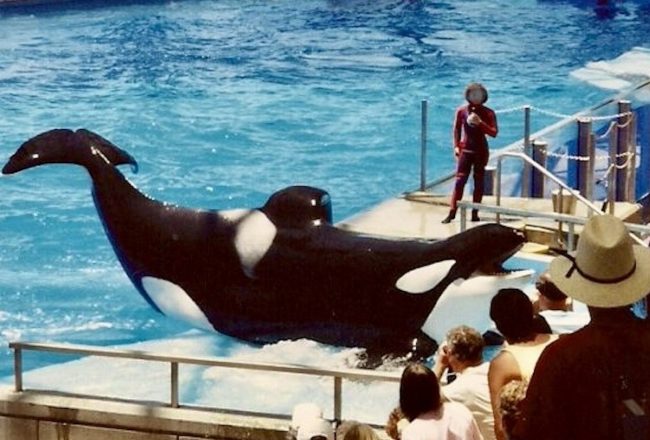
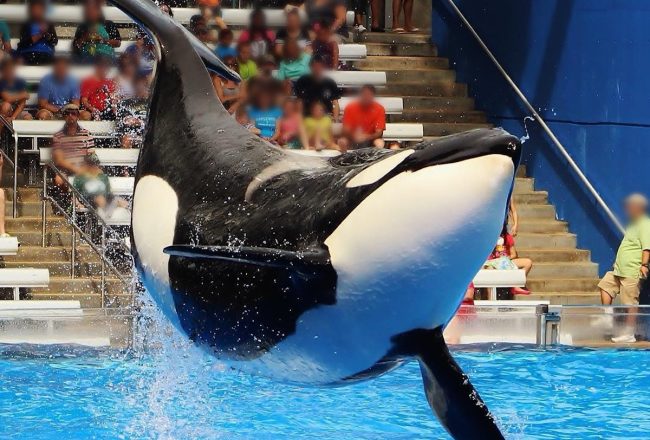
Winston at SeaWorld San Diego, August 1982. Photographer unknown. Provided by CetaceanCollective/flickr/CC BY-NC 2.0
Meanwhile, SeaWorld’s killer whale trainers got to work getting Winston under their new training regimen. They noted it took some time for him to learn some new routines and be desensitized. Ken May said in 1978, “He doesn’t like to do one trick. That’s the one where he jumps out of the water over a rope. He sometimes snaps at us to let us know he doesn’t like it.” John Spafford further elaborated in 1981, “Namu has been a handful. He came to us with some bad habits, but he’s making really amazing progress. I was reluctant to get in the water with him at first. Now I trust him. He likes to be touched by me now. At first he was shy. And he’s gained about 2,000 pounds.”
Winston could still be somewhat of a safety risk: he was “acting playfully” during a training session with trainer Greg Williams in May 1978 when he mouthed and nipped his legs. Williams was released and was able to swim back to the stage. He was briefly hospitalized to treat “several small puncture wounds.”
From 1977 to 1978, nine juvenile orcas would be added to the SeaWorld system, whether they were flown straight from Iceland, or laundered through neighboring marine parks. They would be rotated between the Florida and the now-defunct Ohio parks, or kept in the San Diego park’s petting pool or put into training at Shamu Stadium with Winston.

(L to R) Canuck II, Kandu V and Winston. 1980s Seaworld brochure, provided by Jovana Ivanstanin/flickr
In the spring of 1984, courtship between Winston and the two female orcas at the San Diego park had been observed but it was not smooth sailing. On March 15, one of whales — whether it was Kandu V or Katina — did not reciprocate his romantic overtures. Nobody was there to witness what exactly happened, but park staff would find Winston bleeding in his tank, part of his flopped dorsal fin badly smashed. SeaWorld vets had no choice but to remove part of his fin on order to save the rest of it. The next day, Lanny Cornell and veterinarian staff anesthetized and amputated 2½ ft/0.7m feet off of Winston’s 4½ ft/1.3m-high dorsal fin. He was feeling well enough, post-surgery, to eat 300 lbs/136kg of fish.
While he also felt well enough to mate again a month later (Katina would be confirmed pregnant while performing for the Ohio park’s summer season), he was soon phased out from shows. A former SeaWorld marine biologist (who wished to not be named) that worked for the company in the 1980s, confirmed that the park did end his performing career: “I watched poor old Winston decline… By about 1986 Winston, post-operative, was kept in the back tank at the then ‘new’ killer whale facility at the east side of the San Diego park.” It is not a far-fetched guess that Winston’s partly-missing dorsal fin would provoke questions from visitors, a scenario SeaWorld wished to avoid. He was at least occasionally let out to mingle with his potential mates Kandu V and Kenau.

Winston soaking the audience at SeaWorld San Diego, August 1982. Photographer unknown. Provided by CetaceanCollective/flickr/CC BY-NC 2.0
Winston passed away during the night of April 28, 1986, and was discovered the next morning floating on the surface. His general health declined and his appetite waned “over a six month period.” He experienced acute kidney failure two weeks prior to his death, and was given intravenous and subcutaneous fluid injections to keep him hydrated. The former SeaWorld marine biologist described the scene when Winston’s body was discovered: “Not wanting to show alarm to the public, the trainers turned a lawn sprinkler on Winston’s back as he floated around the pool pushed by the circulation currents.” Later that night, the back pool was drained, his corpse was lifted out by crane and placed on a flatbed truck for necropsy. It would be chronic cardiovascular failure that did him in; “baseball-sized cirrhotic lesions” were found on his heart. Afterward, his body was hauled off by truck to the nearest rendering plant.
Winston did not have nearly an extensive progeny as SeaWorld would have hoped. Kenau’s calf, born January 15, 1986, lived for eleven days before expiring from a heart defect. Kandu V delivered a stillbirth at the end of that month. But his only offspring, Kalina (born September 26, 1985), would be celebrated as a zoological milestone, and jump-start SeaWorld’s much-lauded killer whale breeding program for the next thirty years.
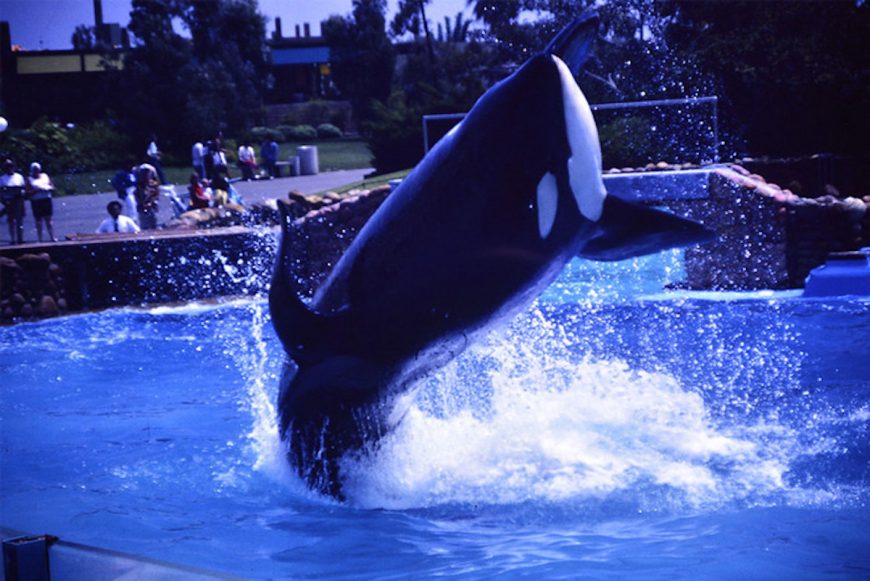
Featured Image: Winston breaching at SeaWorld San Diego, August 1982. Photographer unknown, courtesy CetaceanCollective/flickr/CC BY-NC 2.0.
(Originally published March 10, 2021).
Sources Cited:
“Windsor History: Windsor Safari Park.” The Royal Windsor Website. March 24, 2005.
Terry Bobrowicz page; Poolside, Windsor Safari Park Archives.
Ramu — A Report on Inter-Species Relationships and Transport of a Large Marine Mammal. Wayne Reid. Aquatic Mammals, Volume 5(2), 40-49. 1977.
Observations on the Birth and Development of a Captive-Born Killer Whale. Ed Asper, W. Glenn Young, Michael T. Walsh. International Zoo Yearbook, 27: 295-304. 1987
Orca: How We Came to Know and Love the Ocean’s Greatest Predator. Jason Colby, Oxford University Press. 2018.
Puget Sound Whales for Sale: The Fight to End Orca Hunting. Sandra Pollard, Arcadia Publishing. 2014.
Doug Cartlidge, personal communication with Stefan Jacobs, March 2010. Archived orcahome.de.
Kalina profile. SeaWorld Animal Profiles, revised June 2010.
“Feeding a Killer.” Port Angeles Times, October 1, 1970.
“A Whale of a Show.” New York Daily News, 25 July 1971.
“It’s a Whale of a Time.” John Andrews, The Guardian, 18 October 1976
“London Park Loses Whale, Cites Growth.” Associated Press, Messenger-Inquirer, 18 October 1976.
“She Keeps Whales, Walruses Healthy.” T.J. Ryner, The Des Moines Register, 29 April 1978.
“Killer Whale Mouths Trainer’s Legs.” Associated Press, The Chillicothe Constitution-Tribune, 26 May 1978.
“Killer’s Pal.” Arizona Republic, 23 March 1981.
“Kiuller [sic] whale injured during courting.” United Press International, March 17, 1984.
“Amorous Namu Loses his Fin to Love.” Associated Press, The San Francisco Examiner, 17 March 1984.
Winston’s Necropsy Report. National Oceanic Administration Agency, National Marine Fisheries Service, 29 April 1986.
“Killer Whale’s Death at SeaWorld Linked to Old Age.” Associated Press, The Journal Times, 29 April 1986.
“Windsor Safari Park closes but seeks a Saviour.” Nicholas School, The Independent, 26 October 1992

Related posts
Katina: Half a Century Stolen
One Dolphin’s Story – Keet