One Dolphin’s Story – Veera
 10Jan
10Jan
Quick Facts
Captured: August 1984, Pine Island, Florida
Died: 2021, Oltremare Park, Italy
Veera was captured near Pine Island, Florida in August 1984, along with four other dolphins named Delfi, Näsi, Joona, and Niki. They were all sold to a newly built dolphinarium in the Särkäniemi Adventure Park in Tampere, Finland. The capture is documented in a Finnish documentary-type film called Operaatio delfiini, which translates into Operation Dolphin. The film, which is not at all critical towards the capture of dolphins, shows American veterinarian and dolphin hunter Jay Sweeney and his team hunt down pods of dolphins off the coast of Florida. It’s an important film, because it shows the cruelty and tragic consequences of the captures that took place in the Unites States during the 1960s, 70s, and 80s to facilitate the demand for show quality dolphins in European dolphinariums.
The film crew follows Jay Sweeney and team members Gene Hamilton, Ray Stone, and Willem H. Dudok van Heel during the capture operation which lasted several days. Shown is the actual capture with the team encircling dolphins with large nets, jumping in the water, dragging terrified dolphins to the capture boat, and hauling them onboard. Despite the obvious cruelty of yanking dolphins out of the sea, Jay Sweeney, during a conversation with the Finnish interviewer, proudly describes the capture process as “a fine art.” He tries to make the capture look animal friendly by saying: “We put a great deal of effort into the way the animals are handled in the nets, how they are taken from the net and put on the boat and managed on the boats throughout the entire capture process, throughout the transportation, throughout the acclimation process. The animals are very carefully and delicately handled so that any adverse effects are minimized. These animals are going to be stressed, we can’t do a whole lot about that, but we can do a whole lot about minimizing the stress and shortening the time elapsed before the animals are feeling comfortable and allowed to go on and resume their natural behavior in a slightly different environment, that which we call captivity.”
After the first dolphin has been hauled onto the boat, the interviewer asks Dudok van Heel what he thinks. He answers: “It looks beautiful, very clean and without scars or anything.”
Over the course of four days, Sweeney and his team capture three females and two males. They lock the dolphins up in a temporary sea cage, and the interviewer asks Sweeney if he is happy with the results. Sweeney answers: “They are perfect. They are really very nice animals.”
The interviewer wants to know how he selects dolphins during capture, and Sweeney explains that the dolphins’ gender and size are important. Old dolphins are “set in their ways,” as he puts it, adding that it’s best to get juveniles. He clarifies: “So we have a very narrow age and size criterium from which to pick;” The reporter also wants to know if Sweeney thinks the dolphins the team have captured are in good health. Sweeney says that they are. He says the dolphins were active, alert, and swimming with their mothers up until their capture.
The journalist asks Sweeney why he has this job, and Sweeney explains: “I’ve been very lucky in my life to have become involved in marine mammals. It was 15-16 years ago that I have been given the chance and the opportunity to do this, and I have been able to make a living off of it. (…) And being in this wonderful environment… the water, the birds. It’s a glorious experience. It’s a wonderful opportunity for me, how can I not absolutely love it?” Apparently, he completely fails to see how painfully ironic it is that the dolphins he captures will be incarcerated inside a concrete amphitheater inside of a dreary building where they can’t even see the sky.
In one of the next scenes, the dolphins are lined up in the bottom of a boat with white towels over them. Viewers are told the dolphins’ next destination is a training center in Grassy Key. The name Dolphin Research Center isn’t mentioned, but this is where they are going. Another scene shows one of the dolphins being carried from the boat and loaded into a truck.

Flipper’s Sea School sign at the Dolphin Research Center, Grassy Key, Florida. Credit: DolphinProject.com
Once the dolphins arrive at Dolphin Research Center, the training process begins. The journalists interviews one of the trainers in front of a building with the words “Flipper’s Sea School” on it. (That’s apparently what Dolphin Research Center was called in the early years.) The interviewer asks the trainer what is going to happen with the dolphins during the next several months, and the trainer explains: “The very first thing that has to happen to these little characters is they have to learn how to eat dead fish. That is step number one. Now, out in the wild, if a dead fish comes floating by them, they say “no way, I am not going to eat a dead fish,” because it means it’s deceased, something is wrong with it, so step number one is you throw that dead fish in the water, and they look at it like “this is absolutely disgusting.” So we’ve got to get them used to the fact that the dead fish is what they are going to be eating. Once they start eating the dead fish, and you actually start out by throwing it out in the middle of the pool, you start bringing them up to the dock, with the food, then you start bringing their heads up, then you start touching them, and once you’ve got a bond, once they start to trust you, the training can actually begin. The most tedious and the most difficult part of training in my opinion is actually taking these wild little creatures that are afraid of human beings and getting them to realize that we’re not going to hurt them and to trust us.”
Like a typical dolphin trainer, she calls it trust, when, from the dolphin’s point of view, it’s all about surrender and survival.
The film leaves it out, but one of the captured dolphins – a female with the ironic name Happy – died a few weeks after she arrived at Dolphin Research Center. She was captured on August 22nd and arrived at Dolphin Research Center on August 24th. She wouldn’t eat and was found dead in the morning of September 16th. Happy was put in a freezer, and Sweeney carrried out the autopsy on September 22nd. He doesn’t call her Happy in the autopsy, simply F-3. The autopsy report describes “rapid weight loss and dehydration.” Happy’s dead body was put in a freezer, and another female was captured to replace her.
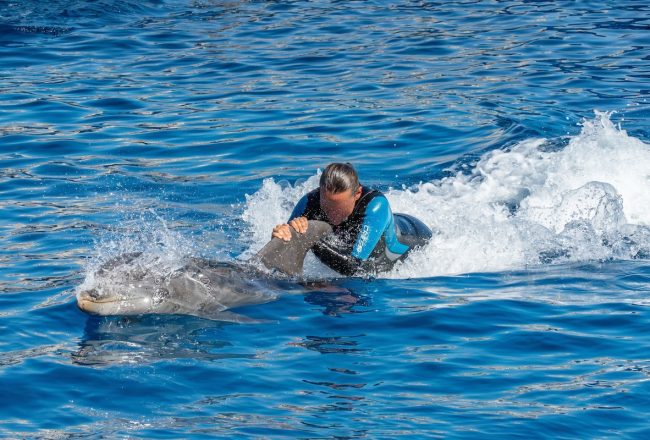
At the end of March 1985, Veera and the other four dolphins were trucked to the airport and flown to Tampere, Finland where the new indoor dolphin stadium was ready to receive its performers. By now, trainers had transformed them into performing circus clowns, and they obediently played with balls, jumped through hoops, and beached themselves so that children from the audience could pet them.
The film ends with an interview with Dudok van Heel, who is sitting by the show pool. He was involved in the dolphins’ transport from Florida to the amusement park in Tampere and says the journey went smoothly, and that it is no more difficult for dolphins to be on a long flight than it is for humans. He says the dolphins on the plane were in transport boxes with water in them, and it’s almost as if they themselves were swimming from one place to the next. He justifies the capture by saying: “We have borrowed this group of animals from nature to be ambassadors.” It’s the standard excuse that makes it sound as if dolphins are more than happy to give up their freedom and their families to entertain humans and spend the rest of their lives in tanks where they can’t even swim normally. But when you borrow something, you’re supposed to give it back. The capture team did not “borrow” Veera, Happy, and the other dolphins from their families in Florida. They literally stole them.
Three decades later, the dolphinarium in Finland finally closed down due to declining ticket sales, and in August 2016, the amusement park sent its four surviving dolphins to the Attica Zoo in Greece. Veera and Delfi were among the original five that were captured in Florida. The other two, named Leevi and Eevertti, were born at Särkäniemi Adventure Park. (Eevertii is Veera’s son, and Delfi is Näsi’s son.) Delfi died at the Attica Zoo the following year, in January 2017.

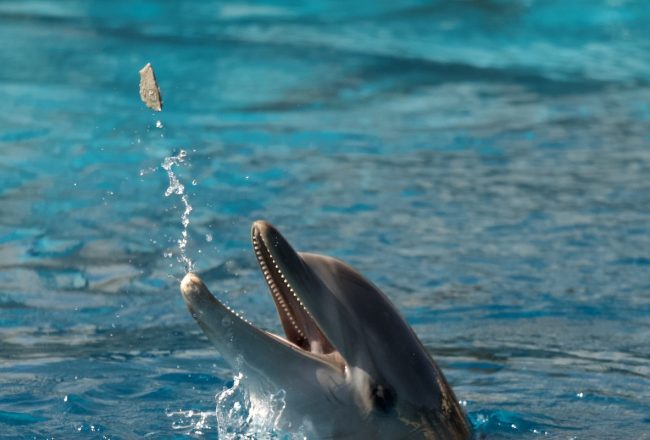
Captive dolphins perform at Oltremare Park in Italy. Credit and license: Roberto Ferrari, Creative Commons Attribution-Share Alike 2.0 Generic license
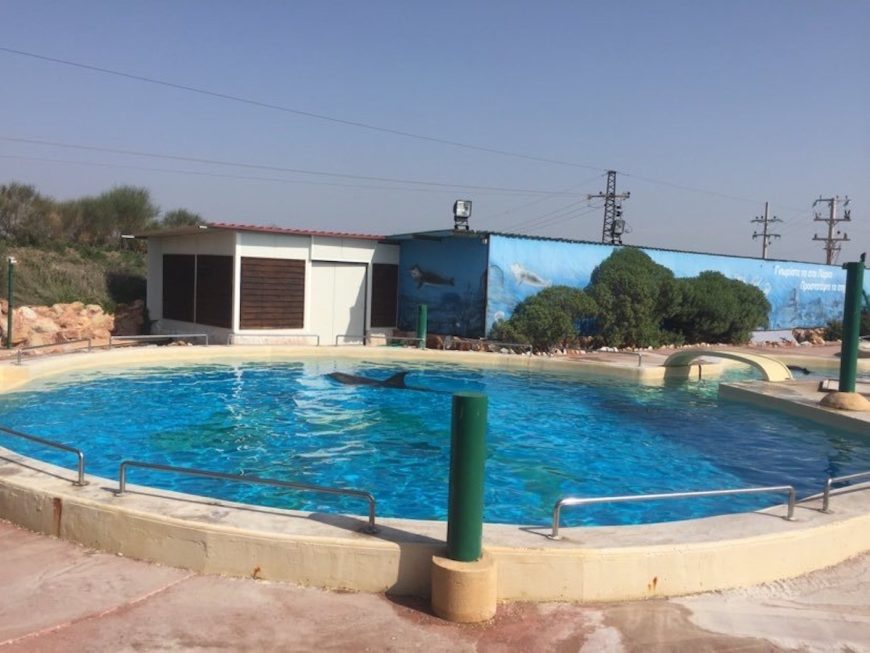
Ric and I saw Veera at the Attica Zoo in the summer of 2018. She was in a holding tank all by herself and did not participate in the show. Maybe she had become too old and too tired to keep working, or maybe the zoo wanted to keep her separated from the males, as she was now too old to breed. While her son Eevertti and the other dolphins went through their repertoire of trained behaviors, Veera lay motionless on the surface of the water, facing a concrete wall. In August 2020, the Attica Zoo sent Veera to Oltremare Park in Italy where she died the following year. The Attica Zoo kept Veera’s son Eeverttii, and as far as we know, he still performs there.
Featured image: Veera swims in endless circles at Attica Zoo in Greece. Credit: Ric O’Barry/DolphinProject.com
References:
Watch the film Operaatio delfiini
Read Behind the Dolphin Smile by Ric O’Barry

Related posts
Beyond the Cove: How Captivity Sustains the Hunts
Concrete in a Dolphin’s Mouth After Transfer