Ordinary Actions = Meaningful Impacts
 23Oct
23Oct
Recently I had the opportunity to chat with Cynthia Fernandez, Educational Coordinator for Dolphin Project about how young people really do have the power to enact positive change in the world.
Everything begins with education. At Dolphin Project, we believe that education equals empowerment, for it is through knowledge that better choices can be made — which in turn leads to positive actions that anyone can take.
Q: Why are balloons so harmful to birds and marine mammals?
The biggest problem that balloons cause for wildlife is that the entire balloon or fragments of a balloon may be mistaken for food and cause internal blockages. There are ocean animals such as sea turtles who may mistake balloons for jellyfish. Dolphins and other whales, seals and sea lions may also ingest balloons. On land, birds may also mistake balloons for food. Once ingested, the balloon may block the passageway to the stomach or the lungs, which can lead to starvation, or an inability to breathe.
Many balloons are made of plastic, meaning they will break down very slowly, and will be present in the environment for a long time. Mylar balloons may take hundreds of years to break down. The so-called biodegradable balloons will break down much quicker (in months), but those months allow for plenty of time to be ingested by animals.
Another problem is entanglement. Balloons have strings attached to them, which can get tangled in claws, paws, fins and even around necks or mouths, which can injure or, in severe cases, if the string or ribbon is entangled around a beak or mouth, cause an animal to lose its ability to eat, leading to a slow and painful starvation. Released balloons can travel hundreds of miles – what goes up must come down. Many end up in waterways and have a way of making their way into the ocean. Sadly, during Cynthia’s many whale and dolphin watching excursions, she has seen countless balloons floating in the water.
Action: Are you having a birthday? Going to a birthday party? Ask that it be a balloon-free event.
Q: How can picking up trash near a waterway positively impact marine life?
It is estimated that every day, around 8 million pieces of plastic make their way into the ocean.
Since all rivers and streams eventually end up at the ocean, whatever is in the water is also dumped in the ocean. No matter where you live, you can help, not only by aiding the local waterways, but the ocean as well by picking up trash and making sure it it properly disposed of.
Large amounts of rubber, paper, metals, and an assortment of lost or discarded items – even large items such as tires and chairs – have been seen in the ocean. As trash, especially plastics, break down into micro pieces, they make their way into marine life, which affects the biochemistry and possibly even their reproduction. Land animals that eat fish and other marine life will also be affected. Picking up trash anywhere will help the local environment and, ultimately, the marine environment.
Action: Bring reusable containers when going for a walk in nature, and whenever possible, stop to pick up trash and dispose of this material safely.
Q What plants are best for pollinators? Why are bees so important to the environment?
Bees have evolved and adapted to native plants (which are the best plants for pollinators), and together, work with the local environment, climate, and growing seasons. However, with the business of gardening imported plants from around the world, bees are having to adapt to new plants. These non-native plants sold at nurseries can also bring in new pests as tiny insects hitch rides in the roots and leaves. These pests may end up being destructive to local plants.
Bees play a crucial role in maintaining the health of both our wild plants as well as many food crops. They help keep plants healthy by transferring pollen and helping plants reproduce. Healthy plants provide food for wildlife and for humans.
Action: Encourage the planting of bee-friendly native flowers around your neighborhood.
Q: Chewing some gum that has lost its flavor? Why can’t you just spit it out onto the ground?
Chewing gum that’s been spit out on the ground can kill wildlife. Cynthia recalls a seeing a heartbreaking photograph of a bird standing by its dead mate whose beak was covered with chewing gum. Chewing gum also contains chemicals which, as the gum breaks down, can enter the environment.
Action: Thrown on the ground, chewing gum often ends up in sewers and waterways, where it pollutes water and harms animal life. Please dispose of your gum responsibly.
Q: How can choosing a plastic bag over a paper bag at the grocery store harm the environment?
Unless plastic bags are recycled or properly disposed of, they can get into the environment and maybe even end up in the ocean. As we discussed earlier in this blog, plastic bags can be mistaken for food but they can also break down into microplastics and release harmful chemicals into the environment.
Action: Bring your own reusable bags but if you forget, choose paper bags.
Q: What’s wrong with buying bottled water?
Who hasn’t grabbed a bottle of water at their local store? While this might seem like an inexpensive and convenient way to hydrate, there are several problems with this, including the bottles themselves and the source of the water. A reusable water bottle will reduce plastic use and pollution as many water bottles never make it to recycling. Chemicals in the bottles may leach into the water. In addition, water used to fill the various brands of bottled water may be sourced from aquifers and groundwater, which can deplete the water in that area.
Action: To hydrate responsibly, use a reusable water bottle.
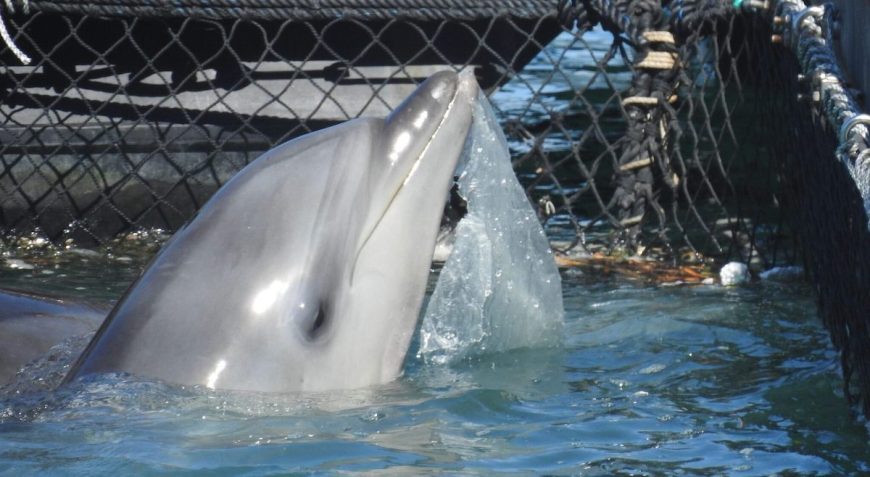
Featured image: Plastic garbage in dolphin’s sea pen, Taiji, Japan. Credit: DolphinProject.com
RELATED:
Learn more about Youth Activism.

Related posts