Returning to Taiji: A Paradox of Pain and Purpose
 08Feb
08Feb
With Cove Monitors Alex and Cynthia currently on the ground in Taiji, Japan, Dolphin Project has continued to gather information to both support our legal initiatives against the cruel drive hunts, as well as report on what we are witnessing, in real time.
In their own words, Alex and Cynthia describe what it means to be back at the Cove – ground zero for the captive dolphin trade.

The fishermen of Taiji claim ownership of wild-caught dolphins, Taiji, Japan. Credit: DolphinProject.com
ALEX
“Coming to Taiji is a strange paradox: it’s deeply painful to witness the cruelty, yet I feel an unshakeable need to stay, to witness, and to advocate.”

My return to Taiji, nearly nine years after my first visit in 2016, was filled with anticipation, anxiety, and an overwhelming sense of familiarity. I’d wondered how much would have changed. Would I remember what to do? Would the town be different? But as soon as I saw the Cove again, and reunited with fellow Cove Monitor Cynthia, it felt as though I’d never left. The emotional weight of the place – its beauty and its brutality – struck me just as hard as it had back then.
Statistically, fewer dolphins are being killed and captured now than in the past. But despite this, the waters of the bays in Taiji are still filled with captive dolphins, and the reality of the situation remains: the work is far from over. Coming to Taiji is a strange paradox: it’s deeply painful to witness the cruelty, yet I feel an unshakeable need to stay, to witness, and to advocate.

Cove Monitor Alex watches for any sign of the hunting boats — either they return with no dolphins, or black smoke will be seen on the horizon, indicating that a hunt is in progress, Taiji, Japan. Credit: DolphinProject.com
One of the most jarring moments of my return came when I visited the Taiji Whale Museum. Nine years ago, I met Angel, an albino bottlenose dolphin, swimming in a tiny pool. This time, I went back for an update, and it hit me hard: while my own life has shifted and evolved, Angel has remained trapped in that same small space, swimming the same lonely circle – her life reduced to nothing more than a form of entertainment.
In the few weeks since I’ve been here, 14 bottlenose dolphins have been captured, and one died from the stress of capture(I fear there may have been more), four Risso’s dolphins have been captured and five were slaughtered, and two striped dolphins were captured, and 18 slaughtered. But despite the heartbreak, there’s a glimmer of hope in knowing that Dolphin Project continues to support the brave Cove Monitors, people on the ground who keep watch and report, ensuring the world knows what’s happening here.

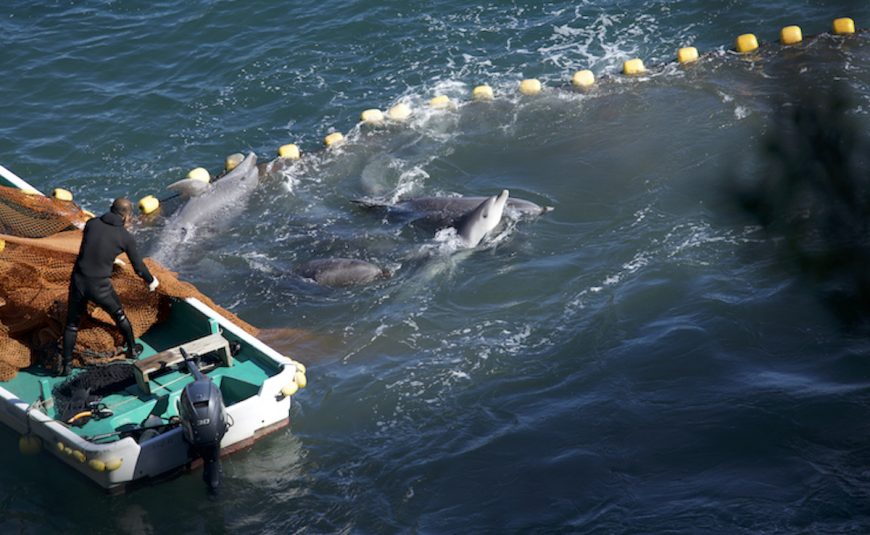
Exhausted bottlenose dolphins are driven into the Cove. After a devastating struggle, one mammal can be seen secured in nets against the skiff, indicating a captive selection, Taiji, Japan. Credit: DolphinProject.com
CYNTHIA
“Thirteen years later, I continue to travel to Taiji each year. It isn’t easy and my heart and soul are scarred by what I’ve seen here but I won’t give up.”
I first traveled to Taiji in 2012. After seeing The Cove movie and researching about what happens in Taiji, I knew I had to go, to try to make a difference. I wanted to be a part of the effort to stop the dolphin drive hunts and to end dolphin captivity. After witnessing my first dolphin slaughter, I made a promise to myself and to the dolphins that I would fight for them. I would tell their stories, educate and try to inspire change, and, most importantly, that I would never give up. I’ve kept that promise as I continue to be a voice for these dolphins, educating children as well as adults, telling their stories. Thirteen years later, I continue to travel to Taiji each year. It isn’t easy and my heart and soul are scarred by what I’ve seen here but I won’t give up.

Cove Monitor Cynthia documents as hunters head out into open waters, searching for unsuspecting pods of wild dolphins, either to kill or take captive, Taiji, Japan. Credit: DolphinProject.com

Agitated and exhausted, a pod of bottlenose dolphins are left overnight in the Cove, after bring driven in from open waters, Taiji, Japan. Credit: DolphinProject.com
When The Cove came out and won the Academy Award for Best Documentary, the spotlight was on Taiji. The remote fishing village was flooded with activists, news media picked up stories about Taiji and the hunts were being exposed. However, despite the global outrage, the hunts continued. Over time, the spotlight has dimmed. I believe that change takes time and I’ll never give up. It’s important to keep raising awareness.
Education works. I’ve been doing presentations for all ages of students for the past fourteen years and I have seen a shift in attitudes. When I started, many students had been to dolphin shows and really didn’t see anything wrong with them. Now, when I speak with kids, many of them are already aware of the cruelty behind the captive industry and most haven’t been to a dolphin show. That’s not to say we can let up as the captive industry is alive and well. We have to keep getting information out so individuals can make informed decisions about supporting dolphin captivity. The documentation we get in Taiji is a strong educational tool. When will I stop coming to Taiji? When the Cove is forever blue and dolphin shows permanently end.
LEARN MORE about Dolphin Project’s campaign in Taiji, Japan.

Cove Monitors Cynthia and Alex are witness to the brutality taking place in the Cove during the dolphin drive hunts, Taiji, Japan. Credit: DolphinProject.com
Featured image: Bottlenose dolphins are driven into the Cove for captive selection and/or slaughter, Taiji, Japan. Credit: DolphinProject.com

Related posts
25 Dolphins Taken Captive as Taiji Hunts Begin
Beyond the Cove: How Captivity Sustains the Hunts