
Space Between Us
 28Jan
28Jan
I was on a boat off Norway in the winter when we were fortunate to see a pod of orcas. The sea was rough, and for a long stretch, there was nothing but waves and sky.
When the orcas suddenly appeared, they were far from the boat. We saw their dorsal fins break through the surface as they moved through the water, hunting herring. They stayed together and disappeared almost immediately. We watched quietly, aware that we were only distant observers in their environment. The orcas surfaced, dove, and moved on, focused on what they were doing. We were there, but we were not part of it.
They hunted with coordination that comes from shared experience. Calves stayed close. Adults moved with purpose. Each individual was part of a social structure we could only glimpse before the group disappeared again. What we witnessed was orcas traveling and hunting according to their own rhythms, visible only for a brief moment before they moved on without us.
That distinction matters: unlike captive orcas at marine parks such as SeaWorld and Loro Parque, these wild orcas were not putting on a show for food, nor interacting with us or responding to our presence. It was simply orcas going about their lives, momentarily within view.
The sighting ended as it began: on their terms. I could see them for such a short time that it felt like looking at their world through a keyhole—a fleeting moment into something that was not meant for us, and then they were gone.
An encounter with wild orcas is not something you arrange. You may happen to be in the same area as them, but there are still no guarantees of seeing them. Their lives unfold independently of us, and any time we happen to notice them is unpredictable.
In the vastness of the ocean, we are likely to remain unaware of their presence. Observing them, even briefly, reminds us of something we are rarely asked to accept anymore: the world does not exist to meet our expectations. It does not revolve around us.
In nature, orcas decide where to swim to, how long to remain, and when to move on. They are entirely focused on their own lives. Humans may observe a fragment of that life, but only as outsiders, never as participants.

Morgan (in the back) and now-deceased Kohana performing a coordinated jump at Loro Parque in Tenerife, Spain. Their movements follow trainers’ commands, timed for spectators’ applause, amid music, snack stands, and a shop selling orca toys. Behind the spectacle lies a life of monotony and endless repetition — training sessions and shows replacing natural purpose, choice, and social freedom. These orcas are reduced to commodities, their strength and knowledge confined to a predictable routine for human entertainment. Credit: Helene O’Barry
Seeing orcas moving through the waves with such power and focus was not something we took for granted. It was not offered to us, staged for us, or shaped by our presence. Shows with captive orcas are the complete opposite. They are encounters we take whether the orcas want to or not.
They are guaranteed. Printed on tickets. Conveniently scheduled between meals and souvenir shops. The orcas will be there at a specific time, again and again, because they cannot leave. They cannot opt out. They cannot decide they want to do something more meaningful and purposeful. For them, there is no way out.
That guarantee of an “orca experience” is the problem.
We have become accustomed to access without patience and proximity without consent. Marine parks exist to take advantage of that expectation. Orcas perform on cue to provide entertainment, reassurance, and the appearance of connection, regardless of their own needs and preferences.
But a one-sided interaction is not a real encounter. It is forced.
In captivity, every variable is controlled: the music, the commands, the social groupings, the behaviors. The arrangement is convenient precisely because it removes uncertainty. Spectators are assured that the animals will be in view and willing to perform. The orcas cannot hide or disappear. They cannot refuse.
In a tank, the orcas are always there. Always on display. Always available. Nothing about them is allowed to remain undisclosed. The essential mystery of a wild being—the right to remain unseen—is erased.
They are a commodity.
What is sold as an “orca encounter” in a marine park is not a real relationship. It’s a transaction: a social, long-lived, socially sophisticated being reduced to a predictable product delivered on schedule.
Off the coast of Norway, I saw a matriarch moving with her family through waters their ancestors have used for generations. She was not reacting to spectators or responding on cues. She was simply living her life.
In marine parks, that same matriarch would be confined to a small concrete stadium, her family fractured, her movements restricted, her days structured around show times and constant training. We are told these performances inspire respect and care. But there is no genuine inspiration in parading wildlife on a stage—it is fundamentally selfish and deeply compromised.
Real respect requires limits. It requires accepting that access is not a right.
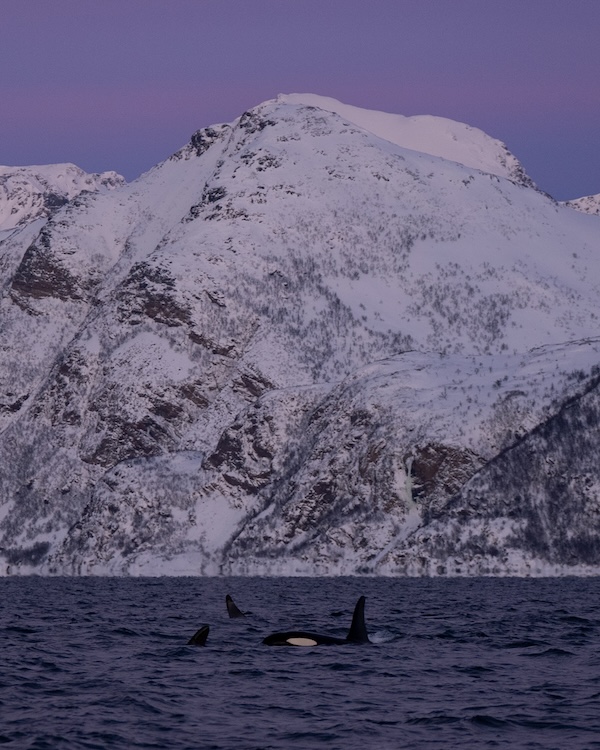
A pod or orcas off the coast of Norway hunts herring with the precision of apex predators. It’s a stark paradox that marine parks like SeaWorld and Loro Parque confine these intelligent, socially complex beings to tiny show stadiums, training them to perform tricks for food rewards of dead fish, and reducing them to submissive beggars and performers. Credit: Alexandra Johnston
Standing on that boat, cold and unsteady in rough water, the experience reinforced what captive orca spectacles consistently deny: awe does not require closeness. It does not require control. It requires accepting that distance is essential to respect.
If we want future generations to care about orcas, we must teach them that care does not mean possession, and that wildlife belongs in its own world, not in ours.
Wild orcas move through their world as they choose, following their own paths. Any glimpse we get is entirely by chance. If we do, consider ourselves lucky—no one has a right to witness them. They live in a completely different world than us, and there is meant to be space between us.
Observing them this way, without control or entitlement, makes it impossible to mistake guaranteed access for genuine connection.
And applause will never sound the same again.
Featured image: Wild orcas move through the ocean guided by their own knowledge, experience, and social bonds. This individual, part of a coordinated hunt, demonstrates strength, power, and purpose that can never exist in captivity. In marine parks, orcas are confined to concrete show arenas, their days dictated by training sessions and performances, their intelligence and skills reduced to routines for spectators. The raw vitality of a wild orca could not be more different from the controlled, predictable lives of those held in tanks. Credit: Alexandra Johnston
