Stopping the Exploitation of Dolphins in Germany
 20Jan
20Jan
A few months ago, the Flemish Minister for Animal Welfare announced that Boudewijn Seapark, which is located in Bruges, Belgium must close its doors by 2037 at the latest. With this decision, Belgium will finally become dolphinaria-free. When will Germany do the same and ban the confinement and commercial exploitation of dolphins?
Just like several other countries in Europe, Germany has a gloomy history of using dolphins in theatrical shows, and over the years, Germany has had 14 captive dolphin facilities, including 2 traveling dolphin circuses. Today, only two remain: one at Nuremberg Zoo and the other at Duisburg Zoo. They hold seven bottlenose dolphins each. Three of the dolphins that perform at Nuremberg Zoo were sent there from Duisburg Zoo.
The dolphins at Duisburg Zoo are confined in an indoor roof-covered stadium which seats 1400 spectators, and by taking advantage of the dolphins’ hunger, trainers have successfully shaped them into performers who carry out repetitive shows in exchange for food rewards of dead fish.
Duisburg Zoo’s dolphin stadium opened its doors to the public in 1965, and in the past, the zoo purchased several wild-caught cetaceans of different species. Dolphins that once swam in the waters of Florida, Argentina, Colombia, Mexico, Chile, Venezuela, and Canada’s Hudson Bay have ended their lives inside the minuscule concrete confinements at the zoo. Among them are beluga whales, Amazon River dolphins, Commerson’s dolphins, tucuxi dolphins and, of course, the ever-popular bottlenose dolphins. The zoo’s last remaining Amazon River dolphin, known to zoo visitors as “Baby,” lived in isolation for 14 years before he passed away in December 2020. Today, the last remaining cetacean species at the zoo are bottlenose dolphins. As of January 2025, seven dolphins, of which two were captured from the wild and five were born there, are used in shows.

Captive dolphins throughout Europe are put to work to attract paying customers. During the captive-dolphin spectacle at Duisburg Zoo, the dolphins play ball, jump, and beach themselves on command. The spectators are amused by it and are led to believe that the dolphins, too, are having fun. In reality the dolphins are doing what they know they have to in order to obtain food rewards. In short, they work for food. Credit: Ron Weimann
Ivo was captured in 1981, as he was swimming alongside his mother in the Gulf of Mexico. Both he and his mother were sent to Antwerp Zoo in Belgium in March of the same year. They were then sent from Belgium to Duisburg Zoo in March 1999 when the dolphin stadium in Antwerp Zoo closed down. Iris died at Duisburg Zoo four years later, in March 2003.
Pepina was wrestled from her mother in Cuba in November 1983 when she was just a young calf. According to Duisburg Zoo’s own website, she performed at Hansapark Sierksdorf until 1994 when she was shipped to Duisburg. Her daughter Daisy, who was born at Duisburg Zoo, also performs there. Pepina’s son Diego and her grandson Darwin, however, were sent to Lanzarote dolphinarium in Spain in 2016. Pepina’s daughter Donna was sent to Nuremberg Zoo in 2014.
Delphi was born at Duisburg Zoo in July 1992. Her parents were named Flapine and Playboy. (Flapine died in 1994 after spending 13 years at the zoo. Playboy died in the year 2000 after spending nearly two decades as a performer.) Delphi is the mother of three female dolphins named Dörte, Dolly, and Dora. Dora still performs in Duisburg. Dörte and Dolly have both been sent to Nuremberg.

The performance of captive dolphins is achieved through a strictly controlled training method that takes advantage of the dolphins’ hunger and total dependence on their trainers for food. Credit: Ron Weimann
Daisy was born at Duisburg Zoo in September 1996. Her mother is Pepina. According to online information, Daisy was sired by Playboy.
Debbie was born at Duisburg Zoo in December 2015. Her mother is Delphi. According to online information, Daisy’s father is wild-caught Ivo.
Dobbie was born in September 2016. His mother is Pepina, and her father is wild-caught Ivo.
Dora was born at Duisburg Zoo in September 2020 to Delphi and Ivo.
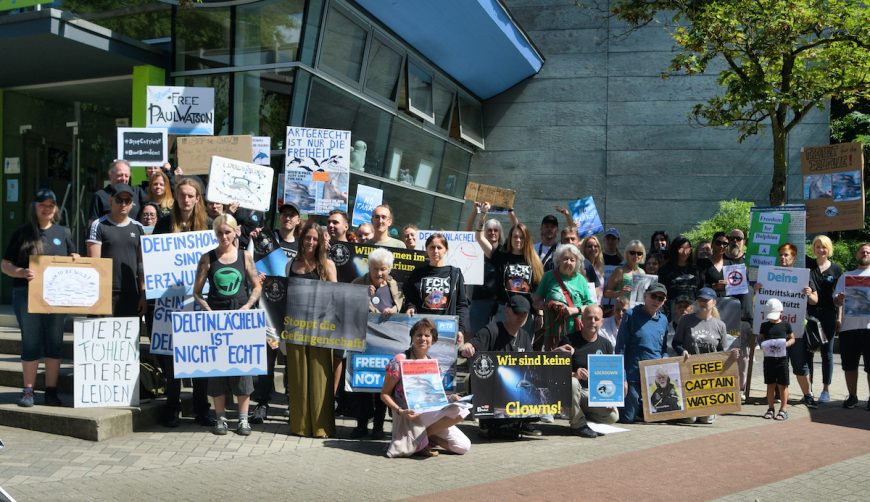
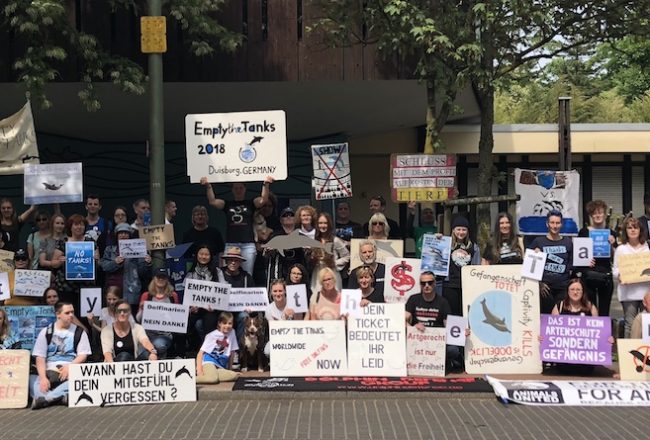
The German organization Freedom for Dolphins and Whales, which was founded by dolphin freedom advocate Chriss Küppers in 2011, held protests in front of the zoo every single day for 44 days during the schools´ 2024 summer break when families flocked to the zoo to watch the dolphins perform. Chriss and his team of volunteers spent hours each day passing out flyers and trying to convince people not to buy tickets. We fully support Freedom for Dolphins and Whales in their efforts to make the confinement of dolphins in Germany a thing of the past and in August last year participated in a protest in front of the Duisburg Zoo together with Chriss and fellow activists.

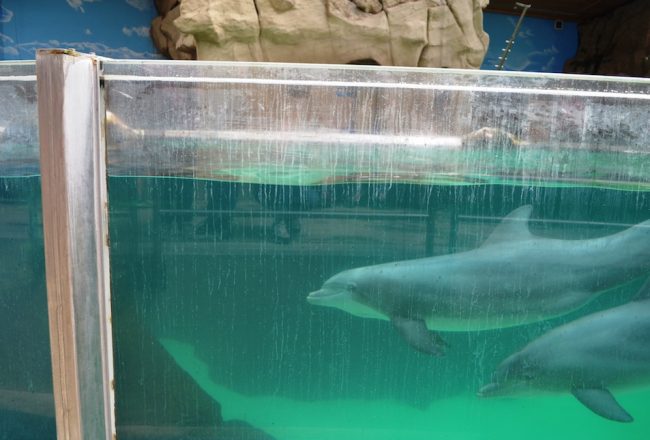
Performing dolphins at the Duisburg Zoo. Credit: Ron Weimann
How you can help
➡️ TAKE ACTION: Orcas and Dolphins Do Not Belong in Captivity!
➡️ SIGN THIS PETITION: Take the pledge to never buy a ticket to a dolphin show
➡️ If you live in or near Germany, please participate in one of the protests at Duisburg and/or Nuremberg Zoo
Featured image: Duisburg Zoo has been exploiting dolphins in shows for five decades. The dolphins are confined in a small roof-covered stadium, and there is no way for them to express their natural abilities, such as foraging, navigating, and exploring. It is time for all countries in Europe to finally ban the cruelty. We support the German NGO “Freedom for Dolphins and Whales” in their efforts to stop the exploitation of dolphins in Germany. Credit: Ron Weimann

Related posts
Dolphin Exploitation at Duisburg Zoo
Empty the Tanks at Duisburg Zoo!
