Taiji Dolphin Sales are Being Revealed
 19Nov
19Nov
Over the past several months, Japanese organization Life Investigation Agency (LIA) has been sorting through and translating 1000s of documents acquired from the town of Taiji pertaining to the sales, exportation and inventories for live dolphins. These documents were acquired as a result of a nearly three-year long legal battle in which the high court ruled that Taiji’s response was unconstitutional – a ruling in our favor.
For decades there has been a great effort to conceal not only the drive hunts, but also the information of where live-captured dolphins were going, how many die during the training process, and much more.
We have only scratched the surface in translating these documents, but here is some of what we know so far:
At least 73 dolphins have been sold from the Taiji Whale Museum to Eastern Sunrise Wildlife Services Co. Ltd. and Tianjin Foreign Trade Group, and Fujian Province Changtai Tianzhu Mountain Feilong Tourism Development Co., Ltd. between – all three of these corporations are located in China. Species sold in these instances include bottlenose dolphins, Risso’s dolphins, melon-headed whales, pan tropical spotted dolphins, Pacific white-sided dolphins, striped dolphins, and a rough-toothed dolphin.

Entrance to the Taiji Whale Museum, Taiji, Japan. Credit: DolphinProject.com
The price for each individual dolphin in these transactions range from $30,000 USD to $128,626.00 USD (¥20,000,000). Factors such as age, sex, species and level of training are believed to determine the price. The majority of the higher priced dolphins are bottlenose dolphins. All of the dolphins each priced at $30,000 USD (¥4,662,720) were Risso’s dolphins.
Eastern Sunrise Wildlife Co. facilities include:
- Yunnan Joy World Investment Holding Co. Ltd.
- YiJiu Village, Yousuo Town, Chengjiang Xian, Yuxi City, Yunnan Province
- Fujian Province Changtai Tianzhu Mountain Feilong Tourism Development CO. Ltd. Tourism Ocean World
- Tianzhushan, Mayangxi Ecological Tourist Area Changtaixiam, Zhangzhou City Fujiansheng, P.R. China
Fujian Province Changtai Tianzhu Mountain Feilong Tourism Development Co., Ltd. facilities include:
- Tingxia State-owned Forest Farm Ecological Tourist Area, Changtai Mayangxi, Shangzhou City, Fujian Prov.
Tianjin Foreign Trade Group TEDA Co. Ltd. facilities include:
- Shandong Kunhe Tourism Development Co. Ltd
- No.08 Tourism Rd., Yellow River International Ecologie Town, Qihe, Shandong

Wild-caught dolphin loaded into a truck to be transferred to an unknown destination, Taiji, Japan. Credit: DolphinProject.com
This document also revealed that two additional bottlenose dolphins were sold from the Taiji Whale Museum to South Korea in September, 2016. Thankfully, no more dolphins will be going here. In April, 2018, South Korea’s Ministry of Environment announces a revised bill on the Protection and Management of Wildlife, banning all imports of dolphins captured in such a brutal manner.
What about dolphinariums that don’t directly purchase from Taiji?
These newly released documents reinforce the reality that the aquarium and marine park trade are inextricably tied to Taiji’s dolphin drive hunts, and that the desire for captive dolphins fuels the continuation of these captures.
In recent years, a growing number of places around the world have banned importing dolphins from Taiji, largely due to the documentation showing the cruel treatment during the drive huntsor have banned captivity altogether. These are positive steps in the right direction, but there is still much work to do. The dolphin captivity industry is very interconnected, and many dolphinariums that are not currently purchasing dolphins from Taiji still have international influence- newer marine parks in China with orca and dolphin stadiums bear a striking resemblance to the biggest-name marine parks in the US. There has also been multiple instances of facilities in the US and Australia, as well as IMATA, hosting programs to teach dolphin trainers that work with wild-captured dolphins. Both LIA and Dolphin Project have also documented foreign dolphinarium employees being trained in Taiji in past years.
What’s next for the Taiji campaign?
LIA and Dolphin Project have won all lawsuits we filed against the dolphin hunting and captivity industry. Legal actions take a great deal of time and resources, but we believe that shifting our campaign focus to these will have a greater chance to not only expose aspects of the hunts that were previously inaccessible, but also to end the hunts as a whole.
As LIA continues to process documents from Taiji, we will continue to work together and share the information revealed here on our blog.

Ren Yabuki of LIA in front of Osaka High Court May 17, 2024. Credit: LIA
As discussed above, the primary economic driver of Taiji’s drive hunts is the global captivity trade. The easiest way you can take action is to NOT buy a ticket to any facility that displays captive dolphins or whales.
Find more ways you can help take action at:
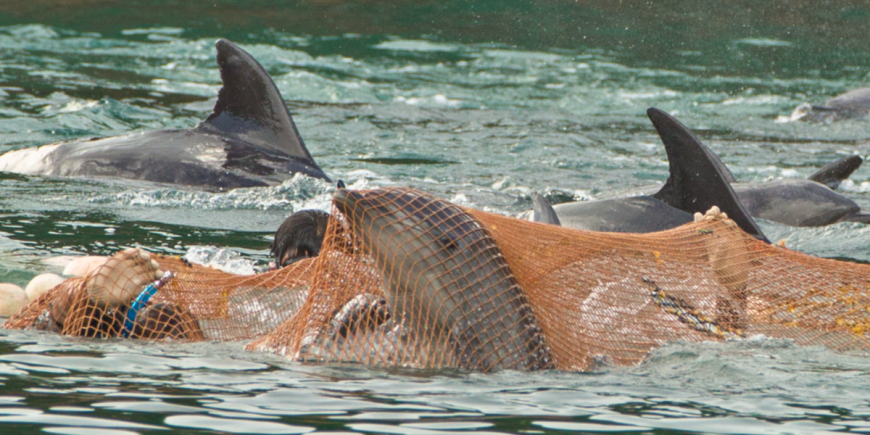
Featured image: Wild bottlenose dolphins brutally captured during a drive hunt in Taiji, Japan. Credit: DolphinProject.com

Related posts
25 Dolphins Taken Captive as Taiji Hunts Begin
Beyond the Cove: How Captivity Sustains the Hunts