Taiji: Nothing Justifies This Level of Cruelty
 11Dec
11Dec
Whenever we post footage of the dolphin drive hunts in Taiji, Japan, some people immediately reach for the same predictable defenses: “Well, we eat cows and chickens, what’s the difference?” or “It’s their culture.” Both fall apart the second you look closely.
Pointing to the suffering of other animals doesn’t excuse this one. If something is cruel, it’s cruel, no matter the species. Few people would ever defend the deliberate and prolonged torture of a cow or a lamb. Yet some use the suffering of livestock to justify Taiji’s dolphin hunt—a moral shrug that basically says, “We harm so many already, so why care about this?” But pointing to other harms does not make this one disappear. It only reveals how far we still have to go in building an ethical relationship with animals whose lives are in our hands.
Another reason this “what about cows, lambs, and chickens” line appears so often is that some people use it to imply we’re giving dolphins special attention, as if caring about one species means ignoring the rest. But empathy isn’t a finite source. The opposite is true: people who care about dolphins almost always care about other animals as well. And those who jump into dolphin-related posts with “Why aren’t you fighting for cows?” are really saying we should work on every animal welfare issue simultaneously. The irony, of course, is that they’re usually the ones who work on none of them. Their objection isn’t about fairness; it’s a way to shut the conversation down and avoid taking responsibility for animal cruelty altogether.
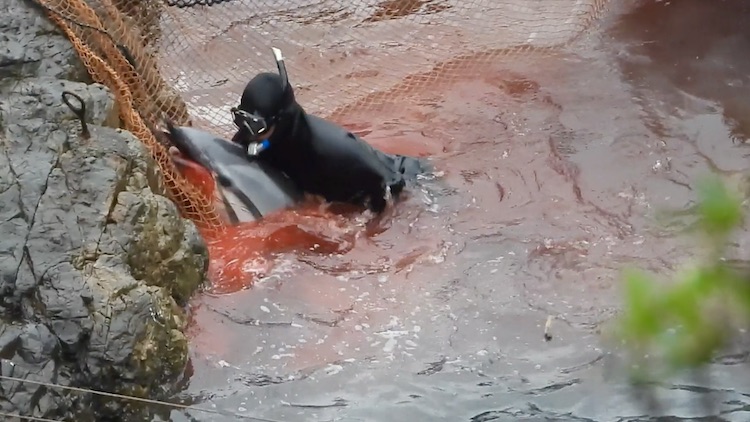
In Taiji’s Cove, a diver grabs a striped dolphin. Its beak torn, blood flowing—a scene of sheer brutality. That anyone could try to justify this is beyond belief. Credit: DolphinProject.com
And the “culture” argument?
Calling something culture doesn’t make it ethical or justified. Taiji defends the dolphin drive hunts as a traditional practice, claiming they are essential to feeding local people. Whatever the claim, neither culture nor tradition can legitimize intentional and calculated cruelty. In the Cove, dolphins endure sheer torture. That the meat is contaminated with some of the world’s most dangerous toxins—mercury among them—only reveals how reckless this justification is.
As for tradition, the historical record tells a very different story. In 2013, Japanese conservationist Sakae Hemmi explained how recent Taiji’s systematized drive hunt actually is, citing the town’s own publication, The History of Taiji (1979).
According to Hemmi, “The first recorded dolphin drive was in 1933, with subsequent hunts occurring in 1936 and 1944. It was not until 1969 that dolphin drive hunts have been conducted on a large scale.” She also noted that the 1969 hunt was not about food at all, but about capturing pilot whales for display at the Taiji Whale Museum.
“In other words,” she wrote, “the dolphin drive was purely for profit having nothing to do with cultural history.”
And that is exactly what we see today.

Risso’s dolphins are among the species targeted in Taiji’s annual drive hunts. This image shows a mother and her calf after they were driven into the Cove and killed, a heartbreaking reminder of the brutality of the hunt. This is not culture, nor tradition. It is simply cruelty. Credit: DolphinProject.com
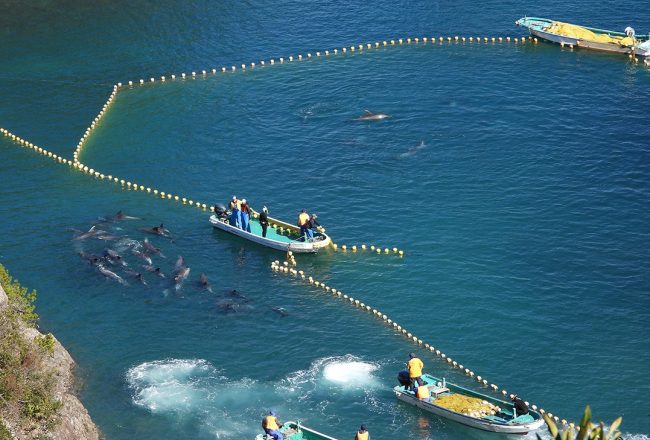
In Taiji, the dolphin drive hunt is a modern, profit-driven operation executed with military-like precision—a system designed to drive dolphins into a Cove, kill some, and sell others to dolphinariums and marine parks for enormous sums. The live-capture industry is what keeps these hunts alive.
How anyone can watch the footage of this violence and still dismiss it as “culture” or as “men trying to feed their families” defies belief. The willingness to defend something so unmistakably cruel exposes how readily some people rationalize brutality when it suits their narrative.
And even if the dolphin drive hunts were rooted in ancient tradition—which they are not—the brutality is so extreme that the idea of justifying it is staggering. What happens in that Cove is so grotesque, so wildly cruel, that no one should be able to witness it and then search for justifications. To defend it is to sink to the lowest moral ground: to endorse a world in which humans are entitled to do anything they wish to other living beings, to inflict as much pain as they want, with no boundaries whatsoever.
We owe it to ourselves—and to the animals affected by our choices—to confront practices that cause profound suffering and to fight against them whenever they occur. Silence and deflection aren’t neutrality; they are complicity, allowing the cruelty to continue while giving people an easy excuse to do nothing.
Featured image: Dolphins trapped and killed in Taiji’s Cove. It’s a brutal, barbaric practice that leaves no doubt about the suffering inflicted. Credit: DolphinProject.com

Related posts
25 Dolphins Taken Captive as Taiji Hunts Begin
Beyond the Cove: How Captivity Sustains the Hunts