The Fight to End Taiji’s Dolphin Hunts
 11Sep
11Sep
Taiji’s Japan’s annual dolphin drive hunts have officially begun. Each year, commencing on or around September 1 and continuing for six months, a large-scale hunt of a variety of dolphin species takes place in this small village. The brutality of these hunts was laid bare in the 2010 Academy Award-winning documentary The Cove, which documented the ruthless drive hunt techniques used to herd dolphins to shore, resulting in their capture or death.
One only has to examine Taiji’s own documentation to see what is fueling such a level of cruelty – and it all points to the live trade of dolphins to aquariums and marine parks for public display, and corporate profit. While a secondary component of these hunts is the slaughter of dolphins for meat, the price for live captures is many times higher than for those killed. We are also seeing the price for dolphin meat decrease due to the lack of demand, with prices being slashed even before their expiration dates.

Dolphin meat is seen in the sale section of a store near Taiji, with prices marked down before the expiry date. Credit: DolphinProject.com
For many years, Dolphin Project focused exclusively on putting Cove Monitors on-the-ground to document the drives. However, over the past few years, we have shifted our strategy, focusing instead on funding several lawsuits and other legal actions, as well as promoting education within Japan to both defend dolphins and expose aspects of the hunts that were previously unobtainable. We continue to work with a growing number of independent Japanese activists, including the Japanese NGO Life Investigation Agency (LIA), with whom we are collaborating to analyze crucial documentation related to the hunts. Dolphin Project believes that the greatest opportunities to end the hunts as a whole lie within this strategy.
Did You Know
➡️ Since 2002, Dolphin Project has been actively sharing information related to the hunts with many Japanese organizations, as the hunts are still widely misrepresented in the mainstream media. In addition, Dolphin Project has made available all associated Cove Monitor documentation, including photographs and videos to all Japanese activists to help in their efforts to campaign and educate within Japan.
➡️ Over the years, both the town and the dolphin hunters have made it increasingly hard to view and document the slaughters, with vantage points becoming overgrown with green and bushes. In 2017, Dolphin Project shot the first-ever drone footage of the entire dolphin hunt, from boats leaving the harbor to driving the dolphins into the Cove to the actual slaughter. Previously, the only footage filmed by a drone was of the hunting boats at sea. LIA continue to film utilizing drones and subsequently documented four years of hunts, obtaining never-before-seen footage. This material is leading to new legal actions.
➡️ Dolphin Project has aided hundreds of Japanese activists coming to Taiji to witness the hunts for themselves, many of whom currently work within Japan on cetacean-related anti-captivity campaigns unrelated to Dolphin Project’s Taiji campaign. This remains a stated goal of Dolphin Project Founder/Director Ric O’Barry.
➡️ Dolphin Project and LIA have filed more lawsuits and criminal allegations related to the Taiji dolphin hunts than all other organizations combined.

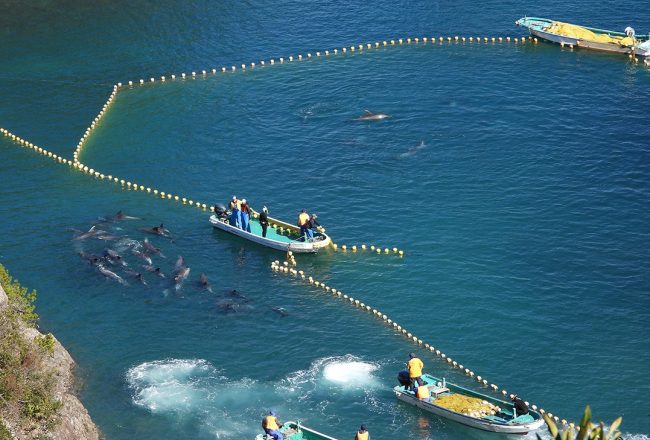
Dolphins are driven into the Cove for slaughter or captive selection, Taiji, Japan. Credit: LIA/DolphinProject.com
To-date, Dolphin Project and LIA have won all lawsuits filed against the dolphin hunting and captivity industry, with several locations around the world now banning the importation of dolphins from Taiji. While these are definite ‘wins,’ more work needs to be done. The dolphin captivity industry is a well-connected machine, with Taiji still having international influence through its reciprocal programs with global marine parks.
Please note: Due to the nature of these lawsuits, not all information can be shared publicly during the filing and/or initial stages of the case(s) as they may contain criminal investigations. We will do our best to keep supporters up-to-date as events transpire.
Ultimately, what is needed is a shift in perception – namely, respecting dolphins as wild-ranging creatures of the sea, deserving of their own freedoms and autonomy versus perceiving them as merely trained assets. Only when this shift does occur will captivity fade into cessation.
Read more about our campaign in Taiji, Japan.
Dolphin Drive Hunt Quota 2025-26

2025-26 Dolphin Drive Hunt Quota, Taiji, Japan
How You Can Help
➡️ Legal actions take a great deal of time and resources, including but not limited to contesting the legality of certain aspects of the drive hunts, including quotas, and species captured and slaughtered. Please consider making a donation in support of our efforts to end the dolphin hunts.
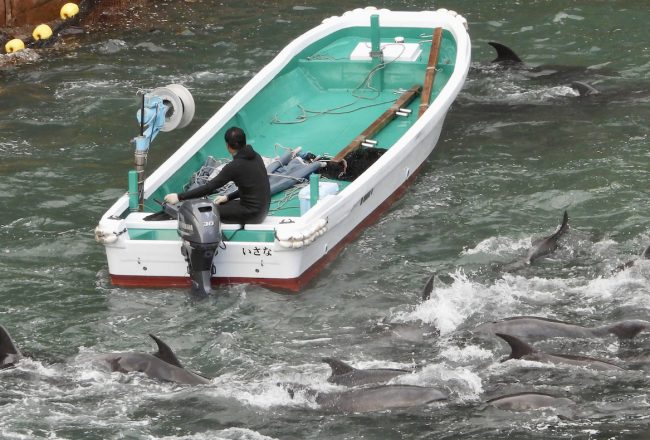
Featured image: Wild-caught bottlenose dolphin secured to skiff, after being driven into the Cove and selected for “life” in captivity, Taiji, Japan. Credit: DolphinProject.com

Related posts
25 Dolphins Taken Captive as Taiji Hunts Begin
Beyond the Cove: How Captivity Sustains the Hunts