The Pain of the Pilot Whales
 21Nov
21Nov
Each and every dolphin driven into the infamous Cove in Taiji, Japan suffers. The suffering begins at sea as the banger boats intercept dolphin pods traveling and feeding along the Kuroshio current. They begin to herd the dolphins to shore by creating a wall of sound which terrifies the dolphins and pushes them to swim towards the Cove (imagine running for your life for hours and hours, being relentlessly harassed and pursued.) It is unknown just how many dolphins die during the stressful drive to the Cove.
Once driven in, the stress continues as dolphins are confined and netted in the Cove, closer to shore than they’ve ever been. We have seen dolphins die from the stress of the process, floating lifelessly in the Cove until collected by the hunters. We’ve seen dolphins panic and drown while in the Cove. Dolphins that are slaughtered endure the “humane” death of having a sharp metal spike hammered or pushed into their necks, just below the blowhole, in an attempt to sever the spinal cord and produce a quick death. (There is evidence to prove that the dolphins do not die within seconds or even a few minutes.) We have heard the sounds of tails slapping the water for an extended time as life slowly fades. We have seen dolphins bleeding from their wounds escape from under the tarps only to be caught in nets and drown as well as dolphins who were presumed dead, being carried to the butcher house, thrashing under the tarps, still alive until they drown from being pulled through the water or the job is finished at the butcher house. There is no question that all dolphins suffer physical pain when driven in and slaughtered in the Cove. That alone is enough to end these brutal hunts but there is more. What about the emotional pain and suffering these dolphins experience?
Dolphin brains, like humans, contain spindle neurons. These brain cells are only seen in humans, the great apes, elephants and have been confirmed in some dolphin species. Like in humans, these spindle neurons support emotional processing and complex social behaviors. These cells are thought to be involved with processing emotions and social interactions. It’s believed that animals with spindle neurons can recognize distress, have deep emotional responses to others and form deep social bonds. The presence of spindle neurons leads to the capacity for deep suffering. They allow for grief, sadness and social pain, in addition to physical pain. Pilot whales have the largest number of spindle neurons of all dolphin species, not the most density but the largest number due to their large brains. Pilot whales have some of the deepest social bonds in the animal kingdom. A tragic example is their tendency for mass stranding, where a few individuals strand due to illness or disorientation and the entire pod follows. Efforts to refloat individuals often fails because they will not desert their family members. We see this behavior in the Cove, as well.

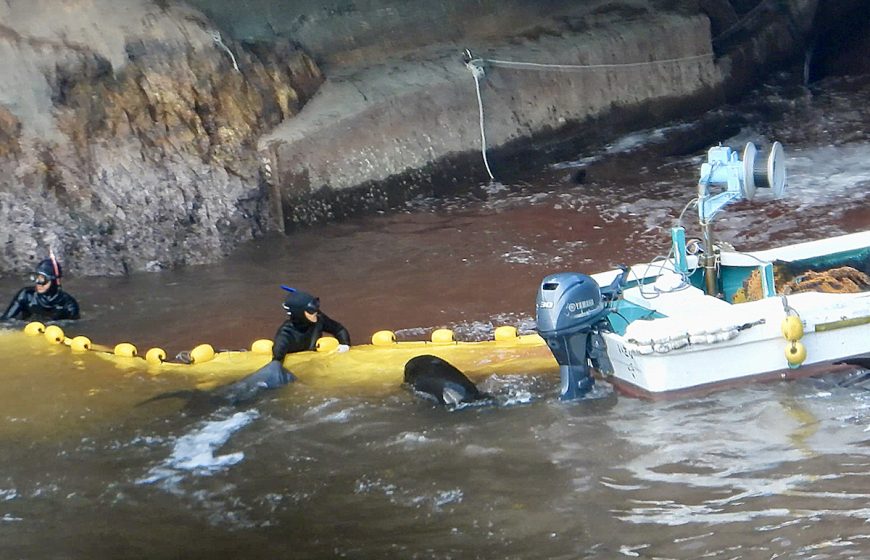
Hunters separate adults from juvenile pilot whales in preparation for slaughter, Taiji, Japan. Credit: Sachiko Ota
Recently, Japanese advocate Sachiko Ota was able to capture shocking footage which shows the intense suffering endured by these sentient beings. Although the footage is difficult to watch, it provides damning evidence as to the cruelty of these hunts. Pilot whales are the second largest dolphin, only killer whales are larger, and ramming the killing weapon through their thick layer of blubber precisely into the spinal cord must be difficult. During this drive, the hunters took four hours to kill 10 pilot whales, forcing both those who were slaughtered and those who survived to endure prolonged suffering. In the footage, we see pilot whales tied by their tails and tethered in very shallow water where they struggle to breathe. While the actual killing is not seen, the water is red with pilot whale blood. Pilot whales are a matriarchal species with females providing leadership and care for the young. There are fewer males than females in pilot whale pods. One of the roles of the males is that they are thought to provide calmness and help keep the pod together during stressful situations. Calves have been seen rubbing up against the males when trapped in the Cove. It is also thought that the males take on the role of protectors. In the wild, males are often seen on the periphery of the pod, a line of defense for the females and the young. The males are larger than females and have a very distinctive large, hooked dorsal fin. In this pod, two very large males could be seen. The hunters went after them first. They didn’t see them as the protectors of the pod but rather as the bodies with the most meat, therefore, the most money. In the footage, we see the two large males desperately trying to get out from under the tarps, desperate to get to their family, to protect them. They struggle mightily but their tails are tied to posts on the rocky beach. Unable to escape, they continue to fight to get to their family as life slowly drains from their bodies. Sadly, it is impossible for them to protect family members from the hunters. The adult females are also seen. Struggling to survive, to escape, to get back to their family. It is a brutal and sad scene. Death does not come quickly. From start to finish, the suffering is prolonged.
“Documenting pilot whale drives has a different feel. Their family bonds are something you can visually see and viscerally feel.” ~ Tim Burns, Dolphin Project
The suffering is not limited to those who are slaughtered. Survivors suffer too. This can be seen in the behavior of the young pilots. With family members’ tails roped and struggling, instead of showing concern for self-preservation, they try with all their might to get under the tarps to their family. They swim in sickening red water. Pilot whales have language and, surely, the young pilots recognize the adults are in great danger but instead of fleeing and moving as far away from the killing area as possible, they push and push in vain in attempts to reach the tethered adults. The hunters pull a net across the front of the killing area and can be seen lined up, pushing the youngsters away. In one heartbreaking scene, a juvenile pilot whale desperately tries to get to one of the tethered males, its protector, and the male tries just as hard to reach the young pilot whale. They are so close to each other but separated by the net and can’t quite reach each other. One can only imagine the emotions these two sentient beings endured. The anguish continues as the pilot whales’ struggles continues. Swimming in bloody water, the distraught pilot whales try desperately to be together but the wall of hunters pushing the panicked young pilots away prevents this. Finally, skiffs are used to force the young pilots away from the tarps, the black tarp of death is pulled across and the lives of the adult pilots are extinguished.

Hunters tether adult pilot whales prior to slaughter, Taiji, Japan. Credit: Sachiko Ota
The terrified young pilots are netted off in a separate area. Alone. Some are battered and bloody from the struggle. They must be so confused and dazed by what is happening, as the adults they rely upon to guide them, to teach them, and to protect them are gone. They spyhop, looking for their family but all they see is the skiffs dragging the lifeless bodies of their family members away. Perhaps calling out to those who cannot answer. The remaining pilot whales will be released. While some may see the release of juveniles as an act of kindness, it is more likely an act of business as the smaller bodies provide less meat and the hunters have a quota. Pilot whale releases are always difficult as the young pilots refuse to leave and always try to return to the Cove where they last saw their family members. Hunters struggle to drive them back out to sea. Will they survive? There is no way to definitively know, however such drastic changes to social structure, along with the loss of the adults makes survival difficult and unlikely.
One doesn’t need to know about the complex brains of pilot whales or the spindle neurons providing the capacity for deep emotions to understand what happens during a pilot whale slaughter. The images tell a story of pain and suffering, of families devoted to each other, of adults comforting frightened and confused young pilots and the pod hopelessly struggling to be together, to protect each other during their darkest hours. Pilot whales are not popular in the captive trade. They are hunted mainly for their meat – meat which has been claimed to be very popular by some who defend the hunts but was seen last season “on sale” with prices up to 50% off at a local grocery store. Given their intelligence and deep emotions, their capacity to experience pain and suffering both physically and emotionally, as well as their importance as top predators in keeping our ocean ecosystems healthy, it seems a very high price to pay for a meal.
Featured image: Hunters push juvenile pilot whales away as adults are prepared for slaughter, Taiji, Japan. Credit: Sachiko Ota

Related posts
25 Dolphins Taken Captive as Taiji Hunts Begin
Beyond the Cove: How Captivity Sustains the Hunts