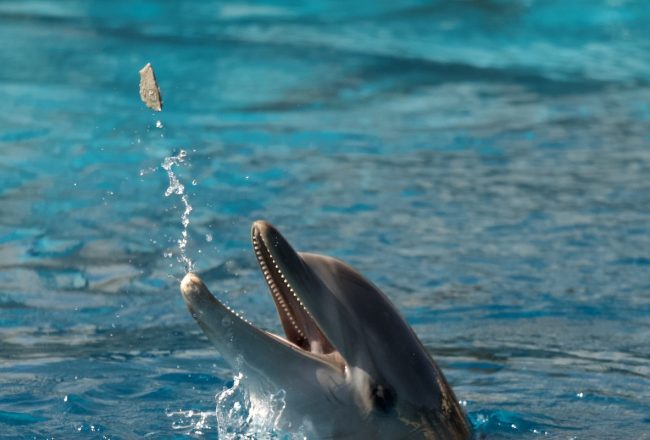
What Happens During Taiji’s Off-Season?
 02May
02May
Taiji, Japan’s infamous dolphin hunts – exposed worldwide in the 2009 Academy Award-winning documentary film The Cove – are not set to resume for another four months, yet life has not returned to normal for the wild-caught dolphins now stuck in the town’s tiny sea pens. For these cetaceans, there will be no return to normal life, no reunion with family members, and in fact, no self-determination at all.
What is taking place is the breakdown of a wild animal into a trained asset.
For a mammal used to navigating an aquatic environment, utilizing underwater skills such as echolocation, foraging and exploration, the shift to receiving cues above the water’s surface must feel extremely unnatural and disorienting. A dolphin’s physiology has evolved over millions of years for living life underwater, including a streamlined physical shape, specialized breathing systems, and unique brain patterns for safe sleeping. Imagine how incredible this actually is: an air-breathing mammal living their entire life in water. Does it not seem then, counter-intuitive to attempt to reverse the sophisticated adaptations dolphins have developed?

A dolphin’s life in captivity is a series of repetitive days pleasing paying crowds for dead fish rewards. Credit: DolphinProject.com
In captivity, dolphins are unable to be dolphins. They are fed dead fish, routinely supplemented with vitamins and minerals to help combat nutritional deficiencies. They are taught behaviors designed to be seen by paying customers, in other words, ones performed above the water’s surface. They are forced into groupings not of their choice. Their offspring, mostly conceived via artificial insemination, are often removed from their mothers at a young age. They are unable to use their powerful flukes to swim as there is literally nowhere to go. It is no wonder that so many captive dolphins suffer from severe stress. This is what the future now holds for the dolphins captured during Taiji’s brutal drive hunts.
What we are witnessing, when we see a dolphin at an aquarium or marine park is a mammal attempting to survive. With the removal of nature, and the replacement with something unnatural, the odds are stacked against survival. Even if some dolphins do manage to ‘live’ years under such conditions, the issue is not one of quantity, but of quality. This is not living, nor is this the sort of “education” that should be taught at such attractions.
In contrast, the utilization of emerging technologies could teach a curious public about the wonders of dolphins, without ever having to capture one, or breed one. And the best part? No animals would be harmed by such methods, and one could actually get to experience the true, wild nature of these beautiful beings.
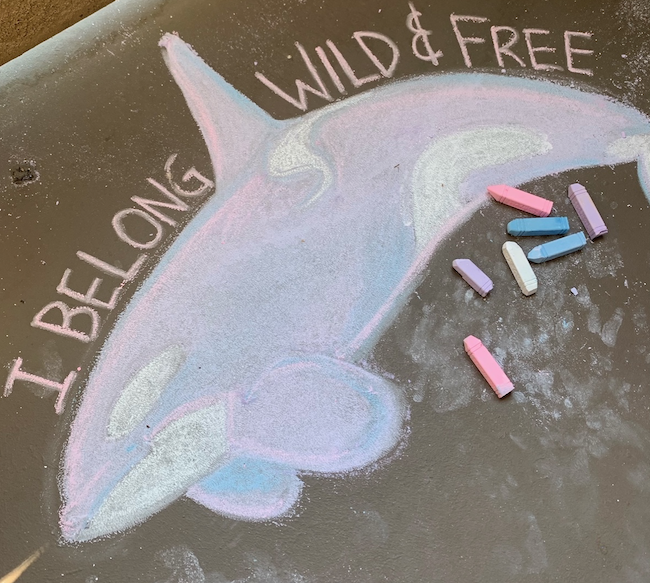
I Belong Wild and Free. Credit: Chalk art by Tracie Sugo
How You Can Help
If you’ve been inspired by this blog, please consider joining an Empty the Tanks event at a city near you, taking place on May 10 and 11.
Learn more about Dolphin Project’s 50+ years protecting dolphins worldwide.
Featured image: Wild-caught Pacific white-sided dolphin in sea pen, Taiji, Japan. Credit: DolphinProject.com

Related posts
25 Dolphins Taken Captive as Taiji Hunts Begin
Beyond the Cove: How Captivity Sustains the Hunts