When the Show Ends, Who Cleans Up the Mess?
 27Aug
27Aug
Marineland in Antibes, France, is finally closed – and that’s a good thing. To those of you who stood outside the gates and protested: take a bow. This is your victory. You are the reason the show is over, yet somehow your voices are often being left out of the conversation surrounding Marineland’s closure. At Dolphin Project, we’ve always aimed to recognize those on the front lines – and there’s no question it was the many compassionate protesters who pushed authorities to finally say: enough is enough.
But now, as dolphins languish in deteriorating tanks, the finger-pointing has begun. And it’s aimed in the wrong direction. People are asking the animal welfare community, including Dolphin Project:
“The shows are over, but the animals are still trapped. What are you going to do about it?”
As if it’s somehow our responsibility to clean up the mess left behind by the multi-billion-dollar corporations and their complicit agencies.
Wrong question.
The real question is:
“Why aren’t Marineland and the authorities being held accountable?”
They created, sanctioned, and profited from a system built on capture, captive breeding, and long-term confinement. The blame lies with them, not with the activists who spent decades working to prevent this cruelty.
I, for one, have been working to clean up their mess since 1970.
Marineland and the French government were the primary profiteers, reaping millions through ticket sales and taxes. So why is the burden now falling on those of us who exposed and documented the abuse for years?
Stop blaming the activists.
Start asking what they – the guilty – are going to do to make it right.
It’s time for Marineland and the government to open their check books and invest in sanctuaries for the animals they no longer profit from.

Dolphin Project built this simple dolphin sanctuary in less than a week in Laguna, Brazil for Flipper, the last captive dolphin there. Not to be confused with the Umah Lumba Center, in West Bali, Indonesia, which is a floating seapen, this sanctuary was fixed, meaning that poles were driven into the sandy bottom. And here is where Flipper underwent intense rehabilitation. When it came time for release, we simply opened the gate and gave him the choice of freedom – which he took. (For the next two years following, there were multiple documented sightings of Flipper.) Credit: David Higgs
Marineland purchased wild-caught orcas and bottlenose dolphins and deliberately bred and, in some cases, even in-bred them in small, barren tanks, with government approval. They created these lives for commercial gain, and they are responsible for them for the entirety of those lives. Authorities should have made it clear from the beginning: If you profit from captivity, you are responsible until the end. You don’t get to walk away. You don’t get to quietly ship these animals off to China, Japan, Spain, or elsewhere the moment they are no longer useful to you.
Right now, two orcas and 12 bottlenose dolphins remain in those tanks, bored, confused, and isolated. I have reason to believe they are receiving the bare minimum of mental stimulation, if any at all. And boredom, in captivity, is a killer. Marineland knows this. Since Marineland’s closure, the park’s true face has been revealed. They do not care about the welfare of these animals. If the authorities gave them the green light, they’d pack these dolphins into crates and ship them out of the country without a second thought.
Last year, one of the orcas died a preventable and painful death after swallowing a piece of metal from a tank that is literally falling apart. That could happen again – and if it does, Marineland and the authorities will be to blame.

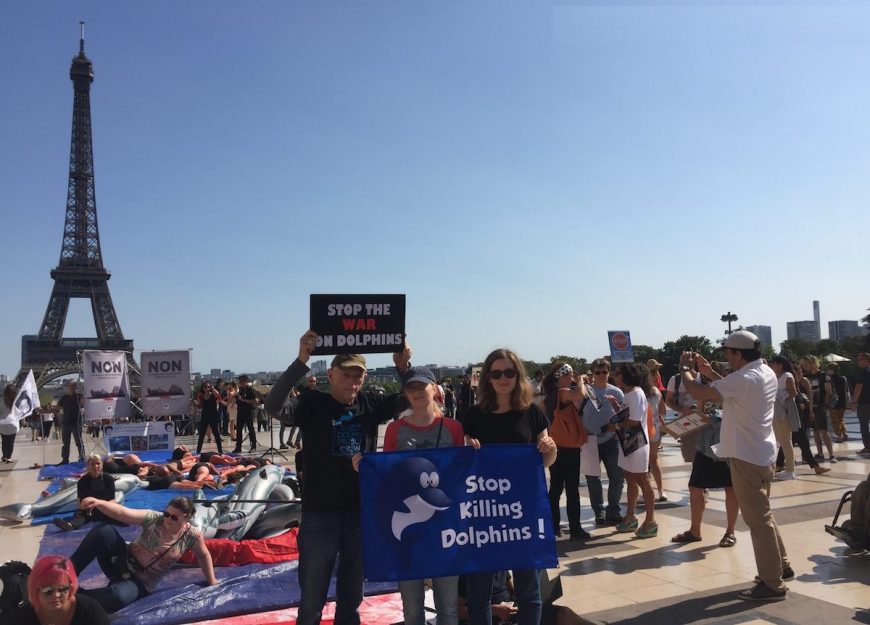
Ric O’Barry and local activists protest in front of the gates of Marineland in Antibes, France. Credit: Helene O’Barry
Why is it taking so long to get these animals out? How hard is it to construct a temporary seapen while working on a permanent solution? They will die in those tanks if nothing is done. It’s been months since the park closed its doors to the public, and the dolphins are still waiting. How much longer can they wait?
It’s time to stop dodging the truth and finally lay responsibility where it belongs. Marineland and the authorities created this tragic situation. Now, they must work together to fix it. They must save these animals before it’s too late.
Featured image: Ric and Helene O’Barry supporting local activists in Paris, France. Credit: C’est Assez!

Related posts
Concrete in a Dolphin’s Mouth After Transfer

Wikie and Keijo: From One Tank to Another?
