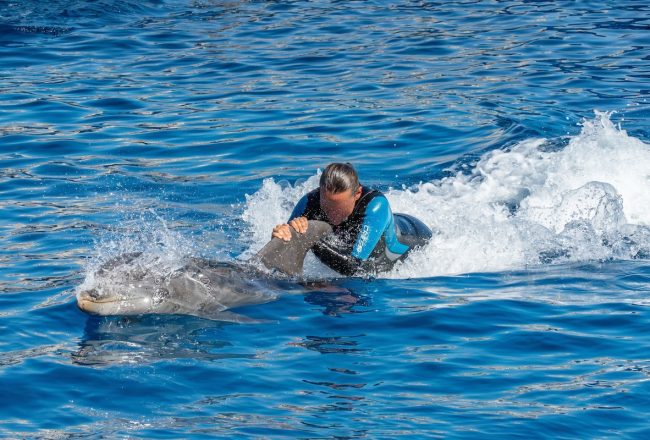
Why We Must Stop Breeding Dolphins in Captivity
 16Jul
16Jul
For decades, dolphins have been bred in captivity under the guise of education and conservation. The dolphinarium industry has long relied on scientific-sounding justifications to defend this practice — but these claims don’t hold up. Dolphinariums don’t breed dolphins to preserve wild populations; they do it to sustain an entertainment industry built on confinement, human control, and profit.
Having witnessed the psychological and physical toll captivity takes on dolphins, I can say without hesitation: these intelligent and wide-ranging marine mammals do not belong in lifeless concrete tanks where their natural behaviors are stifled. In the wild, dolphins can roam vast ocean territories, hunt cooperatively, and engage in complex social interactions of their choosing. Captivity robs them of all of this.

Dolphins born inside concrete tanks suffer because they are deprived of everything that gives life meaning to a dolphin. Over the years, I’ve seen how these intelligent, social beings are brought into a world of artificial noise, barren walls, and degrading performances. They never experience the vastness of the ocean, never learn to hunt or play freely, unconfined by human-made barriers. Instead, their lives are reduced to swimming in endless circles and depending on humans for food and stimulation – conditions that can lead to psychological distress, boredom, and depression. It’s a heartbreaking existence, far removed from the freedom and complexity of life in the wild. This image was taken at Clearwater Marine Aquarium in Florida, USA. Licensed under the Creative Commons Attribution-Share Alike 4.0 International, 3.0 Unported, 2.5 Generic, 2.0 Generic and 1.0 Generic license, Author: Beyond My Ken
Breeding dolphins in captivity only guarantees that the cycle of suffering continues. Calves are born into barren, artificial concrete environments managed by humans. From a young age, they are trained to perform degrading tricks — dancing, jumping, spinning, and waving at spectators — in exchange for dead fish. They grow up cut off from the natural world, unable to learn from wild relatives, choose mates, hunt, or live freely. Worst of all, captive-born dolphins will never experience the open ocean — the place where they truly belong.
Ending captive dolphin breeding programs is a crucial first step toward phasing out dolphin shows and profit-driven swim-with attractions. It creates an opportunity for ethical alternatives, such as seaside sanctuaries, where non-releasable dolphins can live out their lives in a setting that more closely resembles their natural habitat—free from the constant pressure to perform for fun-seeking crowds. Sanctuaries also provide meaningful opportunities for public education based on respect and compassion, rather than circus-style entertainment.
The future should not include breeding dolphins and using them as attractions for tourists. Instead, it must reflect our growing understanding of their intelligence, autonomy, and right to live wild and free. It’s time to move beyond exploitation and commit to a more empathetic relationship—one that acknowledges the harm we’ve done and strives to make it right.
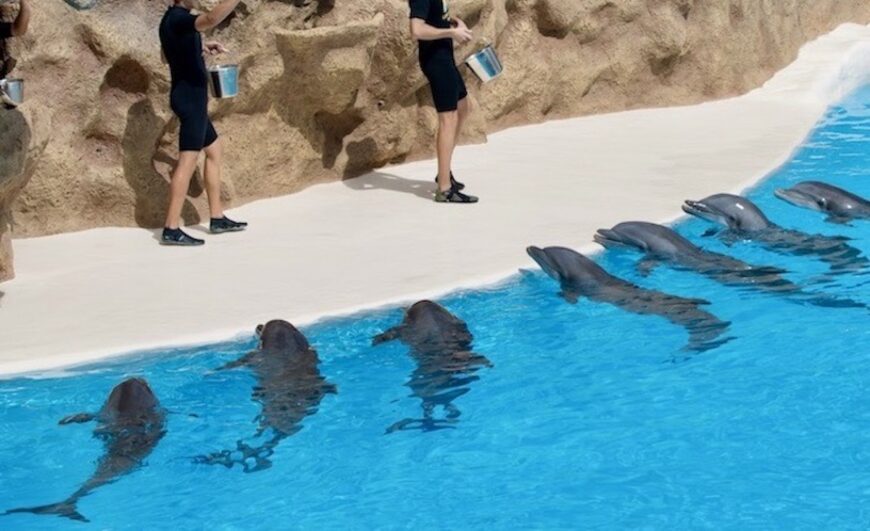
Featured image: Six of the eight performing dolphins at Loro Parque in Tenerife were born in captivity. They’ve never seen the ocean or chased a live fish. Yet they’re promoted as “ambassadors” for their wild relatives. But dolphins in tanks don’t represent the wild — they represent a life stripped of freedom. Credit: Helene O’Barry


Related posts
Beyond the Cove: How Captivity Sustains the Hunts
Concrete in a Dolphin’s Mouth After Transfer