Tui’s “Choice” Argument Leaves Dolphins with None
 23Apr
23Apr
TUI sells holidays filled with smiling faces, turquoise waters, and the promise of unforgettable experiences. But behind the glossy marketing lies something far less cheerful: dolphins performing tricks for paying tourists.
TUI Group, commonly known as TUI, describes itself as “the world’s number one tourism company.” Its slogans promise that “TUI creates the moments that make life richer” and encourage customers to “Live Happy.”
On its website, TUI Musement, which is a member of TUI Group, presents Loro Parque in Tenerife, Spain — where bottlenose dolphins, orcas, and sea lions perform shows — as a “top attraction.” Dolphin Explorer Park in the Dominican Republic is marketed as a “once-in-a-lifetime opportunity” to get “up close and personal with these fascinating, friendly mammals,” with packages offering encounters and swims. In Mexico’s Riviera Maya, TUI promises tourists a “unique opportunity” to swim with dolphins and reassures customers with “Best value guaranteed.”
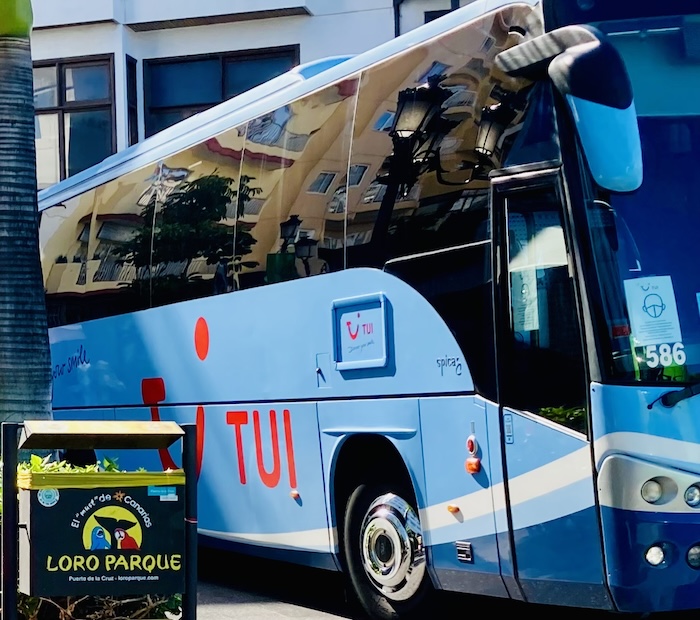
TUI continues to sell tickets to Loro Parque in Tenerife, where orcas, bottlenose dolphins, and sea lions are used in shows. They present it as “customer choice,” but in reality they are actively working to drive ticket sales. Credit: Helene O’Barry
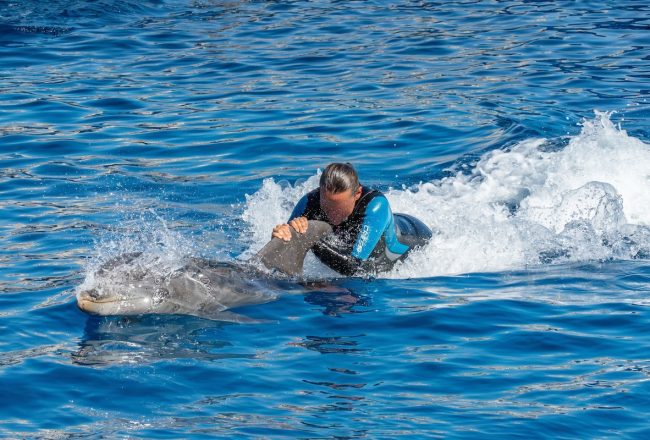
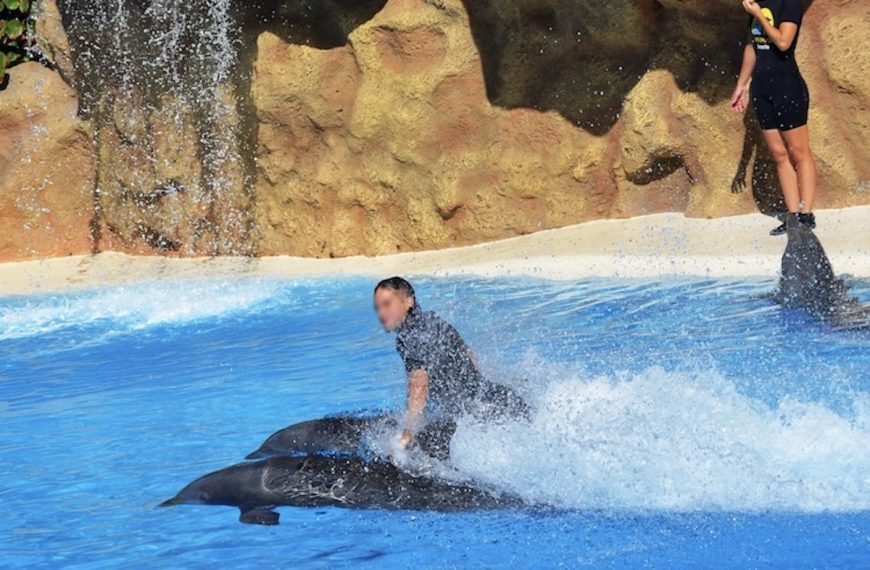
Dolphin Explorer promotes close-up interactions including “kissing and dancing with dolphins, the belly ride, where you will hold the dolphin as he rides across the water and much more!” Visitors can even “hold hands with the dolphin.” These programs depend on dolphins being trained to tolerate kissing and invasive touching, rides, and constant handling by humans. By continuing to sell these experiences, TUI turns the exploitation into a marketable product.
TUI Musement also offers a “dolphin trainer for a day” scheme, where customers are told it’s a “dream job” experience, complete with a trainer diploma. TUI describes the captive dolphin swim as: “Swimming with dolphins is the stuff holiday dreams are made of. Put a big tick on your bucket list.”
These experiences are repeatedly framed as must-do holiday activities, encouraging participants to pose for photos, kiss dolphins, and treat dolphins as ride-on attractions. Yet the marketing never reflects what happens behind the scenes: lifelong confinement in small spaces, food control used to reinforce trained behaviors, and an environment offering little variation or complexity.
Hundreds of dolphins worldwide are confined to barren pools or small sea enclosures, a tiny fraction of the ocean they evolved to roam. In the wild, dolphins travel freely, forage, explore, and live in complex social groups. In captivity, they circle endlessly, obeying commands for handouts of dead fish. That is the reality hidden behind TUI’s curated holiday marketing.
TUI is aware of the controversy. Over the past several years, animal protection organizations, including Dolphin Project, have urged the company to stop promoting marine parks that keep dolphins for entertainment.
Several other companies are moving on. Thomas Cook, for example, changed its policy based on strengthened animal welfare standards and customer feedback, ending its promotion of dolphin shows and close-up encounter programs. TUI, on the other hand, has refused to change.
UK travel trade publication TTG Media reported that Andrew Flintham, managing director of TUI UK and Ireland, said the company would “allow people to choose.” There are several problems with this argument. I am not aware of any major travel companies today that sell tickets to watch dancing monkeys or tourists riding elephants, as the cruelty behind those practices is widely understood. TUI Group itself does not sell tickets to elephant riding, yet when the company promotes dolphin shows and staged encounters, it helps sustain an industry built on capture, lifelong confinement, continued captive breeding, and behaviors enforced for entertainment purposes.
With its “choice” stance, TUI claims neutrality, but the company actively persuades consumers to buy tickets. TUI Musement’s marketing phrases such as “Why you’ll love this,” “The feeling of being at one with nature when you swim with dolphins is unbeatable,” and “Complete your bucket list with a dolphin swim,” shape how tourists perceive these experiences.
They are not offering choice. They are scripting it.
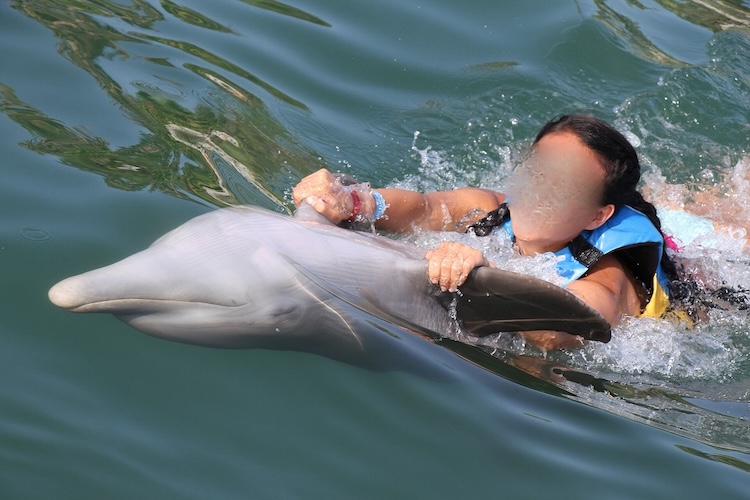
A “ride” built on control, not choice. What TUI describes as “the stuff holiday dreams are made of” is a coerced interaction, with dolphins used as props for rides and photo ops for tourists. License: Creative Commons Attribution-Share Alike 4.0 International license; Author: Ohpencap
TUI promises to “make life richer” and encourages customers to “Live Happy.” Yet the dolphins it profits from live nothing like this. Every aspect of their lives is shaped by human management.
Confined for life to the same small enclosures, they cannot travel, explore, or seek new, exciting activities. They exist to entertain a rotating stream of tourists, while those tourists move freely from one destination to the next.
There is another bitter irony in TUI’s consumer-choice argument: the company emphasizes freedom for its paying customers, while the dolphins themselves have none. Trapped and trained to perform for endless lines of tourists, these highly intelligent and social beings exist only to fulfill the expectations of paying customers.
TUI sells happiness and choice. But the dolphins TUI profits from have neither.
WHAT YOU CAN DO
Please help us convince TUI to put ethics over profits and stop selling tickets to dolphin shows and swim programs
➡️ Ask TUI to Stop Supporting Dolphin Captivity
Featured image: TUI sells experiences where dolphins are used as ride-on objects, turning them into attractions within a commercial holiday offer and stripping them of any recognition as complex, intelligent beings. Credit: Helene O’Barry

Related posts
Beyond the Cove: How Captivity Sustains the Hunts
Concrete in a Dolphin’s Mouth After Transfer